Polestar 2 review
The stylish Polestar 2 oozes quality and has a long electric range, but an overly firm ride holds it back

Our opinion on the Polestar 2
The Polestar 2 continues to deliver quality, style, great onboard tech, and reassuring levels of safety kit. The updated model gets more power and an official range of over 400 miles that few electric cars can come close to matching. For those seeking something different from a Tesla Model 3, the Polestar 2 has most bases covered. Its main downside is that the ride is far too firm for most UK roads, and it doesn’t drive as sharply as the BMW i4 to make that a worthwhile compromise.
About the Polestar 2
It wasn’t that long ago that Polestar held the banner for Volvo’s motorsport activity (mainly in Swedish touring cars) before becoming the performance sub-brand for the Swedish marque’s quicker models. Now, it's a maker of premium electric cars.
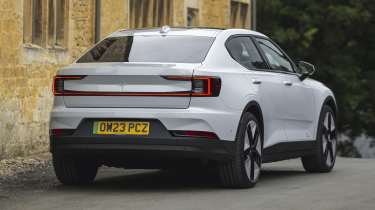
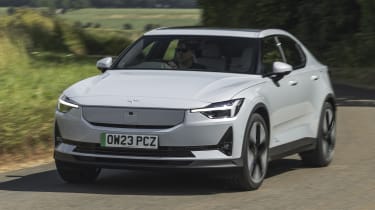
The fastback-styled Polestar 2 is the follow-up to the brand's aptly named first car, the Polestar 1, and sits on Volvo’s Compact Modular Architecture (CMA) platform, which also underpins the Volvo EX40 and Volvo EC40. The Polestar 2 has undergone several updates over its lifetime, including a facelift in 2023, which switched the Single-Motor versions from front to rear-wheel drive, making the electric motors more powerful and efficient, and fitting a highter capacity battery pack to Long-Range models.
Used - available now

2023 Tesla
Model Y Premium
36,304 milesAutomaticElectric
Cash £25,160
2021 SEAT
Arona
8,887 milesManualPetrol1.0L
Cash £12,040
2023 Polestar
2
32,175 milesAutomaticElectric
Cash £18,670
2024 Cupra
Leon
17,455 milesAutomaticPetrol1.5L
Cash £18,870The Polestar 2 has been a persistent thorn in the Tesla Model 3’s side for a number of years, so we felt it was only fitting that we pit the two EVs against each other in our real-world twin test. To get a taste of life with the Polestar 2, special contributor, Chris Rosamond, spent six months with a Long Range Single Motor as part of our long-term test fleet. We've also tested a Long Range Single Motor version in our Electric Company Car megatest.
Performance & driving experience
Pros |
|
Cons |
|
The Polestar 2’s facelift included efficiency boosts, extra range, and power. The Single Motor variant switched from front to rear-wheel drive, while Dual Motor, four-wheel drive models have a greater rear bias.
Performance, 0-60mph acceleration and top speed
The Standard Range Single Motor Polestar 2 produces 268bhp and 490Nm of torque; enough to go from 0-62mph in 6.2 seconds and hit a top speed of 127mph (the same as all Polestar 2s). The Long Range Single Motor only gets a slight power bump up to 295bhp, though torque stays the same. It takes 5.9 seconds to complete the same benchmark sprint, and thanks to instant throttle response and plenty of power for effortless overtaking.
Upgrading to the Long Range Dual Motor variant adds an extra motor on the front axle for all-wheel drive, yielding a total power output of 416bhp with 740Nm of torque. If that’s not enough get-up-and-go for you, you’ll need to add the Performance Pack. Available exclusively for the Dual Motor variant, this bumps the power up to 469bhp and cuts the range-topping Polestar 2’s 0-62mph time down from 4.3 to 4.0 seconds.
| Model | Power | 0-62mph | Top speed |
| 2 Standard Range Single Motor | 268bhp | 6.2 seconds | 127mph |
| 2 Long Range Single Motor | 295bhp | 5.9 seconds | 127mph |
| 2 Long Range Dual Motor | 416bhp | 4.3 seconds | 127mph |
Town driving, visibility and parking
We’ve already mentioned the Polestar’s firmness a few times, but there’s definitely no avoiding it when driving on pothole-ridden city streets. There’s a constant fidget to the ride quality, and it does make things rather uncomfortable on the worst stretches of tarmac, and this effect is only amplified further by the larger wheels.
A reversing camera, along with front and rear sensors, are included as standard, so the 2’s small rear windscreen isn’t too problematic when parking.
We’d like to see more variability with the regenerative braking, because you only get two settings in the Polestar 2, and you’ve got to delve into the touchscreen in order to change them. The Hyundai Ioniq 6 is far better in this regard, with easily accessible paddles behind the steering wheel giving you various settings from one-pedal driving in its strongest mode, to coasting while on a motorway cruise. The brake pedal feel for the mechanical brakes in the Polestar 2 is very firm at the top of the pedal travel, but we prefer the more progressive feel to the brakes in the i4 and Ioniq 6.
Country road driving and handling
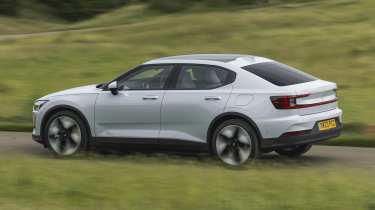
Polestar claims its updates have made the 2 “even more fun to drive”, and while that might be true when compared with its predecessor, the car is still no match for the BMW i4. The Polestar 2 isn’t bad in isolation, but body lean is more pronounced than in the BMW, and the Polestar 2 pitches and dives under heavy acceleration and braking, making it feel less agile than its rival. The steering isn’t as responsive as the best setups in this class, either.
Motorway driving and long-distance comfort
The Polestar’s ride quality also impacts its motorway cruising ability. When you encounter any kind of broken road surface, the car will start to bounce about, causing it to fidget constantly and become rather uncomfortable. It’s even worse in the back, which is bad news for those with children prone to motion sickness. If ride comfort is your priority, then look at the far more compliant Volkswagen ID.7 – especially one with adaptive suspension.
Refinement could also use some work because the Polestar 2 generated the most wind and road noise when tested against the Tesla Model 3 and its closest rivals.
Range, charging & running costs
Pros |
|
Cons |
|
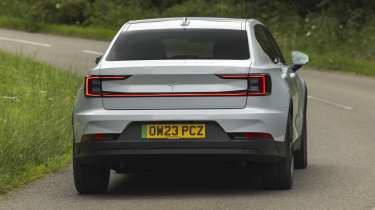
The revised Polestar 2 now consumes up to nine per cent less energy, can travel up to 22 per cent further, and charges up to 34 per cent faster following its facelift. The range kicks off with the Standard Range Single Motor model, which can cover up to 344 miles before its 69kWh battery (67kWh usable) runs flat. Long Range models get a larger 82kWh battery (79kWh usable) for the headline range figure of 409 miles in single-motor guise, or 368 miles if you spring for the Dual Motor version – the latter can disconnect its front motor while cruising to help with efficiency. Adding the Performance Pack to the Dual Motor version further reduces the maximum to 352 miles.
Older versions of the Polestar 2 hasn’t proven to be the most efficient EV in our testing, especially compared to its rivals from Tesla and BMW, making its official range figures harder to achieve in the real world. Polestar’s updates have helped, because the refreshed Long Range Single Motor variant we drove as part of our electric company car group test indicated a range of 271 miles on a full charge and was the fourth-most efficient at 3.3 miles per kilowatt-hour. That’s some way off the 409 miles stated in the official tests, but still pretty impressive.
It’ll take a typical 7kW home wallbox roughly 10 hours to fully recharge the 69kWh battery in Standard Range Polestar 2s, and roughly 12 hours to do the same for Long Range versions with their 82kWh batteries.
The Polestar 2’s rapid charging capabilities aren’t the quickest compared with the Hyundai Ioniq 6, but base models will reach 135kW, meaning a 10 to 80 per cent top-up takes just 34 minutes. Meanwhile, the rest of the range maxes out at 205kW, with the same charging session taking just 28 minutes if you find a suitably fast ultra-rapid charger.
| Model | Battery size | Range | Insurance group |
| 2 Standard Range Single Motor | 69kWh (67kWh usable) | 344 miles | 39 |
| 2 Long Range Single Motor | 82kWh (79kWh usable) | 409 miles | 41 |
| 2 Long Range Dual Motor | 82kWh (79kWh usable) | 370 miles | 44 |
Insurance groups
Insurance ratings for the Polestar 2 vary depending on the battery and motor combination you choose. The entry-level Standard Range Single Motor is in insurance group 39, while the Long Range Single Motor falls into group 41. The more powerful Polestar 2 Long Range Dual Motor lands in group 44, and the same goes for models equipped with the Performance Pack, which adds even more power.
The Polestar 2 won’t be the cheapest car to insure. In fact, the pricier BMW i4 will be less costly to cover because it attracts lower insurance ratings. The Tesla Model 3, meanwhile, sits between groups 36 and 41.
Check if your car needs an MoT and view its complete history with our MoT History Checker...
Tax
Thanks to revisions to the luxury car tax threshold, only EVs above the higher limit of £50,000 will be liable for a surcharge. This means that Standard Range Single Motor and Long Range Single Motor versions of the Polestar 2 fall under this limit, and you'll only have to pay the standard annual rate of vehicle excise duty (VED) road tax (EVs are no longer exempt from that). Of course, add some options, and you can go over this limit and have to pay an additional surcharge on top of the standard rate of VED from the second time the vehicle is taxed until it is six years old. The planned eVED pay-per-mile tax could also increase your expenses if it is implemented as planned in 2028.
Company car drivers will at least see a very low four per cent Benefit-in-Kind tax rate, rising to five per cent from 2027 onwards.
Depreciation
Our Expert data suggests the Polestar 2 will retain 37 to 42 per cent of its initial value (depending on spec) after 3 years and 36,000 miles. In comparison, the Tesla Model 3 is expected to retain between 41 and 48 per cent, while electric versions of the Mercedes CLA are likely to still be worth 51 per cent of their original value over the same period.
To get an accurate valuation on a specific model check out our free car valuation tool...
Interior, design & technology
Pros |
|
Cons |
|
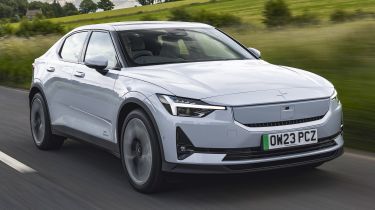
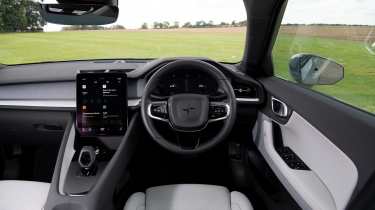
The Polestar 2 is a fastback-styled family car with a cool, minimalist design. Polestar’s close ties with Volvo are obvious even from a distance, as you quickly spot Volvo’s signature “Thor’s hammer” headlight design. The updated model also gets a body-coloured grille panel called the ‘SmartZone’, which houses various radars and cameras, and looks very similar to those on the facelifted Volvo EX40 and Volvo EC40.
Interior and dashboard design
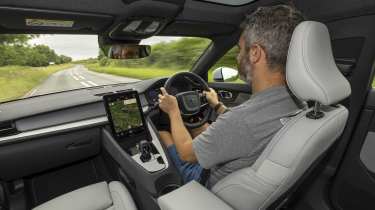
The Polestar also has a Volvo-like feel to its interior, while the frameless door mirrors and glass roof panel just add to the stylish look. The smart steering wheel, chunky door handles and excellent seats are all very Volvo, but we’re certainly not complaining.
Leather upholstery isn’t included as standard with the 2, instead Polestar offers a ‘vegan interior’ with no animal products used in the cabin. However, if you really want to have some cowhide in the cabin, Nappa leather upholstery is available as an optional extra costing around £2,500.
Materials and build quality
Volvo’s cars are known for being securely bolted together, and it’s no different in the Polestar. The interior quality is befitting of this car’s premium status, and arguably puts the Tesla Model 3 to shame in some areas.
Infotainment, sat-nav and stereo
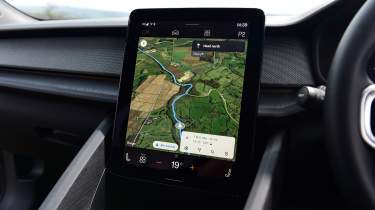
The Polestar 2’s 11.2-inch central touchscreen and 12.3-inch digital driver’s display offer crystal-clear graphics and plenty of functionality. Polestar wisely let Google handle the infotainment system and user interface in the Polestar 2. As a result, the system loads quickly, brings up postcode searches or other specific points of interest with ease, and can adapt a chosen route to real-time traffic changes.
The home screen is split into four quarters, showing Google Maps, Google Search, phone and media controls. Access to functions such as drive settings and external cameras can be accessed through shortcuts at the top, while climate controls can be adjusted at the bottom. Polestar is keen to point out that the infotainment system is being continually improved with over-the-air (OTA) updates.
The integration of Google Maps and other apps is among the best we’ve experienced, although you now have Apple CarPlay should you wish to use other apps on your iPhone. CarPlay requires a wired connection, but wireless phone charging is standard-fit.
Overall, most things work smoothly and easily. However, the central display in the Polestar 2 is smaller than those used by some rivals, such as Tesla. The more compact screen means some of the on-screen keys are smaller than they are on the larger displays seen in the BMW i4 and Model 3, which makes the Polestar a little fiddlier to use. At least the portrait-oriented screen sits slightly proud of the dashboard, so it’s within easy reach.
“There’s a clean, minimalist feel, but sometimes this comes at the expense of usability; while there are plenty of physical switches on the steering wheel, elsewhere on the dashboard there aren’t many. The climate controls are confined to the central touchscreen, for instance.” - Alex Ingram, special contributor
Boot space & practicality
Pros |
|
Cons |
|
Unlike the Tesla Model 3 or the Hyundai Ioniq 6, the Polestar 2 uses a platform that accommodates both combustion-engined models and those with battery-electric powertrains. One consequence of this CMA architecture shared with the Volvo XC40 is the huge transmission tunnel, which compromises comfort for anyone sitting in the middle seat. Those up front may find their knees knocking against the high-set centre console.
During our group test between the Polestar 2, BMW i4 and Tesla Model 3, we found the Polestar’s interior storage to be the least impressive of the three. The door bins are shallow, and the central cubby is quite small, while you’ll find two cup-holders under the centre armrest.
Dimensions and size
The Polestar 2 measures 4,606mm in length, 1,943mm wide and 1,479mm tall. By comparison, the Tesla Model 3 is slightly smaller. The Hyundai Ioniq 6 is even longer though, measuring 4,855mm from nose to tail.
| Dimensions comparison | |||
| Model | Polestar 2 | Tesla Model 3 | BMW i4 |
| Length | 4,606mm | 4,724mm | 4,783mm |
| Width | 1,943mm | 1,933mm | 1,852mm |
| Height | 1,479mm | 1,443mm | 1,448mm |
| Wheelbase | 2,740mm | 2,880mm | 2,860mm |
| Boot space | 407 litres | 594 litres | 470 litres |
Seats & passenger space
There's plenty of space inside the Polestar 2. Even though you feel more cocooned in the Polestar’s cockpit compared to other family EVs, those up front get plenty of head, leg and elbow room. The seats are comfortable enough to ensure you arrive relaxed at the end of a long journey.
Rear passenger space is a close match for the BMW i4, with good legroom and foot space under the front seats. You get a set of air vents and two USB-C charging ports in the back, so your kids won’t have to squabble over who can charge their device on longer journeys. The optional glass roof does eat into headroom a touch, but even the tallest of occupants shouldn’t find it too intrusive. As we mentioned above, the large transmission tunnel leaves little space for anyone forced to take the middle seat.
There are three seats of Isofix mounting points in the Polestar hidden behind plastic covers. One is on the front passenger seat, while the other two are on the outer positions of the rear seats. During our testing, we noted that the rear door openings are smaller than we’d expect, in part due to the sloping roof line, which doesn’t help when fitting a child seat.
Boot space
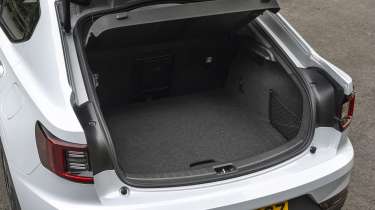
The Polestar 2's boot space is a decent 407 litres, which extends to 1,095 litres with the rear seats folded. It has an advantage over the Tesla Model 3 and Hyundai Ioniq 6 in that it has a hatchback tailgate that opens much wider than those of its American and Korean rivals, making it easier to load luggage. There is also an extra 41 litres of stowage in the car’s nose or ‘frunk’, although it’s only big enough to store the charging cables.
Towing
Every version of the Polestar 2 has a maximum towing capacity of 1,500kg, or 750kg if it’s an unbraked trailer. Polestar also offers a semi-electric retractable towbar as an optional extra. You will need to look into what towing mirror extensions you can get for the Polestar 2, because its frameless mirrors can’t accept the type that clamp onto the door mirror casing.
Reliability & safety
Pros |
|
Cons |
|
Polestar didn’t appear in the most recent Driver Power owner satisfaction survey, but the brand has previously made quite the impression on UK buyers, based on the results of the 2023 Driver Power owner satisfaction survey. The Polestar 2 managed to finish 17th on the best cars to own list at the time, which was ahead of the Tesla Model 3 which only managed 22nd place.
Industry experts Euro NCAP released its crash-test results for the Polestar 2 in March 2021, and it performed very well. The electric fastback was awarded the organisation’s maximum five-star overall rating, scoring 92 per cent for adult occupant protection and 89 per cent for child protection. That rating still applies despite the change from front to rear-wheel drive for Single Motor variants.
The 2 also received an 86 per cent score in the safety assistance category, and comes with a full suite of safety systems as standard. Every Polestar 2 comes with a collision mitigation system, which uses front and rear-facing radars to take 'preventative measures' such as applying the brakes if a crash is likely to occur and the driver doesn’t react quickly enough. Other standard kit includes driver-awareness systems like blind-spot information with steering support, rear collision warning and mitigation, and a 360-degree parking camera.
More features are available as part of the optional Pilot Pack, which includes 'Pilot Assist' lane-keeping assistance, Pixel LED headlights, LED front fog lights with cornering function and adaptive cruise control.
| Euro NCAP safety ratings | |
| Euro NCAP safety rating | Five stars (2021) |
| Adult occupant protection | 93% |
| Child occupant protection | 89% |
| Vulnerable road user protection | 80% |
| Safety assist | 83% |
Buying and owning
Best buy: Polestar 4 Long Range Single Motor
Pricing for the Polestar 2 starts at just over £45,000 for the Standard Range Single Motor variant, which is slightly more than the equivalent Tesla Model 3. At the top end of the line-up sits the Long Range Dual Motor, which surpasses the £53,000 mark. You’ll then need to add another £5,000 if you want to add the Performance Pack on top of this.
With one of the longest battery ranges of any electric car, plenty of performance punch and a strong helping of kit, the Long Range Single Motor is the sweet spot in the Polestar 2 range. That being said, the Standard Range model certainly won’t be out of its depth on longer motorway journeys, either.
The Polestar 2 doesn’t qualify for the Government’s Electric Car Grant, but you can still save money by building your perfect Polestar 2 via the Auto Express Buy a Car service. We also have new Polestar 2s in stock and ready to hit the road. You can sell your car with us, too.
Polestar 2 alternatives
Since it first arrived in the UK, the Polestar 2 has competed with the Tesla Model 3 and the BMW i4 in the electric executive car market. However, some notable younger rivals have also arrived, including the Volkswagen ID.7, Audi A6 e-tron, Hyundai Ioniq 6 and BYD Seal.
Polestar 2 Long Range Single Motor long-term test
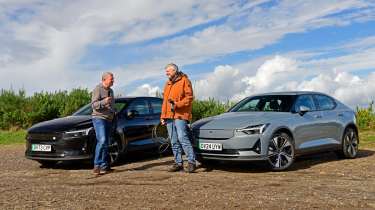
Special contributor, Chris Rosamond, spent several months with the Polestar 2 in Long Range Single Motor form as part of our long-term test fleet. During his time with this executive EV, Chris found the Polestar 2 to be a pleasurable car to drive, and he felt that the car’s overall quality was of a very high standard. However, things did feel a bit cramped in the back when it came to taking on family car duties. Once everyone and everything was crammed in, though, the real-world battery range was impressive. You can read the full long term test here...
Polestar 2 pictures
Key updates of the Polestar 2 review
3 June 2026: General update including refreshed resale valuation data
Frequently Asked Questions
Polestar offers a three-year/60,000-mile warranty for the 2, while Tesla provides a four-year/50,000-mile warranty for the Model 3. The Hyundai Ioniq 6 has no mileage limits on its five years of coverage. Like most electric cars, the Polestar’s battery is covered by a separate eight-year/100,000-mile warranty.
Deals on the Polestar 2 and alternatives