Lexus IS F vs BMW M3 vs Audi RS4 vs Mercedes C63 AMG: 2008 group test
The new Mercedes C63 AMG and Lexus IS F promise to shake up the super-saloon market. We pitch them against BMW’s latest four-door M3 and our current class leader, the Audi RS4, to see which delivers the most driver thrills..

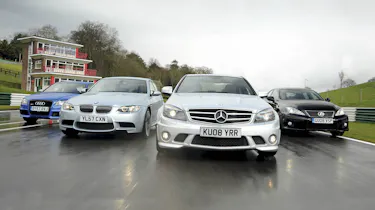
A grand total of 32 cylinders, 14 exhausts, 16 seats, 27 gears, 19 litres of engine capacity and 1,696bhp. All split between four compact executive cars. Welcome to our super-saloon shoot-out.
What’s most surprising is that three of these models are brand new and previously unseen in the UK. Step forward the Mercedes C63 AMG, Lexus IS F and BMW M3 saloon. Our fourth contender needs no introduction. The Audi RS4 officially disappeared from price lists when the new A4 went on sale last month, yet it remains one of the best fast four-doors ever made, and sets a high benchmark for these three pretenders. It’s never been beaten – but has it now met its match? The Audi is no longer the most powerful machine around. That honour belongs to the 6.2-litre Mercedes, which develops a huge 451bhp. Historically, though, the company’s AMG tuning arm has struggled to deliver cars that cope with corners as well as they do straights.
The IS F is the wild card. Lexus products have never shown the slightest hint of sporting prowess, yet this model looks set to upset the establishment. And firmly in its sights is the BMW M3 saloon – the fourth generation of the car that started the hot saloon ball rolling in 1986. We have Cadwell Park race track in Lincolnshire at our disposal, so which super-saloon rules the roost?
Verdict
So keenly fought was this test that it took two full days’ driving and assessing before we could pick a winner. Covering lots of miles in these hot saloons was no hardship, yet it demonstrates how evenly matched our quartet is.
Used - available now

2019 Kia
Stinger GT
51,144 milesAutomaticPetrol3.3L
Cash £22,974
2023 Mercedes
EQC
53,731 milesAutomaticElectric
Cash £22,888
2024 SEAT
Arona
34,237 milesManualPetrol1.0L
Cash £10,856
2023 Volkswagen
Tiguan
22,564 milesAutomaticPetrol1.5L
Cash £22,935Any of them would be great to own, but the Lexus missed out on a podium position. Although it’s a stunning first effort that proves the brand can build entertaining fast cars, the IS F needs more work in a couple of key areas.
The Audi has fallen from first to third. Age has not diminished its abilities in any way, as the RS4 serves up thrills almost as ably as the cars that beat it. But it was edged out by the BMW as the M3 saloon is cheaper and has more forgiving suspension than the coupé that lost to the Audi last year.
Our winner is the C63. While its chassis isn't quite as talented as the M3's, it's more fun to drive more of the time. That tips the balance in the Merc's favour.
First place: Mercedes C63 AMG
No effort has been spared in the C63’s development. Mercedes spent nearly three years getting this model right, testing it in 20 different locations around the world, from the Arctic Circle to California’s Death Valley. Why is so much energy being put into a car that won’t sell in huge numbers?
Two reasons: firstly, its arrival coincides with AMG’s 40th anniversary. Secondly, the competition is now so strong, AMG couldn’t just fit a big engine and hope for the best.
This is why the C63 has an all-new front axle, is 25mm wider than a standard C-Class, has a three-stage ESP system that can be fully disengaged and a more muscular body. Yet despite the quad exhausts and twin bonnet strakes, subtlety is the name of the game.
We wish Mercedes had gone to a bit more trouble inside. Open the door and you are greeted by a heavily bolstered seat – the side supports are so large, they force you to adopt an elbows-out driving style. But once you’re settled in and enjoying the excellent seating position and chunky steering wheel, there’s little to set it apart from an ordinary C-Class.
It’s not even that well equipped, with turn-by-turn sat-nav a £750 extra – full systems are standard in the Lexus and BMW. As with all these cars, the cabin doesn’t really feel special enough to justify a £50,000 outlay.
That’s especially true in the back, where the bulky new front seats restrict legroom to 670mm. The 475-litre boot is the biggest here, though, and there are lots of neat touches. The xenon headlights are strong, all-round visibility is great and the centre of the speedo flashes as the rev needle nears the limiter.
Get used to seeing that red glow, as the Mercedes’ performance is addictive. It starts as soon as you turn the key and the 6.2-litre V8 bellows into life. Blip the throttle and the whole car rocks. No rival offers this sense of drama and excitement – but then none of them has 451bhp and 600Nm of torque.
With all bar 100Nm of that available from 2,000rpm, the C63 is easily the best in day-to-day driving. Overtaking is a breeze, and the engine is tractable, if sensitive to low-speed throttle inputs. The Merc is also the fastest car – it outperforms an Audi R8, let alone the RS4. It was the only model to cover 0-100mph at the test track in less than 10 seconds, and our team felt it sounded the best, too. But it would have been quicker if you didn’t have to change gear so often. No car with this much grunt needs seven gears.
Left alone, the auto hunts around too much, changing down unnecessarily instead of using the awesome mid-range torque. It’s best to select Manual mode instead of Sport or Comfort and use the paddles, but even so, we think Lexus’s eight-speeder is smoother and faster. The M3 also offers marginally better braking performance and handling – although the C63 is more fun to drive.
It’s a touch heavier on the road, the steering needs more lock in corners and the ride is a fraction harsher than the BMW’s. But the Merc is every bit as involving and more characterful, while fantastic body control, poise and agility mean it’s able to cope with that mighty engine. Make no mistake, the C63 is a real driver’s car.
Economy
Even if you can afford the C63’s fuel bills, you will be irritated at how often you have to stop at a petrol station. A 15.5mpg return means you’ll be filling up every 225 miles. When driving gently we got over 20mpg from the V8, but at the track that fell to only 8.9mpg.
Residuals
According to our experts, the C63 should be a big hit used, retaining 53.4 per cent of its value after three years. That’s 10 per cent better than the E63, which has the same engine and gearbox. You’ll lose £23,914 – less than on a high-spec Citroen C6.
Servicing
A super-saloon is never going to be cheap to run, as our service quotes illustrate. The C63 is the least costly, although three checks are still £1,075. And the attitude of garage staff was criticised in our Driver Power 2007 dealer survey.
Second place: BMW M3
The C63 AMG has the power advantage here, but neither it, nor the RS4 and IS F, can match the M3’s heritage. After all, this is the car that single-handedly sealed BMW’s reputation as a maker of some of the best drivers’ machines.
The flagship arrived as a coupé last year, and the saloon version is the most powerful production four-door 3-Series in the firm’s history. Not that you’d know it from the styling. It doesn’t look as sporting as the two-door, and does away with the carbon fibre roof.
Still, there are hints at the pace on offer. The bonnet bulge helps accommodate the 4.0-litre V8, while flared arches, side skirts, 18-inch alloys (our car has the £1,265 optional 19s) and quad exhausts are all M trademarks. Even in the subtle Silverstone II paintwork, our test car attracted its fair share of attention, and we think BMW has got the balance of sportiness and subtlety just right.
Inside, it’s equally understated. Aside from the chunky steering wheel, leather trim and M badging, there’s not much difference from a standard 3-Series. This is no bad thing – it’s easy enough to get on with, neatly laid out, fuss free and very well built. Rear passengers will also like the BMW; it has the most space, with 715mm of legroom.
They’re also likely to enjoy the great soundtrack delivered by the superb V8 engine. At idle, it’s got a higher-pitched note than the rumbling Merc, but it’s equally hard to resist blipping the throttle.
The 4.0-litre has the smallest displacement of the powerplants in this test, and can muster only 400Nm of torque – so we weren’t surprised that it thrives on revs. However, the M3 is every bit as rapid as the Lexus through the mid-range, and delivers an even more addictive top-end rasp.
As with all its rivals, the M3 is incredibly fast. It has far superior initial traction and needs fewer gearchanges, and so pulled out a slender lead over the Lexus during our sprint tests. And even though it trails the IS F’s torque output by 100Nm, it held its own in-gear, too.
The manual gearbox is robust, delivers fast shifts and is better than the Audi’s when pressing on. But at lower speeds, the opposite is true, as the sudden clutch action and sharper throttle make the M3 tricky to manage. There are no such flaws to the exceptional brakes, which were both the best to use and the most powerful here.
And then we come to the way it drives. BMW is cagey about the precise differences between the saloon and the coupé, but it won’t deny the four-door is a bit more yielding. We reckon it makes all the difference. Although the ride is still hard-edged, it’s not as solid as the C63’s, while in the softest of the three modes provided by the optional £1,295 Electronic Damper Control, comfort is almost on a par with the RS4.
Whether you’re driving on the road or track, the M3 is superbly balanced – not only in terms of its chassis, but also the way it all works together. It’s amazingly poised, and takes everything in its stride. The trouble is, it’s almost too capable; the BMW doesn’t feel as special to drive as the Merc, and its limits are simply too high to safely explore on public roads.
Still, it’s the cheapest car here, and the tweaks over the coupé make a noticeable difference. The question is, can it restore BMW’s honour by winning this test?
Economy
As you’d expect from the world’s leading engine builder, the V8 in the M3 blends power with decent economy. It was the best performer in our cruising comparison, with a 23.1mpg return. But over the mixed roads of our 650-mile test route, that fell to 16.6mpg.
Residuals
EVEN though it’s cheaper than the £50,625 coupé, the M3 saloon depreciates by nearly three per cent more. A figure of 53.6 per cent is virtually identical to the Merc’s, although the BMW’s lower list price means it loses £1,000 less.
Servicing
As with its Mercedes and Audi rivals, the BMW runs on a variable servicing schedule. Yet M models aren’t covered by the excellent Service Inclusive package. As a result, three check-ups add up to a rather expensive £1,700.
Third place: Audi RS4
There's no love lost between the rival firms here, with all four cars desperate to win top honours. But the one scalp BMW wants is the Audi’s. We drove an RS4 to the launch of the M3 coupé (Issue 969), where it spoiled the blue propeller’s debut by proving the more rounded and enjoyable machine.
Is that still true? Time – plus the arrival of a new A4 – hasn’t reduced the Audi’s visual appeal. We love the pumped-up arches, muscular sills and black grille surround. And while its fresher rivals have crisper lines, whenever we stopped it attracted the most attention – although that’s mainly down to its Sprint Blue paintwork.
Inside, the RS4 is the furthest from a standard compact executive car. The dash layout is near identical to the A4’s, but beautifully shaped bucket seats constantly remind you this is something special. They are difficult to relax in, yet still manage to be amazingly comfortable on long trips.
It helps that the Audi has the best driving position in this test, and the flat-bottomed steering wheel is great to hold. And while the cabin looks and feels the most dated, there’s no faulting the build or materials.
For what it’s worth, the RS4 also has the best-looking engine – although we’re more concerned with what it’s capable of. At one time, it made the Audi the most powerful car in the class. Mercedes now holds that title, but the RS4’s V8 still performs brilliantly.
Throttle response is savage, particularly if you sharpen it further by pressing the Sport button on the steering wheel. This also brings a louder, more riotous exhaust note. Venture into the top half of the rev range, and the saloon really comes alive. There’s a kick to the acceleration above 5,500rpm, right where the torque peaks, and if you keep the throttle pressed to the floor it’s capable of sprinting from 0-60mph and 30-70mph as quickly as the Lexus. It helps that the 1,650kg Audi is 50kg lighter than the IS F, despite being 4WD – in fact, it has the lowest kerbweight of all four.
The 4.2-litre doesn’t just sound good and go hard. Direct-injection technology ensured it was the most fuel efficient, too, returning 17.7mpg. It’s more flexible low down than the M3 or IS F, pulling well through the mid-range; it’s a great engine to use every day.
Indeed, that is true of the whole car, as the RS4’s trump card has always been its composed suspension. Rather than fitting overly stiff springs, Audi engineers allowed the car to have a bit of roll. This means turn-in isn’t as incisive as in the BMW, and as with the Lexus it’s slower to react. But we think this is a trade-off worth making.
The body movement means you can detect that the car is having to work, plus the damper settings are superbly judged, so the Audi feels controlled and composed. No rival soaks up a B-road better.
At the test track, the 4WD wouldn’t allow the RS4 to oversteer as readily as its rear-wheel-drive rivals, but on the road that’s largely irrelevant. The trouble is, when you do push hard, the Audi isn’t as balanced and adjustable as the engine sits forward of the front wheels, making it feel nose heavy.
That’s a fly in the ointment – although newer rivals will be glancing nervously over their shoulders nonetheless. The RS4 is still capable of springing a few surprises.
Economy
The V8 engines in these cars are designed to be enjoyed, yet they can also be used frugally. Our best from the Audi was 22.6mpg, and despite its 4WD, the RS4 was the most efficient car here. A 17.7mpg average gave it a range of nearly 250 miles.
Residuals
IT’S the oldest car here, but the RS4 is set to have the best residuals, holding on to a superb 55.2 per cent of its price new. So it will be worth the most in three years, which shows how much Audi’s sporting reputation has improved.
Servicing
AUDI dealers finished a disappointing 16th in Driver Power 2007, and the network was strongly criticised for offering poor value for money. Three check-ups on an RS4 will cost owners around £1,240.
Fourth place: Lexus IS F
Legendary service, faultless reliability and polished build. Lexus is famed for many things – but not aggressive styling. Yet with its stacked exhausts, raised bonnet, bulging arches and prominent vents, the IS F changes that. Black paint and dark alloys make the car look even meaner.
This doesn’t continue inside: it’s no stripped-out racer, but the best equipped car here, with 10 airbags, sat-nav and electric everything. On a more fundamental level, the driving position is the least adaptable. The plush seats don’t hug you enough and you sit too high, so headroom is tight, while the chunky windscreen pillars leave you feeling hemmed in. And it’s not that spacious in the back, either.
But it’s pace, not practicality, that’s crucial here – and first impressions suggest the IS F is lacking. It was the quietest at idle inside and out, and its 5.0-litre seems like any other Lexus unit; effortlessly smooth, docile and calm. Don’t be fooled, though, because once the needle sweeps past 3,700rpm the 417bhp V8 takes on a whole new persona – there’s an instant hit of acceleration and the engine note, previously almost silent, becomes purposeful and loud.
It’s at that moment you realise this Lexus is every bit a super-saloon. This ability to be a cosseting cruiser low in the revs and yet run its German rivals close on performance will appeal to many. On our deserted runway it matched the M3 in every acceleration test and, thanks to a slippery 0.27Cd drag factor, we actually managed to beat the claimed maximum, hitting 170mph.
The only downside is that, unlike in the Merc, the engine needs to be worked quite hard to deliver – torque peaks at a high 5,200rpm, and the unit won’t rev beyond 6,800rpm (both the BMW and Audi will top 8,000rpm). Still, there are plenty of gears, so staying in the powerband is easy.
In manual mode, the eight-speed box doesn’t kick down or change up at the red line, so you have plenty of control, and the shifts are fast and more obedient than the Merc’s. Nevertheless, if you are in eighth on the motorway, it takes a while for the set-up to shift down through so many ratios.
There are frustrations with the chassis, too. The IS F’s damping isn’t as well controlled as its rivals’ – there’s a fraction more vertical movement, and as a result it lurches over imperfections and doesn’t feel as anchored to the tarmac as the M3 or C63. This slight motion clips your confidence in corners, as does the electric steering, which lacks the required feel and response – turn-in isn’t accurate or sharp enough in this company.
We have fewer criticisms of its rear-wheel-drive manners. If you do turn the traction control off, the F will slide under power and you’ll need to be quick with the steering to catch it. But the electronic rear differential does a great job of maximising traction and apportioning torque – you can really feel it working when exiting roundabouts.
Overall, while the Lexus is fast, composed and technically very capable in corners, it doesn’t quite have the handling of the M3, the fierce power, control and charisma of the C63 or the surefootedness of the RS4. Still, for a company with no previous experience in this segment, it’s a great achievement.
Economy
The IS F was even thirstier. As high revs are needed to get the best from it, we achieved 15.0mpg – way short of Lexus’s wildly optimistic 24.8mpg claims. Despite the long gearing and great aerodynamics, we struggled to top 20mpg on the motorway.
Residuals
FIGURES have yet to be calculated for the Lexus, but with only 150 cars available this year, it will be highly sought after. While the badge doesn’t have the kudos of the AMG or M3, we still anticipate residuals over 50 per cent.
Servicing
Lexus has yet to reveal servicing prices for the IS F, but buyers are guaranteed to be well looked after at their local garage. The brand came 1st out of 32 in our 2007 dealer survey – as it has for the past five years.