Kia EV6 review
The Kia EV6 is a vast all-electric family car, but it can’t disguise its dynamic and packaging compromises

Our opinion on the Kia EV6
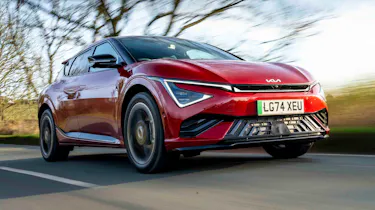
Now, more than ever, the Kia EV6 confirms that you can kick your petrol or diesel habit and choose an electric car. With its upgraded larger battery, the EV6 now has more than 300 miles of range, while ultra-rapid charging speeds make pit stops on long trips a breeze. There’s plenty of standard equipment, and even though the EV6 is a few years old, its rejigged styling is still radical enough to turn heads.
However, while it charges faster than most of its competitors, there are more efficient rivals, such as the Polestar 2, which can go further between charges. There are also more comfortable and practical alternatives to consider, such as the Skoda Enyaq, which offers a more compliant low-speed ride plus a much larger boot.
About the Kia EV6
The Kia EV6 marked a significant step beyond the electric cars that the brand had offered before. The Kia Soul EV and Kia Niro EV helped this carmaker find its feet with EV tech and were very convincing cars for their time, but the EV6 used the Hyundai Group’s E-GMP platform, complete with a high-tech 800-volt architecture with super quick recharging speeds. At its launch, only high-end models, such as the Porsche Taycan, had such an advanced electrical set-up.
Used - available now


But in this rapidly evolving electric era, Kia hasn’t stood still, which is why changes to the facelifted EV6 are more than skin deep. Range has been boosted by an 84kWh battery – up from 77.4kWh – while alterations to the suspension, interior and standard equipment complete the upgrade.
The Kia EV6 is part of the same family of cars as the Hyundai Ioniq 5 and Genesis GV60. The general rule of thumb with these EVs is that the Hyundai is the ultra-techy car, the Genesis is the luxury one, and the Kia is the sporty one. If it’s maximum performance that you seek, though, you’ll want to take a look at our in-depth review of the Kia EV6 GT. Alternatively, there’s also the Hyundai Ioniq 5 N to consider.
We’ve evaluated the Kia EV6 alongside the similarly eye-catching Skoda Enyaq Coupe in a twin test. The Skoda was the victor here due to its extra range, a more ergonomic design, and excellent practicality. The Kia is still an appealing all-rounder, albeit one with a few drawbacks.
Kia EV6 prices and latest deals
Pricing for the Kia EV6 starts from a little over £45,500 for the entry-level Air trim, which is exclusively rear-wheel drive. Next up is GT-Line, which is a little over £48,500. However, those wanting to upgrade this model with the optional four-wheel drive will need to stump up a little over £52,000. At the top of the core EV6 line-up sits the GT-Line S, starting from just under £54,000 in rear-wheel drive spec, or around £57,000 for the four-wheel drive version. You can add a heat pump to this trim level, but you will be looking at a premium of nearly £1,000.
If you’re keen to save on your new Kia, you can do so by building your perfect Kia EV6 through the Auto Express Buy a Car service. If you prefer a shorter commitment, we also have plenty of top EV6 leasing deals to choose from. Alternatively, you can choose from a wide selection of top-notch used Kia EV6 models that are in stock and ready to go.
Performance & driving experience
Pros |
|
Cons |
|
Although the Kia EV6 sits on the same E-GMP electric car platform as the Hyundai Ioniq 5 and Genesis GV60, the Kia has a sportier feel. There’s MacPherson strut front suspension and a multi-link rear end, which helps to keep things nicely controlled. The EV6 has a slightly stiffer set-up than the Ioniq 5, and it isn’t as tall as the more luxurious GV60, so it benefits from a lower centre of gravity.
The less expensive rear-wheel-drive versions of the EV6 feature a single 225bhp electric motor, while all-wheel-drive versions get an electric motor on each axle. Combined, this version puts out a total of 320bhp.
This is more than enough power for typical family car duties and requirements, but if that’s still not enough for your own personal taste and you fancy embarrassing some supercars, be sure to take a look at our Kia EV6 GT review.
| Model | Power | 0-62mph | Top speed |
| EV6 Air | 225bhp | 7.7 seconds | 115mph |
| EV6 GT-Line | 225bhp | 7.7 seconds | 115mph |
| EV6 GT-Line S AWD | 320bhp | 5.3 seconds | 116mph |
Electric motors, 0-60mph acceleration and top speed
The EV6’s dual-motor set-up delivers superb acceleration – 0-62mph takes just 5.3 seconds, and it’s matched to an eager throttle response that’s easy to modulate. But as fun as this is, we feel that acceleration that’s on a par with some serious hot hatchbacks is a little unnecessary for a family car.
For that reason, the standard rear-wheel-drive option – with 225bhp and a 7.7-second 0-62mph time – seems more than good enough for the overwhelming majority of drivers.
Town driving, visibility and parking
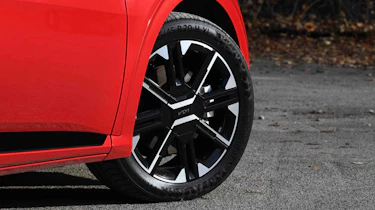
Kia has retuned the dampers to address the original EV6’s slightly fidgety ride, but the changes haven’t gone far enough. While it feels a touch more compliant than before, the car’s rear now feels a little out of sync, bumping harshly across uneven surfaces. Rivals such as the Renault Scenic and Ford Capri are similarly firm, but their damping feels more sophisticated.
Imperfections in the road are transmitted through the stiff chassis – especially in GT-Line S trim with larger 20-inch alloy wheels. It’s far from unpleasant, but can’t quite match the Skoda Enyaq for comfort.
The steering in the EV6, although not as light as its Ioniq 5 or GV60 siblings, is pleasingly direct and allows you to accurately place the car when navigating your way through a tight village or along a busy city street. It’s also backed up by good brake pedal feel, with the regenerative braking system blending with the regular mechanical brakes well. It’s particularly adept when the former is left in its auto setting.
Kia’s excellent regenerative braking system offers several levels of braking strength, and can be adjusted on the fly with paddles behind the steering wheel. There’s a one-pedal driving mode called i-Pedal, which is especially good for stop-start traffic because it’s strong enough to bring the car to a smooth stop and hold it in place until the traffic ahead clears, and you can accelerate away.
However, you are very conscious of just how long the EV6 is when driving in tight urban streets. At close to 4.7 metres long, it’s nearly the same length as one of the brand’s seven-seat SUVs, the Kia Sorento. In order to maximise cabin space, Kia has pushed the front and rear axles out as far as possible; the 2.9-metre wheelbase is very long. A side effect of this is that the EV6’s turning circle is quite wide, at 11.6 metres. There are rivals that can turn in tighter and are easier to manoeuvre as a result.
Country road driving and handling
Unlike some family EVs, the Kia EV6 is a lot of fun to drive on twisty roads. In fact, it’s among the most enjoyable electric cars we’ve driven.
Leave the drive mode in Normal, and the EV6 is alert to your commands, which is good because Sport mode can be too frenetic for everyday use. Given the EV6 weighs up to 2,165kg in dual-motor guise (the single-motor version is 2,090kg – around 120kg heavier than before it was facelifted), the sharper throttle and steering responses are a bit too intense in this sportiest setting, and it all becomes a little unbalanced and overexcitable, particularly when travelling on twisty B-roads. In contrast, Eco driving mode can make the EV6 quite slow to get going again after stopping.
The firm suspension means that the EV6 doesn’t roll too much through corners, although at almost 2.2 tonnes, it’s not a car that encourages you to drive keenly. It’s stable and predictable through bends, the balance is neutral, and the grip is decent. The steering is one of the best aspects of the EV6’s dynamics; it’s precise and naturally weighted.
Motorway driving and long-distance comfort
A long wheelbase means that stability is reassuring at high speeds, and aside from a little road rumble, refinement is great. Kia has added soundproofing around the rear motor for the facelift, which means that even under hard acceleration, motor whine is well isolated from occupants.
The strain of long motorway journeys can be eased by Kia’s Lane Follow Assist 2.0 (LFA) system, which automatically keeps the car in its lane (with constant supervision from the driver). Unlike rival systems, Kia’s steering tech can work independently of the adaptive cruise control, so you can choose for the car to steer itself, maintain speed itself, or both. LFA is standard on every EV6 model.
"Seeking a comfortable ride while maintaining sufficient body control through corners to contain a two-tonne-plus mass throws up varying results, even on the same platform. The Kia EV6 has the firmest suspension, the Hyundai Ioniq 5 the softest, and the Genesis GV60 sits between them.” – Alex Ingram, former chief reviewer.
Range, charging & running costs
Pros |
|
Cons |
|
An even more efficient powertrain than before should mean that the EV6 remains fairly cheap to run, and charging speeds are excellent. Insurance and depreciation are pretty average for the class, but higher-spec models can be expensive to buy in the first place.
While smaller batteries were previously available, every version of the Kia EV6 now uses an 84kWh pack, with the RWD single-motor versions offering the longest range in the line-up, up to 361 miles from a single charge. The AWD system in dual-motor models cuts the maximum range to 339 miles in GT-Line variants (324 miles for the GT-Line S).
Buyers can add a heat pump to the EV6 to help reduce the negative effects of cold weather on battery range, but it’s only available on the top-spec GT-Line S trim. At temperatures reaching minus seven degrees centigrade, Kia states that it should be able to preserve the range to around 80 per cent of what’s possible at 25 degrees ambient temperature by scavenging heat from the coolant system to warm the interior.
During our time behind the wheel of a dual-motor EV6, we averaged 3.4 miles per kilowatt hour – a fair return given the cool outside temperature during our testing and the performance of this four-wheel drive powertrain. That gives an overall range of 286 miles. This was a little shy of the 3.5 miles per kWh that Kia claims it’ll achieve, but this figure should improve on a journey with more opportunities to utilise regenerative braking. The lighter rear-wheel-drive Air and GT-Line models have a better efficiency rating of 3.9 miles per kWh, and in our testing of the previous EV6, these have been the most efficient versions in the range.
Unfortunately, rivals have quickly been playing catch-up to the EV6 both in terms of overall range and efficiency. The 85 version of the Skoda Enyaq is on par with the EV6 for range, while the Long Range Single Motor Polestar 2 is significantly better, and manages more than 400 miles to a charge, averaging 4.2 miles per kWh.
However, few can match the speedy rapid charge times of the EV6. As with its Hyundai Ioniq 5 and Genesis GV60 siblings, the EV6 uses an 800V charging system, so if you can plug into a 350kW ultra-rapid charger, a 10 to 80 per cent top-up takes just 18 minutes for both the 63kWh and 84kWh models. When utilising a 7.4kW home wallbox, it’ll take just under 10 hours to refill the 63kWh model, and a little under 13 hours to fully replenish the 84kWh version.
| Model | Battery size | Range | Insurance group |
| EV6 Air | 84kWh | 361 miles | 34 |
| EV6 GT-Line | 84kWh | 361 miles | 35 |
| EV6 GT-Line S AWD | 84kWh | 324 miles | 40 |
Insurance groups
Insurance groups range from 34 for the entry-level Air, up to 40 for the dual-motor version of the GT-Line S. That means the Air sits one group higher than the (more powerful) Enyaq Coupe 85 Edition, and the GT-Line S is two groups higher than even the sportiest Enyaq, the vRS.
Tax
The revised £50,000 electric car luxury car tax threshold means that the Air and two-wheel drive GT-Line just about manage to avoid this additional £440 annual surcharge. Cross this barrier, and you’ll be forking out this extra cash between years two and six after the car is registered.
Electric cars continue to incur the very lowest Benefit-in-Kind (BiK) tax rates, so the Kia EV6 is a pretty strong company car candidate when you combine these savings with its sizable battery range.
Depreciation
The Kia EV6 does a decent job of resisting depreciation. Our market data indicates that it’ll retain between 47 and 50 per cent of its initial value after three years or 36,000 miles. This is actually a stronger performance than its sister car, the Hyundai Ioniq 5, which only manages to retain 39 to 42 per cent in standard guise. The Genesis GV60, meanwhile, barely ekes out 35 to 36 per cent.
Looking further afield, the Skoda Enyaq retains 45 to 48 per cent after the same amount of time or mileage in SUV form. The Skoda Enyaq Coupe, however, is a weaker performer at only 40 to 42 per cent.
To get an accurate valuation on a specific model check out our free car valuation tool...
Interior, design & technology
Pros |
|
Cons |
|
All EV6s are well equipped, and the entry-level Air model is more than ready for family life, including:
- Dual-zone climate control
- Heated front seats and steering wheel
- Dual-screen infotainment system with integrated sat-nav
- Wireless Apple CarPlay and Android Auto
- Numerous USB ports
- Front and rear parking sensors
- Reversing camera
For around £3,000 more, GT-Line trim brings sportier exterior and interior styling, and adds blind spot monitoring with a safe exit assist system, electric front seats, wireless phone charging, and adaptive headlights.
The top-spec GT-Line S version offers niceties such as bigger 20-inch alloys, a tilt/slide sunroof, a head-up display, a 360-degree camera system, an upgraded 14-speaker Meridian audio set-up and a more advanced suite of driver-assistance technology.
Interior and dashboard design
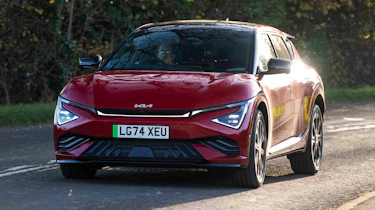
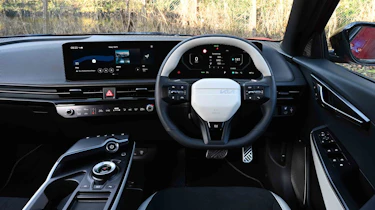
Interior design was always one of the EV6’s strong suits, so it’s little wonder that Kia didn’t change much inside for the facelift. The cabin is dominated by two 12.3-inch displays that wrap around the driver. Combined with a raised centre console, with a neat rotary dial for switching between drive, neutral and reverse, the driver feels cocooned – in a good way – in an otherwise airy interior.
The only significant change between old and new is a fresh steering wheel in the higher trim levels, with a drive-mode button in the centre of its lower spoke.
Materials and build quality
The interior feels smart and up to date, with cabin materials of sufficient quality for a £45k-plus family car. There’s also a further nod to sustainability by offering artificial leather upholstery as standard. The updated EV6 has replaced the piano-black trim used extensively before with a matt-textured finish, which looks classier and is less susceptible to scratches – a real boon for anyone who regularly wears rings or often sets their keys down on surfaces.
Taking a leaf out of Volkswagen’s book, the front door pockets are flocked to prevent items from rattling as you drive down the road.
Infotainment, sat-nav and stereo
The twin, gently curved 12.3-inch screens in the EV6 look fantastic, work well and offer clear graphics. Kia’s infotainment system is easy to use, but there’s also wireless smartphone connectivity for both Apple CarPlay and Android Auto if you want to use apps from your phone. It all works seamlessly, while the touchscreen display is responsive. It’s all laid out well, and the menus make sense, plus we like the use of black backgrounds to reduce eye strain at night. Meanwhile, the driver’s display provides all the information you need.
The standard six-speaker audio system included with Air and GT-Line trims is decent enough, while GT-Line S and above come with a 14-speaker Meridian premium audio system. Only the entry-level Air trim misses out on a wireless phone charging pad.
With such a huge battery, it’s good that the EV6 also features a three-pin plug socket, allowing you to run more power-hungry appliances from the outlet located at the base of the rear seat bench. The same Vehicle-to-Load tech also works from the car’s charge port; a special adapter can be bought from Kia for a little over £300.
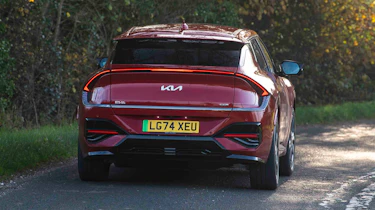
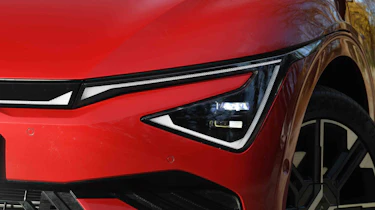
“To me, the wild angles of the updated lamp units are a much better fit with the car’s distinctive profile. The steeply raked windscreen and bigger wheels mean that, regardless of trim level, it’s one of those cars that looks like it’s going fast even when it’s parked.” – Alex Ingram, former chief reviewer.
Boot space & practicality
Pros |
|
Cons |
|
A mix of a low roof and a high boot floor means the EV6 isn’t as spacious inside as its exterior dimensions will have you believe.
Dimensions and size
As with the Hyundai Ioniq 5, the EV6 is a surprisingly big car in the metal. It’s both longer and lower than a Skoda Enyaq, which helps give the Kia its sporty, dynamic look.
| Dimensions comparison | |||
| Model | Kia EV6 | Hyundai Ioniq 5 | Skoda Enyaq Coupe |
| Length | 4,695mm | 4,655mm | 4,658mm |
| Width | 1,890mm | 1,890mm | 2,148mm |
| Height | 1,550mm | 1,605mm | 1,623mm |
| Wheelbase | 2,900mm | 3,000mm | 2,766mm |
| Boot space |
490 litres (480 litres with subwoofer fitted) | 520 litres | 570 litres |
Seats & passenger space
While its rakish looks mean the EV6 looks less SUV-like than many of its rivals, this comes at the expense of headroom. Some taller testers felt like they were sitting too close to the roof, even with the seat adjusted to its lowest position. That aside, there is plenty of adjustability in the front seats and the steering wheel. Both a six-foot driver and front passenger should have no issue getting comfortable in the front of an EV6, though.
While the Ioniq 5 chooses to emphasise the amount of space it offers, the EV6 separates the driver and front passenger with a centre console, but it’s not so wide that you’ll be banging your knee into it all the time or tall enough to make you feel entombed within the cabin. You won’t sit as low as you do in a Tesla Model 3, for instance, but the driving position seems more enclosed because of its steeply raked windscreen and high centre console, giving the EV6 a sportier feel than the Ioniq 5.
GT-Line cars and above include Kia’s Premium Relaxation Seats, which recline when the vehicle is charging to provide the driver with a more comfortable position to take a nap if they feel tired.
Storage space is plentiful, thanks to big door bins (carpeted to stop small items rattling about) and a two-tier centre console which has cup-holders and smartphone charging on top, and a deep cubby below.
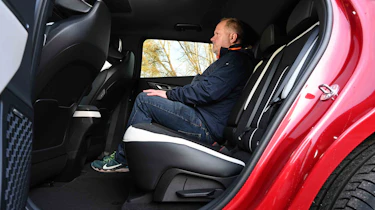
Interior space is a mixed bag in the back of the EV6. Kneeroom is immense – among the best of any car we’ve measured – but this is balanced out by disappointing headroom. It’s possible to recline the backrests a little, which means a more slouched position can take advantage of the room ahead.
There are USB-C charging ports built into the sides of both front seats, so there should be no squabbling between those in the rear about who gets to charge their devices. Parents with children who need child seats can utilise the two Isofix points on the outer positions of the second row, although the points aren't that easy to locate and fix a seat to.
Boot space
Behind those back seats is a boot with a huge floor area, but it is also shallow. As a result, the 490 litres of volume on offer (or 480 litres if the Meridian subwoofer is fitted) is fairly average for a car so large on the outside. Dog owners might be better served by a rival with a full SUV bodystyle, such as a Volkswagen ID.4 or Ford Explorer.
Fold the rear bench down, and the overall volume increases to 1,300 litres, leaving only a small step up from the boot floor to the 60:40-split seat backs. Kia also provides a ski hatch for loading long, thin items.
Rear-drive cars benefit from a 52-litre storage compartment under the bonnet, while this space is reduced to 20 litres in all-wheel-drive versions. Either way, the EV6’s front storage is good for keeping your charging cables out of sight and away from your luggage. Rivals such as the Renault Scenic and Volkswagen ID.4 offer underfloor stowage, which might be an issue if you have stuff in the boot that needs to be removed first in order to access the cables.
Towing
The maximum braked trailer towing weight for the EV6 was increased as part of its facelift. Every model can now handle up to 1,800kg, which is far more impressive than the disappointing 1,200kg of the Volkswagen ID.4 GTX or the 1,400kg of the four-wheel-drive 85x Skoda Enyaq.
The EV6 should be more than capable of pulling a decent-sized trailer or a small-to medium-sized caravan. However, we'd always advise double-checking your trailer’s weight before hitting the road.
“A flat floor and plenty of elbow room make it reasonable for a third passenger in the back of the EV6, but while large doors make it easy to manoeuvre a child seat into position, the Isofix mounts are more awkward to reach than in some rivals.” – Alex Ingram, former chief reviewer.
Reliability & safety
Pros |
|
Cons |
|
The Kia EV6 hasn’t appeared in the Driver Power owner satisfaction survey for quite a while, but when it did last appear in our 2023 poll, it secured seventh place with glowing praise for its powertrain, ride, handling and smoothness, as well as the number of safety systems, child-friendly features and rear legroom.
More recently, the Kia brand achieved a rather middling 18th-place finish out of 31 brands in the best manufacturer rankings. Rivals such as Toyota (14th), Skoda (12th) and Tesla (11th) all proved more satisfying to own.
Euro NCAP awarded the EV6 a five-star safety rating in May 2022, with the all-electric family car achieving a 90 per cent rating for adult protection and 86 per cent for child passenger protection. For the facelift, Kia reinforced the B-pillars, which should enable it to score highly against NCAP’s ever-more stringent testing criteria. Also new is the ability to mute the speed limit warning bong more easily. Rather than delving into an infotainment menu to disable it, the driver can push and hold the volume dial on the steering wheel for three seconds.
Along with smart cruise control and a rear view camera, Kia’s family EV includes a host of active safety systems: Forward Collision Avoidance Assist uses a front radar to monitor for possible hazards, such as pedestrians, cyclists or other cars, before providing a warning and then automatically applying the brakes to help avoid or mitigate a potential collision. There are also systems designed to help keep you in your lane and tech that will sound a warning if it detects any loss of attention or driver fatigue.
The top-of-the-range GT-Line S trim has a more advanced highway driving assist system that helps to centre the car within your lane, and even change lanes for you, provided the blind spot system has determined the coast is clear.
| Euro NCAP safety ratings | |
| Euro NCAP safety rating | Five stars (2022) |
| Adult occupant protection | 90% |
| Child occupant protection | 86% |
| Vulnerable road user protection | 64% |
| Safety assist | 87% |
Buying and owning
- Best buy: Kia EV6 Air RWD
It may be the entry-level car, but the rear-wheel drive Kia EV6 Air combines the longest battery range in the EV6 line-up, and a very strong list of kit. It also comes with the smaller 19-inch wheels, which helps to mitigate the EV6’s firm ride on larger wheels.
Kia EV6 alternatives
The Kia EV6 is more of a sporty family EV crossover than a traditional SUV, but it still stands against plenty of capable competitors. Not only does it have its own Hyundai Ioniq 5 and Genesis GV60 siblings to contend with, but there are also the likes of the Ford Mustang Mach-E, Nissan Ariya, Renault Scenic E-Tech, Skoda Enyaq, Toyota bZ4X, and Volkswagen ID.4.
This competition is already strong, but Kia also has upmarket ambitions for its EV6, which brings additional rivals such as the Audi Q4 e-tron, Polestar 2 and Tesla Model Y into the mix.
Key updates of the Kia EV6 review
13 April 2026: Updated to include revised powertrain and trim level information.
Frequently Asked Questions
We’ve tested the facelifted all-wheel-drive EV6 in GT-Line S trim (with an optional heat pump) and managed 3.3 miles per kWh in 10-15 degree temperatures, which is just shy of the 3.5 miles per kWh that Kia claims it can achieve.
Deals on the EV6 and alternatives