Renault Megane E-Tech review
The Renault Megane E-Tech blends a classic name with up-to-date tech, and the result is a convincing one

Our opinion on the Renault Megane E-Tech
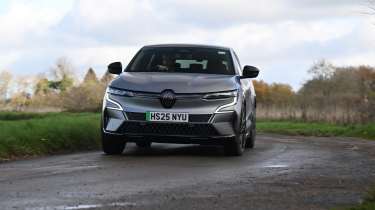
While the Renault Megane E-Tech is no longer the freshest model in the company’s electric car line-up, it’s still a very strong contender in the electric family hatchback class: it just goes to demonstrate that the French firm is on a roll with its EVs. The Megane E-Tech is appealing due to its style, especially inside, where the cabin successfully combines a modern layout with user-friendly technology.
It’s not the biggest EV on the market, so back-seat space isn’t much to write home about, and the ride is on the firm side, but if you can live with these shortcomings, then this car makes a lot of sense.
About the Renault Megane E-Tech
While some brands have created all-new models for the electric era, the Renault Megane E-Tech demonstrates the French firm’s practical approach to adapting household nameplates for fully fledged EVs. Allowing for the bit of licence in adding E-Tech to the name, the Megane E-Tech moves into its fifth generation since the 1995 original, and has fully turned its back on petrol and diesel power.
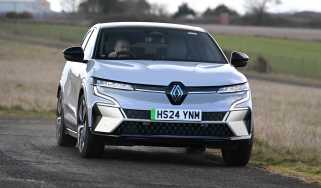
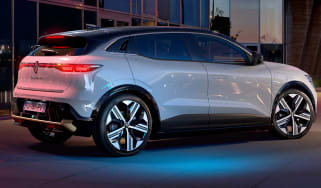
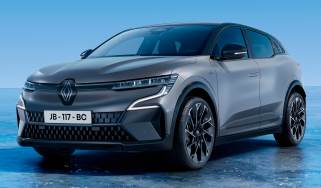
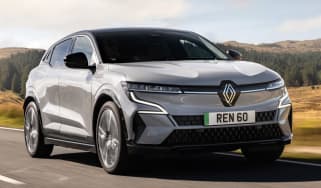
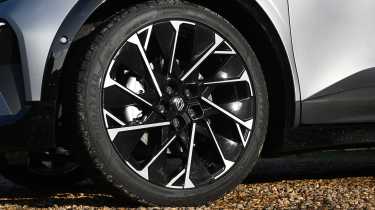
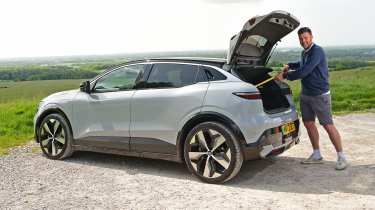
The Megane has always offered distinctive design (remember the big-booted Mk2?), and this latest car takes a dramatic turn again, with a sleek, rakish five-door hatchback shape and almost cartoonishly large 20-inch alloy wheels in higher trim levels. In a class that’s filled with compelling alternatives, it gives the Megane E-Tech a unique selling point.
Used - available now

2022 Renault
Megane E-Tech
12,565 milesAutomaticElectric
Cash £18,300
2022 Renault
Megane E-Tech
10,286 milesAutomaticElectric
Cash £18,000
2022 Renault
Megane E-Tech
24,041 milesAutomaticElectric
Cash £17,361
2022 Renault
Megane E-Tech
27,427 milesAutomaticElectric
Cash £15,338In terms of where it fits in the brand’s line-up, the Megane E-Tech slots between the compact Renault 5 and Renault 4 electric models and the larger Renault Scenic, and its five-door hatchback body has family car buyers in mind. Unlike rivals such as the Skoda Elroq, there’s only one powertrain available, which features a 60kWh battery that powers an electric motor driving the front wheels.
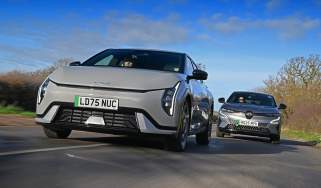
In order to see how well this Renault holds up against its younger competitors, we’ve pitted the Megane against the Kia EV4 in a twin test. Thanks to its superior interior space and solid real-world battery range, the Kia took the win here. However, the Renault offers better on-board tech and is cheaper to buy.
Renault Megane E-Tech prices and latest deals
With one powertrain and three trim levels to choose from, the Megane E-Tech line-up is a pleasantly simple one to get to grips with. Prices start from around £31,500 for a base Techno model, rise to just over £34,000 for the mid-spec Techno Esprit Alpine, and top out at around £35,500 for the fanciest Iconic Esprit Alpine. These prices include the £1,500 discount that’s provided by band 2 of the Government’s Electric Car Grant.
If you're interested in getting yourself a Renault Megane E-Tech, we can help. Configure your ideal Renault Megane E-Tech with the Auto Express Buy a Car service now to get top offers from local dealers, check out the latest Renault Megane E-Tech leasing deals, or search for used Renault Megane E-Tech models. You can even sell your existing car for a great price with Auto Express Sell my Car.
Performance & driving experience
Pros |
|
Cons |
|
Renault has kept things very simple with the Megane E-Tech’s line-up, because there’s a single motor and battery combination throughout the range. While some buyers might be disappointed that there isn’t a more potent version available, in reality, the powertrain is more than adequate for a family hatchback.
There’s a single motor driving the front wheels, and it produces a healthy 212bhp and 300Nm of torque. On the road, the Megane E-Tech feels as lively as the claimed numbers suggest. The throttle responds keenly to inputs, with the car jumping forward with real enthusiasm from a standstill. Those who find it too sharp can switch to Eco mode; this doesn’t blunt the overall performance, but does make the pedal a little less responsive at the top of its travel.
| Model | Power | 0-62mph | Top speed |
| Megane E-Tech EV60 | 212bhp | 7.5 seconds | 99mph |
Electric motors, 0-60mph acceleration and top speed
The Megane officially cracks the 0-62mph sprint in 7.4 seconds, and it certainly feels good for it. It’s helped by what is, by EV standards, a modest kerbweight of less than 1,700kg. The use of aluminium on the doors plays its part here, but so does the 60kWh battery, which is a little smaller than what is fitted to many of the Megane’s closest rivals. At 354kg, it’s a full 116kg lighter than the Kia EV4’s 81.4kWh unit, for example.
The Megane E-Tech has an electronically limited maximum of 99mph to help preserve battery capacity. Obviously, that’s still more than enough for UK roads.
Town driving, visibility and parking
Light steering and the relatively compact footprint both work in the Megane’s favour at low speeds, making it a reasonably easy car to drive around town.
We found that the transition between regenerative motor deceleration and mechanical braking wasn’t the smoothest on the road, partly due to the fact that the discs and pads felt a little bit grabby. This made it quite hard to modulate the pedal at parking speeds. A 2025 update introduced one-pedal driving, which some EV drivers will love, although the maximum level of regen isn’t as strong as in some electric cars we’ve tested.
A variety of artificial sounds can be chosen to warn pedestrians of your presence, including a slightly spooky tone created by French electronic music icon Jean-Michel Jarre. More jarring is the Megane E-Tech’s ride, because the mix of firm suspension and large 20-inch alloy wheels makes it a little harsher than we’d like from a family car.
Country road driving and handling
By the standards of most slightly leaden-footed EVs, the Megane feels really quite agile and enthusiastic through turns. It’s certainly one of the more engaging cars to drive in the segment, thanks to the positive way that it turns into corners and changes direction.
Some of our road testers felt that there was a little too much hyperactivity with the Megane, though; given that it’s a family car, they wished that it was just a little more relaxed over bumps, and that the steering wasn’t quite so darty and responsive. As we’ve already mentioned, 20-inch alloy wheels don’t do the low-speed ride any favours, but cars equipped with them do feel more compliant at higher speeds.
The stability control system is very restrictive and caps the power until the wheel is almost completely straight. This makes it hard to flow smoothly along a twisty road. These things are a shame, because the Megane E-Tech feels like it has a promising chassis that’s only hamstrung by software.
Motorway driving and long-distance comfort
Despite the fairly sensitive steering, high-speed stability is hard to fault, with the Megane feeling planted and secure at speed. The Renault’s main disadvantage at 70mph comes from the tyres; quite a lot of road roar makes it through the cabin, which takes the shine off what otherwise would be an impressively refined car.
“It’s a balance a lot of EVs get wrong, but the Megane is enjoyable to drive and composed enough to make you feel like using the lively performance. In the wet of winter there were a few occasions when it spun its front wheels excessively under hard acceleration, but on dry roads traction is plentiful.” - Steve Walker, head of digital content.
Range, charging & running costs
Pros |
|
Cons |
|
On the two occasions that a Renault Megane has taken part in an Auto Express comparison test, our consumption has ended up at 3.8 miles/kWh. Given the modest battery capacity of 60kWh, that translates into a fairly underwhelming real-world range of 228 miles. We’ve no doubt that in warmer climates that figure will improve, but it’s still some way behind the class-leaders for range, such as the Kia EV4. At 130kW, charging speeds fr the Megane are okay, if not class-leading. A 15-80 per cent top-up takes 32 minutes.
It’s worthwhile plotting a route to a charging station in the car’s navigation system if you intend to use one, because this will allow the Megane E-Tech to precondition the battery. That’ll make sure the battery is at its optimum temperature to take a higher rate of charge when you plug in to a rapid charging station. Without this function, the rate of charging will be much slower, particularly in cold temperatures.
Most EV owners will be looking into home charging to get the best bang for their buck by utilising a cheaper overnight electricity tariff. A typical 7.4kW home wallbox charger should be able to fully recharge a Megane E-Tech in around 10 hours.
| Model | Battery size | Range | Insurance group |
| E-Tech EV60 Evolution | 60kWh | 285 miles | 26 |
| E-Tech EV60 Iconic | 60kWh | 281 miles | 26 |
Insurance groups
Insurance ratings are fairly low for the Megane line-up, with the top-spec Iconic Esprit Alpine sitting in group 26. In comparison, the MG4 Long Range is in group 28 or 29, while the Cupra Born falls into groups 25 to 28, depending on which trim level you opt for. If you’re interested in paying even less for insurance, then consider the electric Citroen e-C4, which starts in insurance group 21.
Tax
The Megane’s competitive retail price paired with its electric powertrain make it a bargain to run on a company-car scheme. Standard-rate income tax payers will face Benefit-in-Kind (BiK) company car tax deductions of just £222 in the first year, which is much less than a petrol or hybrid family hatch of similar value
All electric cars qualify for the standard rate of Vehicle Excise Duty (VED) road tax, but no model in the Megane E-Tech range goes anywhere near the luxury car tax threshold, so at least there are no surcharges here.
Depreciation
With estimated residual values of 36 to 38 per cent after three years or 36,000 miles, the Megane E-Tech falls well short of the Kia EV4, as this rival retains 43 to 46 per cent after the same period of time. The MG4 is in a similar situation to the Renault, though, because this rival only holds on to 33 to 35 per cent.
To get an accurate valuation on a specific model check out our free car valuation tool...
Interior, design & technology
Pros |
|
Cons |
|
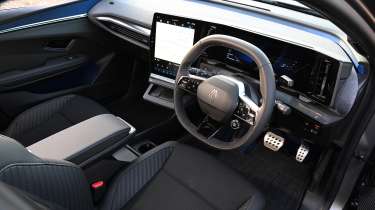
Fantastic interior design and a class-leading infotainment system give the Megane E-Tech one of the best cabins in the segment.
All Megane models are well equipped, with even the base Techno getting 18-inch alloy wheels, wireless smartphone charging, heated front seats and steering wheel, front and rear parking sensors and a reversing camera.
Interior and dashboard design
Inside, the Megane’s dashboard is dominated by a large 12-inch portrait touchscreen, which is gently angled towards the driver to give a slightly cocooned feel. But while the screen takes up a lot of real estate, Renault hasn’t scrimped on the physical controls, because there’s a neat row of toggle keys beneath the screen to cater for all of the climate functions. The Megane’s cabin looks smart, then, but it’s also among the most functional in the class, too.
Materials and build quality
Squidgy plastics and tactile fabrics on the seats and the dash really help to make the cabin quality feel a cut above many rivals’. It doesn’t quite have the wow-factor or the general feeling of plushness of the Peugeot E-308, but that car aside, the Megane’s fit and finish is towards the top of the class.
Infotainment, sat-nav and stereo
One of our test cars came equipped with a digital rear-view mirror. Its functionality is fine for systems of this type, and it overcomes the Megane’s tiny rear window. It’s possible to turn this off, but that has its drawbacks. By incorporating the screen, it gives the standard mirror a hazy finish, especially at night when the headlights of other vehicles are behind.
The Megane was updated in 2025 with vehicle-to-load functionality, which is made possible by buying an adapter from Renault.
Before Renault turned to Google for its infotainment systems, it had one of the slowest and clunkiest systems around. Now, it’s one of the very best. It looks sharp and loads incredibly quickly, with predictably brilliant mapping functions and a responsive screen. But it has maintained the bright, sharp graphics that make it recognisable as a Renault set-up. Our only gripe is that the home shortcut disappears from certain menu pages from time to time.
Because Google is built in, it allows users to install more than 50 apps, including Waze, Spotify and Amazon Music, to personalise the system to their tastes. Speaking of music, audiophiles may want to upgrade to the top-of-the-range Iconic Espirit Alpine version in order to get the fancier 12-speaker Harman Kardon sound system.
“The touchscreen menus are easy to work out, while loading and response times on the built-in Google Maps are fantastic. Over-the-air updates can add further features in the future.” - Alex Ingram, former chief reviewer.
Boot space & practicality
Pros |
|
Cons |
|
At 4.2 metres long, the Megane is refreshingly compact compared with so many ever-inflating rivals. While that makes it a sound choice for those who need to park in tight spots or on busy streets, there’s only so much space that its footprint can offer, and many rivals are more spacious as a result.
Dimensions and size
The Megane E-Tech introduced a radical look with its switch to electrification, but the overall dimensions are similar to previous iterations. It’s similar in size to the MG4 and Cupra Born.
| Dimensions comparison | |||
| Model | Renault Megane | Kia EV4 | MG4 |
| Length | 4,200mm | 4,430mm (4,450mm GT-Line & GT-Line S) | 4,287mm |
| Width | 1,768mm | 1,860mm | 1,836mm |
| Height | 1,505mm | 1,485mm | ,1,504mm (1,516mm Trophy Extended Range & XPower) |
| Wheelbase | 2,685mm | 2,820mm | 2,705mm |
| Boot space | 440 - 1,322 litres | 435-1,415 litres | 289-986 litres |
Seats & passenger space
That sleek, almost hot-rod-like slim glassline makes the Megane look striking from the outside, but it does have its compromises elsewhere. Look through the rear-view mirror, and the driver is presented with a tiny sliver of a back window, so the view behind isn’t great. It’s worse in bad weather, because the narrow glass area only has space for a tiny wiper, so not much of the glass is cleared when it gets grubby. Fortunately, the Megane’s door mirrors are very large, which makes up for the view through the window.
Storage up front is reasonable, if not outstanding. There’s a deep, but slightly narrow, bin beneath the centre armrest, and while there are cup-holders further ahead, they’re set very deep, which means it takes a careful hand to lift a takeaway coffee cup out without spilling it.
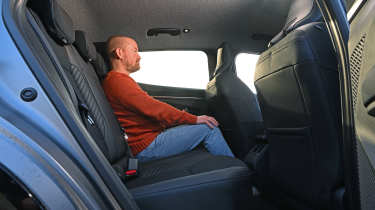
While rear legroom isn’t as impressive as in rivals such as the Volkswagen ID.3 or Kia EV4, and headroom is slightly tighter too, the seats themselves are very comfortable, with lots of foot space and plenty of under-thigh support. Some rivals offer a central fold-down armrest; the Renault doesn’t have one, but on the flip side, this makes the centre seat backrest a little softer, and therefore it’s reasonably comfortable.
Fitting a child seat is easy, thanks to Isofix covers that are easy to reach behind folding plastic covers. There’s also a third Isofix mount on the front passenger seat.
Boot space
At 389 litres (measured by the official VDA measurement standard), the boot space is right on par with a conventional petrol family hatchback of this size – that figure puts it a couple of litres up on what you’d find in the back of a Volkswagen Golf.
The load lip is quite high, though, and the cargo space is fairly deep; both of these things combined mean that it’s a little tricky to load (and unload) bulkier items. Another issue is the boot release itself; it’s a tiny button sitting on the face of the bootlid, which is hard to find when it’s dark and gets dirty easily.
“The problems I had with the size of the Megane stem from the current size of my offspring. With a full car, I have to move the driver’s seat forward two notches from where I’d like it to be and drive hunched-up like LeBron James in a MINI.” - Steve Walker, head of digital content.
Reliability & safety
Pros |
|
Cons |
|
The Megane E-Tech was tested by Euro NCAP in 2022, and it was awarded a maximum five-star rating. Its strongest showing came in the Child Occupant Protection category, where it received a mark of 88 per cent – one per cent lower than the Cupra Born scored when it was evaluated the same year. A centre airbag reduces the risk of head injury between front passengers in the event of a side impact.
It’s very easy to adjust the likes of the speed-limit warning and lane-departure systems, thanks to the ‘MyPerso’ button to the right of the steering wheel. Two presses of this and the systems alter to your chosen settings – it’s the easiest method in any current car. Renault has fared better and better in recent customer satisfaction surveys, and in our 2025 Driver Power best manufacturer results, owners ranked the brand sixth best overall – a great result.
| Euro NCAP safety ratings | |
| Euro NCAP safety rating | Five stars (2022) |
| Adult occupant protection | 85% |
| Child occupant protection | 88% |
| Vulnerable road user protection | 65% |
| Safety assist | 79% |
Buying and owning
- Best buy: Renault Megane E-Tech Techno
The entry-level Techno gets the same powertrain as the fancier models, along with a full suite of electronic safety systems. While additional kit is nice to have, we just don’t think there’s much point in forking out thousands of extra pounds when you’ll already have Renault’s excellent infotainment system on board.
Renault Megane alternatives
There are a number of VW Group rivals to take on the Megane E-Tech, including the Volkswagen ID.3, Cupra Born and Skoda Elroq. The latter is an Auto Express Car of the Year winner, making it one of the very strongest competitors for the Megane.
Elsewhere, the Kia EV4 and MG4 are two other electric hatchbacks which are worth shortlisting. The Peugeot E-308 and Vauxhall Astra Electric also have a unique advantage over the Renault, and that is the option of an estate car variant.
Renault Megane E-Tech Techno long-term test
Our head of digital content, Steve Walker, ran a Renault Megane E-Tech Techno for a long-term test. Steve has two children, and the rear legroom of the Megane E-Tech proved to be tight for them on long journeys, especially behind his preferred driving position (he's just over 6ft tall).
He also found the cold weather range of the test car (which was not equipped with a heat pump at the time - it's now standard) was greatly reduced compared to the range in warmer conditions. On the plus side, the Megane E-Tech's interior quality and design stood out from the other cars in the class, offering a high-quality feel. The driving experience was also impressive, with the Megane E-Tech giving a great balance between comfort and responsive handling. You can read the full long term test here...
Frequently Asked Questions
If you’re not fussed about back-seat space, then it could be all the EV you could need. It offers a decent range, neat in-car tech and a decent drive, if you can live with the firm ride.
Deals on the Megane and alternatives
More reviews