Toyota Corolla review
The Toyota Corolla is efficient, reliable and good to drive, though it’s not the most practical hatchback

Our opinion on the Toyota Corolla
The Toyota Corolla no longer leads the family hatchback segment when it comes to practicality, but this globally best-selling car can still hold its own against newer, slicker competitors. Thanks to great refinement, a comfortable ride, fantastic build quality and handling that’s precise and controlled (if not the last word in driving pleasure), there’s very little to dislike about the Corolla.
What’s more, mid-life upgrades have brought subtle improvements to the Corolla's performance, with no effect on the car’s impressive efficiency. It also received a welcome overhaul of the infotainment system and on-board technology, resolving one of our original gripes with the 12th-generation Corolla. Overall, this British-built hatch is still as solid a family car as ever.
About the Toyota Corolla
Now in its 12th generation, the Toyota Corolla is built in the UK at the Japanese brand’s Burnaston factory near Derby. A midlife refresh saw it receive new technology and a revised hybrid powertrain in order to keep up with its younger rivals.
The Corolla uses the same TNGA platform as the Toyota C-HR SUV and the latest Toyota Prius. This car is only available as a full-hybrid, and you have the choice of 1.8-litre and 2.0-litre petrol engines paired with an electric motor and an automatic CVT gearbox. There’s no plug-in hybrid version, unlike with some of its key family hatchback rivals such as the Vauxhall Astra, Peugeot 308 and Volkswagen Golf. The Honda Civic is perhaps the Corolla’s most direct rival now, having also gone all-in on hybrid power for the 11th-generation model.
Used - available now

2022 Toyota
Corolla
21,438 milesAutomaticPetrol2.0L
Cash £19,155
2022 Toyota
Corolla
69,476 milesAutomaticPetrol2.0L
Cash £15,815
2022 Toyota
Corolla
70,837 milesAutomaticPetrol1.8L
Cash £12,797
2027 Toyota
Corolla
24,923 milesAutomaticPetrol1.8L
Cash £18,570Unlike the Civic, though, the Corolla is available as either a hatchback or estate car. This review focuses on the Corolla Hatch, but we also have a dedicated review of the Toyota Corolla Touring Sports.
We've driven various versions of the latest Corolla since it first went on sale, including long-term tests of both the 1.8-litre GR Sport and 2.0-litre Hybrid Excel.
Performance & driving experience
Pros |
|
Cons |
|
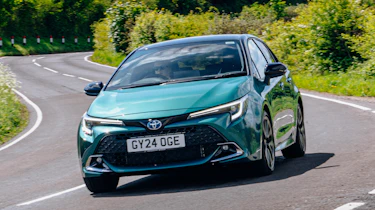
Despite its ‘self-charging’ hybrid powertrain and CVT gearbox, the regular Toyota Corolla is a sportier car than you might think. There’s more good news for driving enthusiasts, too, as the updated model rides and handles surprisingly well.
The refreshed Corolla feels more refined, too. There’s not as much of the droning you used to get from older CVTs, and although it hasn’t been completely eradicated, the benefit is quieter cruising. Toyota has also made some tweaks so the throttle response is much more direct now. Acceleration on the whole is brisk enough.
The electric side of the Corolla’s powertrain was also reworked as part of the car’s mid-life update. With the old battery being replaced by a redesigned, lighter lithium-ion unit that’s more energy dense, meaning it weighs 14 per cent less yet delivers 14 per cent more power.
| Model | Power | 0-62mph | Top speed |
| Corolla 1.8 Hybrid Icon | 138bhp | 9.1 seconds | 112mph |
| Corolla 2.0 Hybrid Design | 176bhp | 7.4 seconds | 112mph |
| Corolla 2.0 Hybrid GR Sport | 176bhp | 7.4 seconds | 112mph |
Performance, 0-60mph acceleration and top speed
The total power from the 1.8-litre hybrid powertrain is 138bhp; enough for a 0-62mph time of 9.1 seconds. If you go for the 2.0-litre hybrid, total power output rises to 176bhp, which cuts down the 0-62mph time to 7.4 seconds.
When the engine is worked really hard, it still makes a loud drone because the CVT transmission causes the revs to rise at a rate that doesn’t match the road speed. However, the extra electrical assistance of facelift models means this rev spike occurs less frequently than before.
Town driving, visibility and parking
At low speeds, silent EV mode makes for relaxing progress. Refinement is such that when the petrol engine does kick in, it’s fairly unobtrusive when trundling around town. If you spend the majority of your time on congested streets, the Corolla will prove very easy to live with. Regenerative braking also takes a bit of effort out of stop-start traffic, but we found this system to be a bit too unpredictable at times.
Parking is a pretty stress-free affair because every Corolla comes with a reversing camera and rear sensors as standard. These make up for the somewhat restricted visibility out of the rear window, but we had no issues seeing both the road ahead and what was going on beside us during testing.
Country road driving and handling
It’s primarily a sensible and efficient hatchback, but the Corolla is a better driver’s car than its looks might suggest. We’re not about to compare it to the Toyota GR Yaris, but the TNGA underpinnings feel sophisticated and allow for a great balance between ride comfort and body control. The steering is precise and well weighted, with the Toyota turning into corners well and providing reassuring grip.
Motorway driving and long-distance comfort
Both the 1.8- and 2.0-litre powertrains provide enough grunt to get up to motorway speeds with little fuss. Some software tweaks also allow the facelifted car’s engine to run at lower revs at a cruise, making the Corolla a quieter long-distance companion than pre-update models, aside from a bit of tyre roar.
“Regardless of which mode I selected (usually eco), the Corolla had good grip and body control. It could even be described as exciting at times on the right kind of road.” - Darren Wilson, creative director.
MPG & running costs
Pros |
|
Cons |
|
The Corolla range lacks the plug-in hybrid technology offered in its key rivals like the Vauxhall Astra, Peugeot 308 and Volkswagen Golf, but Toyota’s faithful ‘self-charging’ hybrid running gear continues to promise lower running costs and superior fuel economy compared to the traditional petrol hatchbacks, and some diesel models, too.
According to Toyota, the 1.8-litre hybrid in the Corolla hatchback can return up to 64.1mpg, while the 2.0-litre hybrid with its larger petrol engine can return 62.7mpg. All figures are measured using the latest WLTP regulations, so you might not achieve those exact figures on the road. However, based on our own testing, you should easily see more than 50mpg in everyday driving.
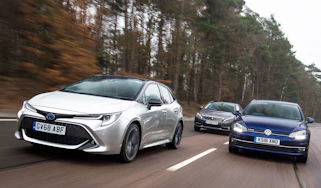
For instance, when we tested the 1.8-litre Corolla hatchback against a Honda Civic and a Kia Ceed, the Toyota was the most economical, returning 54.2mpg compared to the Honda's 50.3mpg and the 43.5mpg we saw from the Kia. And after covering more than 6,000 miles in our Corolla long-term test car, which included a lengthy family road trip to the West Country, we averaged a similarly impressive 53.2mpg.
MPG figures for previous journeys can be displayed in simple-to-understand bar graphs in the Toyota, which is handy if you want to monitor your fuel economy in great detail.
Toyota claims that up to 80 per cent of trips can be completed on electric power alone, and we have no reason to doubt that if you mostly drive in and around town. Over a mixture of driving environments, including some B-roads and dual carriageways, our average was 65 per cent.
| Model | MPG | CO2 | Insurance group |
| Corolla 1.8 Hybrid Icon | 64.2mpg | 100g/km | 17 |
| Corolla 2.0 Hybrid Design | 60.1mpg | 105g/km | 21 |
| Corolla 2.0 Hybrid GR Sport | 60.1mpg | 106g/km | 21 |
Insurance groups
The Toyota Corolla is relatively cheap to insure when compared to some of its hatchback rivals. The line-up sits between insurance groups 17 to 21, whereas the Honda Civic resides in groups 26 and 27.
Check if your car needs an MoT and view its complete history with our MoT History Checker...
Tax
Although it’s only available as a hybrid, the lack of a plug or significant electric-only range means the Corolla doesn't bring any major VED road tax or Benefit-in-Kind company car tax savings. On the plus side, the starting price means you’ll dodge the luxury car tax supplement, even if you go a bit mad with the options list.
Company car drivers will be better served by a fully electric hatchback. Toyota’s current EVs, the bZ4X, bZ4X Touring and Urban Cruiser are all larger than the Corolla, so you’ll need to look further afield. Options include the Cupra Born, Peugeot E-308, Renault Megane E-Tech, Vauxhall Astra Electric and Volkswagen ID.3.
Depreciation
Our market data indicates that the Corolla will retain between 44 and 47 per cent of its original value after three years or 36,000 miles. This is an almost identical outcome to the one faced by the Honda Civic, which retains 44 to 48 per cent. Both of these cars are a little bit ahead of the younger Kia K4, which holds 40 to 44 per cent.
To get an accurate valuation on a specific model check out our free car valuation tool...
Interior, design & technology
Pros |
|
Cons |
|
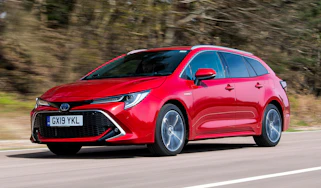
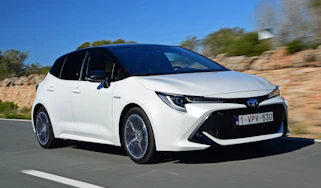
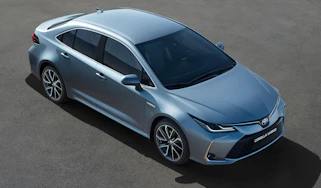
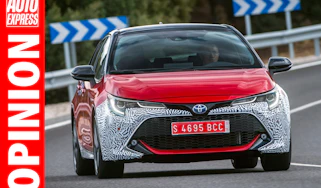
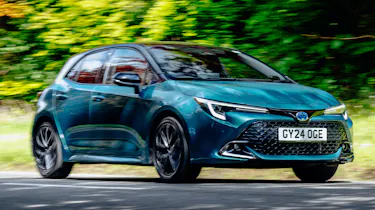
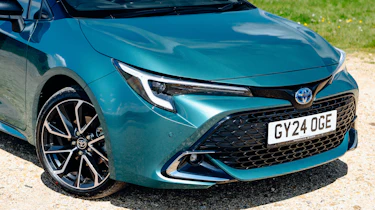
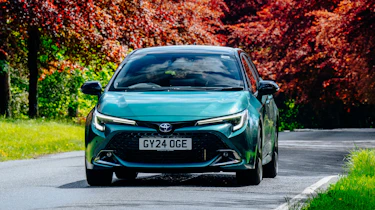
The latest Corolla still looks as handsome as ever after its mid-life facelift, but its design - especially at the front - sports the look of the first-generation C-HR, and not the current Toyota design seen on the second-generation Toyota C-HR, Toyota Prius, and Toyota bZ4X.
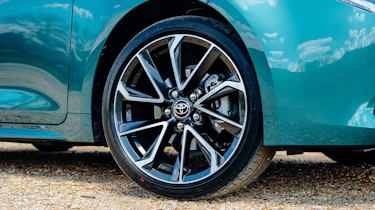
There are various alloy wheel designs across the range, ranging from 16- to 18-inches. Other styling choices include black, red and chrome trim packs. Solid ‘Pure White’ is standard, while a range of metallic and pearlescent paints are available for around £650 to £950. Top-spec Excel models get the option of a two-tone paint job for roughly £950 or £1,250.
Entry-level Icon trim is very well equipped, with 16-inch alloys, auto lights, front and rear parking sensors plus a reversing camera, heated front seats, adaptive cruise control, a 12.3-inch digital instrument cluster and a 10.5-inch touchscreen infotainment with wireless Apple CarPlay and Android Auto smartphone connectivity.
Our preferred trim level is the mid-range Design trim because it comes with:
- Rear privacy glass
- Auto-folding door mirrors
- Auto wipers
- An auto dimming rear view mirrors
- A Naneo air purifier
- Ambient interior lighting
- 17-inch alloy wheels
For those wondering, the GR Sport version isn’t the same as the full-fat GR Corolla sold in North America. The GR Sport carries some unique cosmetic enhancements inside and out, but no changes are made to the engine or suspension set-up. The most obvious changes are the model-specific 18-inch alloys and the standard front sport seats, which offer more lateral support.
The range-topping Excel trim is loaded with extra kit, such as an eight-speaker JBL sound system, a head-up display, laminated front side windows (on 2.0-litre models), adaptive LED headlights, a rear USB charging socket, and blindspot monitoring.
Interior and dashboard design
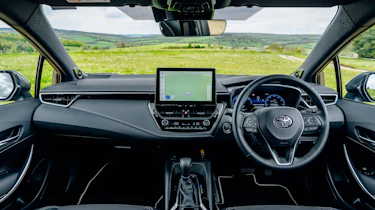
Inside, the Corolla boasts a modern design that’s clearly laid out. It’s not luxurious, but it certainly eclipses the harsher, plasticky-feeling interior of the current Volkswagen Golf. We also like that Toyota has stuck with physical buttons for the climate controls, and made some much needed improvements to the infotainment system with the addition of a revised 10.5-inch touchscreen and a fully digital dash.
Materials and build quality
As is often the case with Toyota’s cars, the Corolla generally feels very well made. Like we mentioned, the interior is mostly a case of form over function because it can’t match the premium feel of an Audi A3, BMW 1 Series, or Mercedes A-Class. But as a durable family car, we’re willing to bet that the Corolla will stand up to whatever your loved ones are willing to (or perhaps literally) throw at it.
Infotainment, sat-nav and stereo
Thanks to its mid-life facelift, the Corolla now features the infotainment system from the Toyota bZ4X running on a 10.5-inch central touchscreen. This is a step up from the eight-inch display that earlier versions came with. The newer setup is more responsive, offers better resolution, and the menus are much simpler to navigate.
Despite the significant steps forward, many people will still prefer to use Apple CarPlay or Android Auto, which work as well as you’d expect and come as standard on all models. You also get sat-nav, DAB radio, Bluetooth and voice activation, not to mention a configurable 12.3-inch digital dash.
The digital driver’s display is a big improvement over the previous part-digital instrument panel because you can set it up to show a variety of different information, including trip data, hybrid energy flow, along with navigation instructions. It’s controlled by buttons on the steering wheel similar to the Volkswagen Golf, although the set-up in the Corolla isn’t as easy to use when you’re on the move, taking more steps to configure what’s on display, which can be distracting while you’re driving.
“It’s all well thought out. Most of the buttons and details like the red stitching look and feel of a high quality (although I’m not convinced by the cheaper-looking plastic gearshift paddles).” - Darren Wilson, creative director.
Boot space & practicality
Pros |
|
Cons |
|
The Corolla hatchback isn’t the most practical family hatchback in its class, so those who need to transport children in child seats and bulky buggies might find that the more versatile Corolla Touring Sports estate is a better fit.
All round visibility is good, with the large glasshouse and relatively high-set driver’s seat making for a good view out. However, boot space in the hatchback isn’t quite as generous as you’ll find with the Corolla’s closest rivals, including the Honda Civic, Volkswagen Golf, Peugeot 308 and Vauxhall Astra. In our opinion the cubby spaces could be better thought out, too.
Dimensions and size
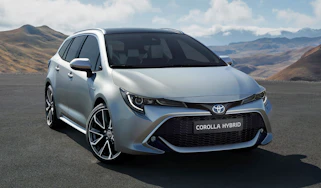
The Corolla hatchback is actually the same height and width as the Touring Sports estate, at 1,460mm and 1,790mm, respectively. There are, of course, variances in length, with the hatch measuring 4,380mm long and the estate 4,670mm. These figures are very similar to the Vauxhall Astra, which is 4,374mm long in hatchback form.
| Dimensions comparison | |||
| Model | Toyota Corolla | Honda Civic | Vauxhall Astra |
| Length | 4,380mm | 4,560mm | 4,374mm |
| Width | 1,790mm | 1,802mm | 1,860mm |
| Height | 1,460mm | 1,408mm | 1,441mm |
| Wheelbase | 2,640mm | 2,730mm | 2,680mm |
| Boot space | 313 to 1,052 litres | 409 to 1,220 litres | 352 to 1,339 litres |
Seats & passenger space
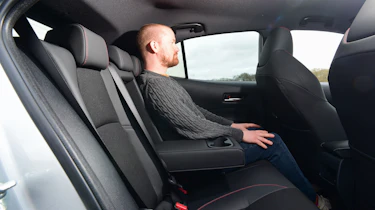
Compared to some newer rivals like the Honda Civic, Vauxhall Astra and Volkswagen Golf, rear cabin space in the Corolla is noticeably tighter and as a result, it doesn’t feel as spacious as it once did. The Corolla is also narrower across the cabin than the Civic, so it’s a little cramped for three.
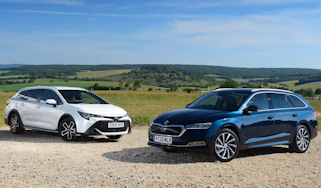
Those looking for the last word in rear passenger space in this class will be better served by the Skoda Octavia, but the Corolla is still okay in this department and easily a match for the Peugeot 308.
There is at least generous head, leg and elbow room up front. You also get Isofix mounting points on the outer rear seats and decent access to the rear seats in both the hatch and estate, which should make fitting a child seat less of a hassle.
Boot space
The hatchback has a 361-litre boot when fitted with the 1.8 litre petrol engine, but this shrinks to 313 litres in the 2.0 litre version thanks to the 12v battery being relocated to the boot area, taking up space. There’s also a big lip when you fold the rear seats down.
The Corolla hatch is easily bettered in terms of boot space by the Honda Civic’s 409 litre capacity (1,220 seat-down litres). The Skoda Octavia hatch is still one of the best in this class, though, with 590 litres or an almost van-like 1,580 litres with the back seats down.
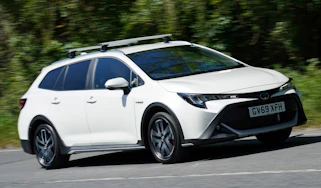
Perhaps unsurprisingly, those looking for the most space available in the Corolla range are best served by the estate. It stands at 581 litres for 2.0-litre models and 598 litres for the 1.8-litre. The load area is a nice square shape to make packing easier, and it boasts a low load lip.
“It’s good to find that the Toyota’s interior is simple enough to wipe down, with relatively few nooks and crannies.” - Darren Wilson, creative director.
Reliability & safety
Pros |
|
Cons |
|
The Toyota Corolla was voted as the 34th best car to own out of 50 in the most recent Driver Power owner satisfaction survey. Owners praised the reliability of their cars, but we were surprised that a number complained about running costs being higher than expected.
A five-star Euro NCAP rating was also awarded to the Corolla in 2019, however this has now expired due to the length of time that has passed. Regardless, there’s still a rather impressive list of on-board safety equipment as standard, including automatic headlights, adaptive cruise control, reversing camera, lane departure warning and Toyota’s lane trace system.
Buying, prices and deals
Best buy: Toyota Corolla 1.8 Design
The Toyota Corolla starts from around £31,000 in base Icon trim with the 1.8-litre powertrain. However, we’d move a step up to the Design trim as this brings in more kit without too much of an additional outlay at £32,500. This price applies to models fitted with the 1.8, and while the 2.0-litre brings a bit of extra power, we don’t think it’s worth nearly another £2,000 for the pleasure. The smaller powertrain offers ample performance and efficiency for a sensible family hatchback such as this.
You can save on the list price by building your perfect Toyota Corolla via the Auto Express Buy A Car service. You can also choose from a variety of new Toyota Corolla deals, as well as a large selection of used Toyota Corollas. We can also help you to sell your car.
Toyota Corolla alternatives
While the Corolla is still a fine choice thanks to its efficient hybrid system, we still think the Skoda Octavia is a top choice for families. It’s far more practical, and while our preferred 1.5-litre petrol choice isn’t quite as economical, its lower starting price helps to balance out the running costs.
If you still want a hybrid you don’t need to plug in, the Honda Civic packs in a little more versatility and a sharper drive.
Company car drivers will be better off considering a fully electric hatchback like the Cupra Born, Renault Megane E-Tech or Volkswagen ID.3. The Peugeot 308 and Vauxhall Astra also have their own EV counterparts; the Peugeot E-308 and Vauxhall Astra Electric.
Toyota Corolla pictures
Key updates of the Toyota Corolla review
- 25 September 2026: Impressions from long-term testing and Driver Power data.
- 10 March 2026: Latest driving impressions
Frequently Asked Questions
The Toyota Corolla comes with a fairly standard three-year warranty as standard, but with Toyota’s 'Relax' programme, the car’s manufacturer warranty can be extended up to 10 years simply by having an annual service at a Toyota dealer.
Deals on the Corolla and alternatives