Volkswagen ID.7 review
The Volkswagen ID.7 is the brand’s best EV to date, offering plenty of range and tonnes of practicality

Our opinion on the Volkswagen ID.7
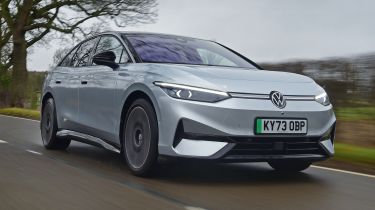
The Volkswagen ID.7 needs to be good to challenge the best EVs around, and thankfully, the German brand has implemented many of the lessons it learned from its earlier cars to make this the best EV in its line-up.
In terms of its cabin, technology and general driving experience, the ID.7 easily justifies its price tag. This VW has every right to be considered in the same sentence as cars like the Tesla Model 3 and considerably pricier rivals.
About the Volkswagen ID.7
As already mentioned, the ID.7 isn’t the only Volkswagen EV, and even if the reaction to the company’s early efforts was a little lukewarm, you could hardly accuse VW of resting on its laurels. Following limp launches for the VW ID.3, VW ID.4 and VW ID.5, the bold-looking VW ID. Buzz won us over with its charming personality and practical interior.
We've driven various versions of the VW ID.7 since its launch, including the high-performance VW ID.7 GTX. The ID.7 also took part in our company car mega test along with other long-range EVs. We've also tested the charging speed of the larger battery Pro S version for our charging speed group test.
Volkswagen ID.7 pricing and latest deals
The ID.7 starts at around £51,500. Those looking to go further on a charge will need to stump up around £55,000 for the larger battery pack in the Pro S variant, while the four-wheel-drive GTX comes in at just over £59,500.
Used - available now


If you’re making the move to an electric car like the Volkswagen ID.7, there are plenty of great deals to be found via our Buy a Car service. You can configure your ideal Volkswagen ID.7 and receive top offers from our huge network of dealers, browse the very latest ID.7 leasing deals or take a look at the best used ID.7 models. If you already have a car and need to sell it, be sure to visit our Sell My Car page.
Performance & driving experience
| Pros |
|
| Cons |
|
In short, the Volkswagen ID.7 can’t match the ultimate agility of a BMW i4 or Model 3 point-to-point, tending to lean over more in bends and feeling lazier to respond to quick changes of direction. It also isn’t as quick as its Model 3 rival in standard form, although anyone coming to the ID.7 from a traditional petrol or diesel car is unlikely to be disappointed. Refinement and ride comfort are ID.7 strong points, which go hand in hand with it being a long-distance EV.
Electric motors, 0-60mph acceleration and top speed
Don’t get us wrong, a 0-62mph time of 6.5 seconds (6.6 seconds for the heavier Pro S version) isn’t anything to be sniffed at for the 282bhp entry-level ID.7. But you’ll need the costliest GTX version with its 335bhp dual-motor set-up and 5.4 second 0-62mph sprint in order to beat the acceleration times of even the entry-level Tesla Model 3 RWD or single-motor Polestar 2.
While that’s more than swift enough in the real world, it isn’t going to eclipse the sub-3.0-second 0-62mph time of the Tesla Model 3 Performance. All versions of the ID.7 have a top speed of 112mph, which is more than enough in the UK, and would only be important in countries with an unlimited top speed on their motorways.
| Model | Power | 0-60mph | Top speed |
| ID.7 Pro Match | 282 bhp | 6.5 seconds | 112 mph |
| ID.7 Pro S Match | 282 bhp | 6.6 seconds | 112 mph |
| ID.7 4Motion GTX | 335bhp | 5.4 seconds | 112 mph |
Town driving, visibility and parking
All the ID. 7's controls are smooth, although we would like there to be more adjustment in the regenerative braking system. It works automatically by increasing the regenerative braking as you approach junctions, using information from either the navigation system or from the camera and radar systems that spot slower-moving traffic ahead of you. Alternatively, it can be on all the time if you’ve engaged the ‘B’ mode on the gear selector. The latter isn’t quite strong enough to offer the one-pedal driving mode of cars like the Model 3 or the e-Pedal system used in the Nissan Ariya, though.
Other than that, the ride is commendably supple at low speeds, especially when you have the optional adaptive suspension that’s available in conjunction with the Exterior Pack Plus. This allows you to soften the suspension to deal with the harshest shocks from potholes and speed bumps.
The nearly five-meter-long ID.7 isn’t the easiest car to slot into a parking space, but the 360-degree camera system and parking sensors front and rear give you some assistance.
Country road driving and handling
Even in the pouring rain and in single-motor guise, the ID.7 provides all the traction you need. For those after something even more capable in slippery conditions, a dual-motor GTX model with the added traction of four-wheel drive is also available. This version doesn’t feel any sportier than the standard ID.7, but you can sense the front motor kick in to drag you out of trouble should the back of the car start to slip a little in a tight bend.
There’s no getting around the fact that the ID.7 is a very heavy car that’s clearly set up for comfort rather than driving thrills, even if you have adaptive suspension and use its firmest setting. We’d also like a little more bite to the brake pedal, because it feels a bit soft and doesn’t give you the same confidence when driving quickly as you get from the BMW i4 or Tesla Model 3.
Motorway driving and long-distance comfort
All versions come with adaptive cruise control with lane assist to offer a semi-autonomous driving experience. When switched on, it helps with steering and braking, taking some of the strain out of long drives by helping to keep you centred in your lane, and it avoids the sensation of being bounced between the markings.
Laminated side windows (the optional Exterior Pack Plus adds laminated side glass for the rear passenger doors) make this an impressively refined motorway cruiser that isolates you from the outside world well.
We found that the optional adaptive suspension provides excellent damping at higher speeds. Even when paired with the largest 20-inch wheels and the suspension in its firmest setting, the ID.7 still manages to deal with bigger bumps well and feels resolutely tied down at all times. It can be a touch fidgety over rougher road surfaces, so we’d select one of its softer settings so that the fidget disappears. However you set it up, the ID.7 feels positively serene, floating over uneven surfaces that rivals, like the Hyundai Ioniq 6 and Polestar 2, would jiggle over.
Range, charging & running costs
| Pros |
|
| Cons |
|
Electric range, battery life and charge time
The entry-level ID.7 Pro can cover up to 379 miles on the WLTP combined cycle, while the larger 86kWh battery pack in the Pro S increases the range up to 433 miles. The added performance and heavier four-wheel drive set-up of the ID.7 GTX comes at the cost of some battery range, with up to 364 miles of range.
During a group test, we found the VW ID.7 Pro was the third most efficient car, but the 3.4mi/kWh we measured still only equates to an overall real-world range of 262 miles with the 77kWh battery pack. We got a slightly better 3.6mi/kWh from our long term ID.7 Pro S Tourer over the course of 5,000 miles, which equates to 310 miles from its 86kWh battery. Neither of these test cars had the then optional heat pump (now standard), which helps to improve the car's efficiency in cold weather.
Rapid charging is possible at up to 175kW for the 77kWh Pro model – matching the base Tesla Model 3. The 86kWh Pro S ups the charging speed to 200kW, but that falls short of the Tesla Model 3 Long Range, which is capable of 250kW top-ups.
We tested an ID.7 Tourer Pro S during our electric car charging speed test and discovered it'll maintain its advertised 200kW peak charging speed until the battery gets to 50 per cent state of charge. That enabled a short 21-minute 20 to 80 per cent top up charge, and could also handle 80 to 100 per cent fill up in a further 16 minutes. That was a quarter of the time it took a pre-facelift Tesla Model Y and a Peugeot E-3008 to achieve the same feat.
It is possible to precondition the battery ahead of visiting a rapid charger, either through route planning in the sat-nav system or manually in the battery sub-menu. This makes sure the battery can accept a higher rate of charge after plugging in, rather than having to wait for it to ramp up after you’ve plugged it into a rapid charger, saving you significant time if you have to make multiple charging stops during a journey.
Those who have access to a 7.4kW wallbox charger at home should be able to refill a flat battery (a worst-case scenario) in a little over 12 hours with the Pro version, and just under 14 hours with the Pro S and GTX models.
| Model | Battery size | Range | Insurance group |
| Pro Match | 77kWh | 379 miles | 39E |
| Pro S Match | 86kWh | 433 miles | 39E |
| 4Motion GTX | 86kWh | 364 miles | 41E |
Insurance groups
Insurance group ratings for the ID.7 start in group 38 for the Pro and group 39 for the Pro S – both in Match Plus trim. That’s a little higher than the Tesla Model 3 RWD, which starts in group 36, but the ID.7 should at least be more affordable to insure than the BYD Seal, which starts in group 48.
The high-performance ID.7 GTX will be the most expensive model in the range to insure because it starts in group 41.
Tax
Electric cars like the ID.7 offer company car drivers lower Benefit-in-Kind (BiK) tax rates compared to traditional petrol, diesel, or even hybrid-powered cars because of zero-tailpipe emissions. It’s presently at four per cent for the ‘26 to ’27 tax year, but will go up to five per cent from ‘27 to ‘28, and seven per cent from ‘28 to ‘29.
However, electric cars are liable for VED road tax, and you’ll need to pay an additional surcharge from the second time the vehicle is taxed until it is six years old because the ID.7’s starting price is above the revised £50,000 luxury car tax bracket. If you want to avoid this particular charge, you’ll want to look towards the BYD Seal, Hyundai Ioniq 6, Polestar 2, and Tesla Model 3.
Depreciation
According to our expert data, the ID.7 is likely to retain 41 per cent of its original value over three years or 36,000 miles in both hatchback and Tourer forms
That's similar to rivals like the Hyundai Ioniq 6 and Polestar 2, but the BYD Seal retains around 47 per cent of its original value, while the Tesla Model 3 is expected to still be worth between 41 and 48 per cent of its original value over the same period.
To get an accurate valuation for a specific model, check out our free car valuation tool...
Interior, design & technology
Pros |
|
Cons |
|
The Volkswagen ID.7 offers a more practical hatchback bodystyle than its rivals, and it has an impressively low drag coefficient of 0.25, which is handy for extending its electric range compared with bulkier electric SUVs.
You have a choice of six colours with the ID.7, and four of those – Stonewashed Blue, Scale Silver, Glacier White and Aquamarine Blue – can be specified with a contrasting black roof. None of them is quite as bright as the colours available on the BMW i4 or Tesla Model 3, but at least you won’t be hit with a hefty bill (between £1,300 - £2,000 in the case of the Model 3) if you want metallic paint on your ID.7.
Every ID.7 comes in well-equipped. Our preferred Match Plus trim includes:
- Adaptive LED lights
- 19-inch wheels
- Three-zone climate control
- A 15-inch Discover Pro infotainment system with wireless Apple CarPlay and Android Auto
- An augmented-reality head-up display
The four-wheel drive GTX Plus models feature unique 20-inch alloy wheels, an upgraded Harman Kardon sound system, ventilated front seats, adaptive suspension, and sportier exterior styling.
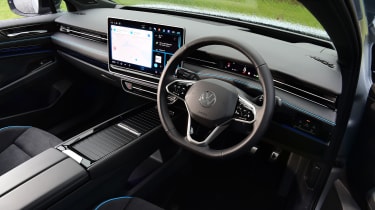
Interior and dashboard design
While it looks smart inside the ID.7, don’t expect any bright colour choices. If you want something beyond black, grey and silver, you’ll have to make use of the 30-colour ambient interior lighting system.
The main controls are a little confusing at first – the wipers are embedded on a stalk to the left of the steering wheel, rather than the right, for example – but at least they’re not buried within the touchscreen, and you still get indicators on a stalk, unlike on the Tesla.
VW has followed Tesla's example of making you adjust where the airflow goes within the screen instead of providing simple manual controls. In our view, it makes what was once an easy adjustment needlessly complicated.
Materials and build quality
Volkswagen’s early ID cars came under heavy criticism for their lacklustre interior quality, plus fundamental failings in their technology and infotainment. With the ID.7, the maker is looking to right those wrongs.
Indeed, from the driver’s seat, all appears well. The general cabin ambience has been lifted to a level that easily competes with cars in this class; there are soft-touch materials on the doors and dash, and the seats offer plenty of support.
Infotainment, sat-nav and stereo
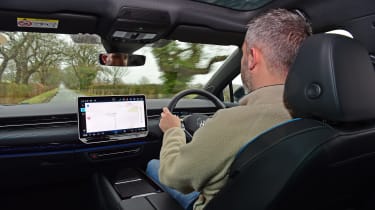
The Volkswagen ID.7’s 15-inch central display instantly feels more responsive than in the maker’s previous offerings. The menu layout still has some controls buried deep within sub-menus, but at least the large screen allows some frequently used functions to be on permanent display, such as the climate controls at the bottom of the screen.
The touch-sensitive adjustment sliders for the climate temperature and audio volume settings remain below the screen, but at least they’re backlit and allow you to find them in the dark. We still prefer the physical climate controls of the Hyundai Ioniq 6, and the BMW i4’s iDrive clickwheel, because both are much easier to use while on the move.
Wireless smartphone connectivity and a wireless phone charging pad are standard. All ID.7s come with a nine-speaker audio system with DAB radio, but you’ll need to pay for the pricey £2,000 Interior Pack to get the upgraded 12-speaker, 700-watt Harman Kardon sound system.
Boot space & practicality
Pros |
|
Cons |
|
The Volkswagen ID.7’s large hatchback body gives it a practical advantage over its rivals that have stuck with the traditional saloon format.
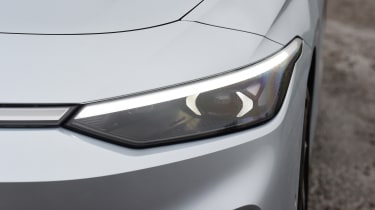
All ID.7 models come with LED-matrix headlights that provide excellent visibility at night while also adjusting the beam pattern to avoid dazzling oncoming traffic.
Dimensions and size
The ID.7 is 241mm longer than the Model 3, and 161mm longer than a Seal, so factor that into your calculations about where you’ll park it. The ID.7 isn’t as wide as the Seal, but it is taller than both of its rivals.
Go for the ID.7 Tourer, and both the length and width remain the same as the hatchback, but the height goes up by 15mm to 1,551mm.
| Dimensions comparison | |||
| Model | Volkswagen ID.7 | BMW i4 | Tesla Model 3 |
| Length | 4,961mm | 4,783mm | 4,720mm |
| Width | 1,862mm (2,141mm inc mirrors) | 1,852mm (2,073mm inc mirrors) | 1,933mm (2,089mm inc mirrors) |
| Height | 1,536mm (1,535mm GTX) | 1,440mm | 1,448mm |
| Wheelbase | 2,971mm | 2,856mm | 2,875mm |
| Boot space | 532-1,948 litres | 470-1,290 litres | 594-977 litres |
Seats & passenger space
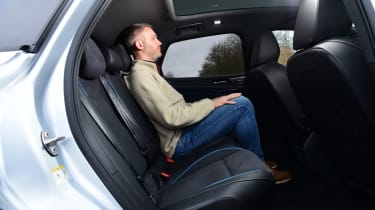
Adults who are six feet tall will have no trouble getting comfortable in the front of the ID.7 thanks to plenty of head, leg, and shoulder room to stretch out in. All versions come with electrically adjustable front seats with memory settings on the driver’s side, and there’s electric lumbar support for additional comfort.
There’s a storage space under the centre armrest, and you'll find a pair of well-sized cup-holders ahead of it under a roller cover. The front door bins are generously proportioned and flocked to prevent items from rattling as you drive.
The vast wheelbase of the ID.7 is really noticeable in the back, where kneeroom is limo-like, and (according to our tape measure) headroom is far more generous than in the likes of the BMW i4 or Tesla Model 3.
Families with young children who need child seats will be pleased to find Isofix child seat mounting points conveniently hidden behind some easily removable plastic covers on the outer positions of the rear seats. There are also Isofix mounts on the front passenger seat to provide some flexibility in where you can put child seats.
Boot space
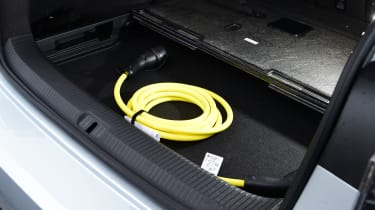
The Volkswagen ID.7 has a huge 532-litre boot that dwarfs the Model 3’s 425-litre luggage area. Folding the rear seats down in the ID.7 increases capacity up to 1,586 litres, with the 60:40-split bench lying almost flat. All models feature a variable-height boot floor, which eliminates an annoying load lip and provides space beneath the floor for storing charging cables or, if necessary, the tonneau cover.
Despite the saloon shape being less practical than a traditional estate, the ID.7 still has a roof-hinged hatch, which works wonders for accessibility when loading bigger items. The boot opening in the ID.7 is significantly larger than the narrow, letterbox-like opening found in both the BYD Seal and Tesla Model 3.
Of course, there’s also the Volkswagen ID.7 Tourer estate, which you can read about via the link provided.
“While the Pro S and GTX can be ordered with a tow bar (for around £1,000), neither can tow all that much, only managing a braked caravan or trailer up to 1,200kg in GTX form. In our view, you’d be better off with a VW Passat that manages up to 1,800kg.” – Max Adams, online reviews editor.
Reliability & safety
Pros |
|
Cons |
|
The Volkswagen ID.7 is yet to appear in our Driver Power owner satisfaction survey. However, the Volkswagen brand has its work cut out because it finished in a disappointing 27th position out of 31 in our 2025 survey. That puts it ahead of BYD (30th) and MG (31st), but behind Hyundai (20th), Tesla (11th) and BMW (8th).
At least the ID.7 should be a very safe place to put you and your loved ones if you do end up in a collision. It received the maximum five-star rating from safety experts Euro NCAP in 2023, with higher scores in all areas than the BYD Seal.
As you’d expect with such a high score, the ID.7 comes loaded with safety features and assistance technology. There’s autonomous emergency braking (AEB) to help mitigate or prevent low-speed collisions with other vehicles, cyclists and pedestrians. You also get adaptive cruise control to keep you a safe distance from the vehicle in front, as well as lane-keeping assist to help maintain your position within the lane.
Blind-spot monitoring alerts you to vehicles approaching alongside you when you change lanes. It also works while you're parked at the side of the road to prevent you from opening a car door and stepping out into the path of a vehicle approaching you. The ID.7 comes with a rear cross-traffic alert system to let you know of vehicles crossing your path as you go to reverse onto a busy main road.
| Euro NCAP safety ratings | |
| Euro NCAP safety rating | 5 stars (2023) |
| Adult occupant protection | 95% |
| Child occupant protection | 88% |
| Vulnerable road user protection | 83% |
| Safety assist | 80% |
Buying and owning
- Best buy: Volkswagen ID.7 Pro 77kWh Match Plus
While a larger 86kWh battery is available, the 77kWh unit still offers considerable range that should be more than enough to cater for people’s needs. The entry-level Match Plus trim is loaded with equipment as standard, which is just as well given the price.
Volkswagen ID.7 alternatives
The most obvious competitor to the Volkswagen ID.7 is the Tesla Model 3, which has the edge on range, efficiency, and ease of charging. But the ID.7 is far more practical, though. You might also like the BMW i4, which is a lot sharper to drive.
Other EVs with a long driving range include the well-equipped BYD Seal, the interestingly styled and fast-charging Hyundai Ioniq 6, the just plain fast MG IM5, and the classy Polestar 2.
Key updates of the Volkswagen ID.7 review
23 February 2026: General update with the latest depreciation figures and a link story regarding the proposed pay-per-mile eVED charge for EVs from April 2028.
18 November 2025: updated to include how the VW ID.7 performed in our electric car charging test.
3 February 2025: review updated to reflect how the ID.7 compares with its rivals after our electric company car megatest.
Frequently Asked Questions
Like the rest of the ID line-up, the ID.7 only requires servicing every two years, with no specified mileage limits. A service plan can be set up at the time of purchase for a lump sum of £249.
Latest deals on the ID.7 and rivals
More reviews
In-depth reviews
Long-term tests
Road tests
Which Is Best