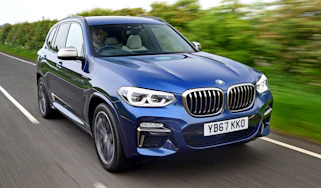
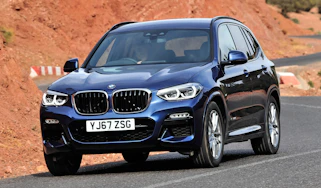
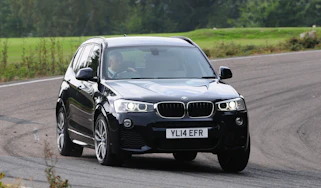
BMW X3 review
The latest BMW X3 is a firm Auto Express favourite in the premium compact SUV class

Our opinion on the BMW X3
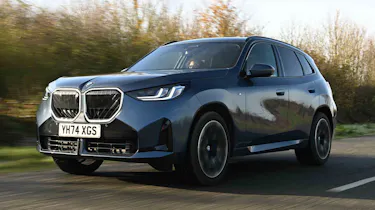
The BMW X3 has been around for more than 20 years now, and the constant refinement of the formula to arrive at the fourth-generation model (codenamed G45) is evident in a lot of the current version’s strengths. In a segment where some cars feel heavy and lumbering, and others feel firm or brittle over bumps, the X3 manages to strike a really impressive balance between the two, and it’s backed up by a series of strong petrol, diesel and plug-in hybrid powertrain options.
About the BMW X3
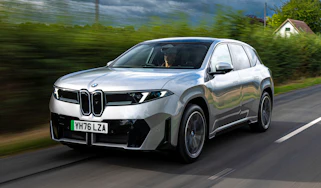
The fourth-generation BMW X3 arrived at the end of 2024, and with it came an evolution in shape, size and powertrains. The latest model is exclusively combustion engined, because the BMW iX3 now uses a completely different platform.
The X3’s five-door SUV body is larger than its predecessor’s, while power comes from a range of engines that’s carried over from before, but with enhanced performance and efficiency. The line-up kicks off with the petrol xDrive20, while the xDrive20d is the sole diesel option. The xDrive30e uses the same petrol engine as the xDrive20, but adds plug-in hybrid tech, and the xDrive M50 is the performance flagship. All cars are four-wheel drive and feature an automatic gearbox as standard, while all cars bar the M50 are available in xLine or M Sport trims and with assorted packs that upgrade the X3’s tech and luxuries.
Used - available now


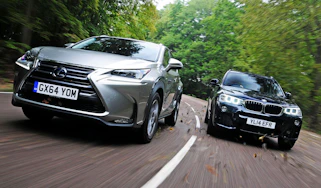
We’ve put the petrol version of the latest X3 head-to-head against the Lexus NX, and we’ve also tested the diesel X3 along with the latest Audi Q5 in another twin test. Our editor-at-large, Phil McNamara, has run a BMW X3 30e xDrive M Sport as part of our long-term test fleet, and we tested a 30e xDrive M Sport as part of our plug-in hybrid megatest.
BMW X3 prices and latest deals
There’s a range of powertrains and trim levels to choose from with the BMW X3, with prices starting from just over £53,500 for the entry-level X3 20 xDrive xLine. At the top end of the scale sits the performance-focused X3 M50 xDrive, which costs just under £74,000.
Whichever spec you desire, there are plenty of savings to be had when you build your perfect BMW X3 via the Auto Express Buy a Car service. We also have a selection of X3 leasing deals to choose from, along with used X3 models in stock.
Engines, performance & drive
Pros |
|
Cons |
|
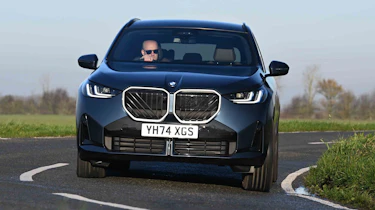
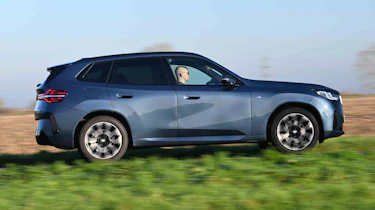
As a ride and handling compromise, the X3 is very well judged. The Alfa Romeo Stelvio is still a better option for the keen driver, but the BMW isn’t far off in bends, while offering more comfort. One drawback is that the light steering can feel a little unnatural on a twisty road.
| Model | Power | 0-62mph | Top speed |
| X3 20 xDrive | 204bhp | 7.8 seconds | 134mph |
| X3 20d xDrive | 194bhp | 7.7 seconds | 134mph |
| X3 30e xDrive | 295bhp | 6.2 seconds | 134mph |
| X3 M50 | 393bhp | 4.6 seconds | 155mph |
Performance, 0-60mph acceleration and top speed
The previous BMW X3 was the first to be offered with plug-in hybrid tech, and the latest 30e moves the game on thanks to a much beefier electrical portion of the powertrain. In contrast to the old model, which could muster at best 107bhp from its electric motor, the 30e xDrive PHEV produces 181bhp. Combined with a 2.0-litre turbocharged petrol engine, there’s a very healthy 295bhp on offer. Usable battery capacity has grown from 12kWh to 19.7kWh, which gives the potential for 56 miles of electric-only driving.
Until the new X3 M arrives, the most potent option in the UK is the M50 xDrive. The 3.0-litre petrol twin-turbo model gets mild-hybrid tech and produces 393bhp. However, the engines that will make the most sense to most buyers are the mild-hybrid 20 petrol (now shorn of its ‘i’ suffix to avoid confusion with BMW’s electric models) and the diesel-powered 20d.
We’ve complimented the petrol X3 on the smoothness of its mild-hybrid set-up in the past, but the diesel’s system isn’t quite as slick. While the petrol version gets a 17bhp motor, the 20d’s 48-volt set-up has 11bhp. That means it’s not quite able to move the X3 away from the line as effortlessly or as smoothly as the petrol unit can before the internal-combustion engine needs to cut in. It’s still smoother than the 48-volt mild hybrid set-up in the Audi Q5, just not as seamless as in the X3 petrol.
Once on the move, the diesel is an excellent engine. It’s smooth and quiet enough that the average driver would be hard pressed to notice it’s a diesel at all, but for the fact that its peak torque of 400Nm makes it very flexible throughout the rev range.
That means the X3’s eight-speed automatic gearbox isn’t desperate to kick down into a lower gear all the time; instead, it’ll try to hold the higher ratio unless you demand a little more urgency. It’s a much more pleasant experience. In manual mode, the gearbox isn’t quite as responsive as the Audi Q5’s unit, but it’s smoother when it’s left to its own devices in auto mode.
Town driving, visibility and parking
Straight away, the X3’s steering showed us how light and responsive it feels on the move. The lack of inertia means that nipping into junctions and twirling the wheel around at parking speeds feels fairly effortless.
M Sport trim brings a slight firmness to the X3’s ride, but there’s still a supple edge overall. It’s more than capable of shrugging off smaller bumps and taking the edge off the potholes that blight British streets, but you can also chose the adaptive suspension option for a more comfortable ride on rough roads.
Country road driving and handling
Despite the tall body and a kerbweight that’s nearly two tonnes (not an unusual figure beside its rivals), the X3 feels tied down in corners. It doesn’t wallow around on its springs, instead remaining impressively level and controlling its mass well. Push those tyres until they begin to lose their grip, and the BMW’s balance stays neutral.
Yet the light steering means that it doesn’t feel like a truly engaging car to drive as BMWs were in the past – even the previous X3 was better in this area. Not only is the steering light, but it’s also short on feedback, a fact not helped by the thick-rimmed and slightly squidgy steering wheels that BMW insists on using.
The BMW X3 M50 comes with uprated brakes (as you’d hope given the significant increase in engine output) with big, four-piston calipers over similarly impressive discs. While fitting huge brakes to a fairly sensible family car can often result in some grabby characteristics from the pedal, their power is complemented by a confidence-inspiring pedal feel.
Motorway driving and long-distance comfort
Cruising refinement is one of the X3’s biggest strengths. Road noise is well isolated from the cabin, and there’s only the slightest bit of wind rustle around the edge of the windscreen. Stability is excellent, and despite that light steering, it doesn’t feel too nervous or darty at high speed.
Our long-term X3 30e xDrive M Sport test car also held up well against the nation’s rougher tarmac when we took it on a long-distance road trip to the coast. Our editor-at-large, Phil McNamara, still felt comfortable after covering hundreds of miles, even though this model’s suspension is set up to feel more taut than the standard model’s.
MPG & running costs
Pros |
|
Cons |
|
During our time with the BMW X3 20 petrol, we achieved just over 35mpg, although we found that the official WLTP figure of 40.4mpg would be feasible on a motorway run.
In comparison, the diesel proved to be really frugal. Cruising at 70mph on a motorway, the BMW didn’t have much trouble achieving mid-fifties mpg, which is a fantastic effort for a car in this class. Over a mix of urban roads and more open sections, and more enthusiastic driving, the xDrive20d averaged 46.8mpg, which is better than what we achieved in the petrol-hybrid Lexus NX 350h.
While the plug-in hybrid 30e xDrive has the potential to be even more frugal – and is also a little quicker – it costs £5,600 more. That means owners would need to cover significant distances before they recovered the additional initial outlay. Unless you’re selecting a vehicle through a company-car scheme, in which case the plug-in hybrid will become much better value, we’d stick with the diesel.
Our 30e XDrive long-termer averaged 59.3mpg over a total of 5,136 miles, and half of those were done using electric power. On an empty battery, we saw a fuel economy figure of 41mpg, which was significantly higher than the 35.2mpg we got from a Mercedes GLC 300e.
| Model | MPG | CO2 | Insurance group |
| BMW X3 20 xDrive | 40.9mpg | 156g/km | 32 |
| BMW X3 20d xDrive | 48.7mpg | 153g/km | 33 |
| BMW X3 30e xDrive | 282.5mpg | 22g/km | 38 |
| BMW X3 M50 | 36.7mpg | 175g/km | 42 |
Electric range, battery life and charge time
Major revisions were made to improve the latest BMW X3 plug-in hybrid compared to the previous model. Badged 30e xDrive, the PHEV version now features a 22.3kWh battery – 10kWh more than you got in the previous generation car. The extra capacity means the all-electric range is up to 56 miles (up from 29 miles previously). However, that’s behind the latest Audi Q5 e-Hybrid, which has a higher-capacity 25.9 kWh battery and a longer 62-mile range.
It's not all bad news because the efficiency of the 30e means we almost matched its claimed range figure in real-world driving, which involved a mix of urban, B road, and motorway driving. In the end, we achieved 53.5 miles on electric alone, which is only 2.5 miles shy of its official figure.
Charging times aren’t rapid, with a maximum recharge rate of 11kWh from the on-board cable – in contrast, the Audi Q5 can accept a 150kW DC charge. You can expect a 20 to 80 per cent top-up to take around two hours and 15 minutes. In addition to BMW’s three-year, unlimited mileage warranty, the PHEV’s battery is under warranty for up to eight years or 100,000 miles.
| Model | Battery size | Range | Insurance group |
| BMW X3 30e xDrive | 22.3kWh | 56 miles | 38 |
Insurance groups
Depending on trim, insurance groups for the X3 range from 32 to 42 (out of 50). The diesel sits one group higher than the petrol, while the PHEV starts in group 38 for xLine trim, but switching from xLine to M Sport spec doesn’t increase the X3’s group rating.
In comparison, the Audi Q5 resides between groups 33 and 45 while the Volvo XC60 sits in groups 34 to 41. So there’s not that much difference between these rivals.
Tax
Vehicle Excise Duty will be hefty regardless of which model you go for, with all X3 variants costing more than £40,000. This is the combustion-powered luxury car tax threshold, and crossing it incurs an additional £440 on top of your annual VED road tax bill. This levy applies between the second and sixth years after the car is registered for the first time.
The PHEV model makes the most sense for company car drivers due to its lower emissions, but it still cannot come close to the fully electric BMW iX3 for outright tax savings, because it’s in a much lower Benefit-in-Kind (BiK) tax band.
Depreciation
Our market data shows that the resale value of the BMW X3 stands up well to the tests of time, because it should retain between 49 and 56 per cent of its initial value after three years or 36,000 miles. The Audi Q5 almost holds up just as well at 47 to 54 per cent, but the Volvo XC60 trails behind both at only 44 to 48 per cent.
To get an accurate valuation for a specific model, check out our free car valuation tool...
Interior, design & technology
Pros |
|
Cons |
|
Recent BMWs have delivered pretty much flawless build quality, but standards seem to have slipped slightly in the X3. It’s a shame, because one or two iffy finishes aside, the cabin looks far more modern and feels more special than almost anything else in the class.
Standard equipment is fairly strong throughout the range, with the xLine getting an automatic tailgate, keyless entry, LED headlights, wireless smartphone charging, cruise control, plus front and rear parking sensors.
We prefer the cosmetic upgrades of M Sport trim, which includes:
- 19-inch alloy wheels
- A sportier M Sport steering wheel
- Shadowline black exterior trim
- M Veganza and Alcantara upholstery
- Aluminium trim
- M sport suspension
The range-topping M50 is the only way to get the 393bhp 3.0-litre engine, but it also gets some unique 20-inch wheels, a set of quad exhaust pipes, and the iconic glow exterior package. The latter amounts to an illuminated grille.
Interior and dashboard design
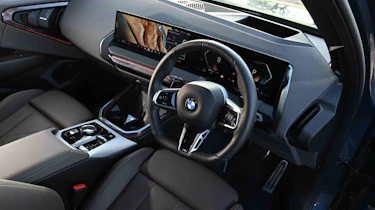
There’s a distinct concept-car feel to the X3’s cabin. The open, gently curving dashboard falls away from the base of the windscreen into the cabin, while a pair of digital displays are angled towards the driver, giving the X3 the feeling of those driver-centric cockpits of BMWs past. Glowing strips highlight sections of the doors, dashboard and around the centre console, while the optional fabric-trimmed dash, which has an almost chainmail-like finish, manages to look both unique and feel expensive at the same time.
Although the latest X3 has lost its predecessor’s physical climate controls, there’s still a large panel of buttons around the iDrive clickwheel, which makes it easy to find specific functions when on the move.
Materials and build quality
For the most part, the X3’s cabin feels solid and well screwed together, which makes the one or two glaring exceptions that are found inside even more jarring.
The door release is surrounded by plastic housing the air-vent controls and door locks, and on every X3 we’ve sampled, it feels only loosely attached to the door. The door releases, while neatly integrated within a curved section of ambient lighting, are finished in a fairly hard, cheap-feeling plastic, too.
Infotainment, sat-nav and stereo
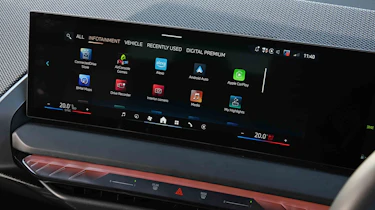
BMW’s latest OS 9 has integrated some features, such as the climate controls, into its software, but we’d have preferred it to just retain physical buttons for this. Yet the system remains among the best on the market.
Excellent graphics, the responsiveness of the screen to touches, the superb loading times, and the general layout of the menus make it very hard to fault. Some BMWs have lost their iDrive clickwheel, but the X3 still has this handy feature – and that’s a good thing.
“The figure-hugging M sports seats are plumper than November turkeys but a lot more vegan. The £1,350 glass sunroof also lifts the dark cabin, which has a few characterful touches compared with our previous BMW 530e long-termer.” - Phil McNamara, editor-at-large.
Boot space & practicality
Pros |
|
Cons |
|
The BMW X3 is a competent all-rounder when it comes to space. There’s not really one area where it’s outstanding for the class, but as a family car it manages to tick all of the boxes.
Dimensions and size
The fourth-generation X3 is significantly longer than its main rivals, but has a shorter wheelbase than the Mercedes GLC, while boot space is a little behind its Mercedes rival, too.
| Dimensions comparison | |||
| Model | BMW X3 | Audi Q5 | Mercedes GLC |
| Length | 4,755mm | 4,717mm | 4,716mm |
| Width | 2,132mm | 2,155mm | 2,075mm |
| Height | 1,660mm | 1,662mm | 1,640mm |
| Wheelbase | 2,865mm | 2,828mm | 2,888mm |
| Boot space | 570-1,700 litres | 520-1,472 litres | 620-1,680 litres |
Seats & passenger space
The high driving position that’s common in all SUVs is helped here by the fact that the dashboard line is fairly low when compared with many of the X3’s rivals. The slim, widescreen displays sit low, too, so the view ahead is better than much of the competition. However, the thick base of the BMW’s A-pillars and large door mirrors can create little blind spots when you are trying to pull out of junctions.
An open area in the centre of the dashboard can house two smartphones ahead of a pair of cup-holders, plus there’s a large covered cubbyhole beneath the central armrest, while the door pockets are shaped to house a large drinks bottle as well. On the downside, the German machine’s glovebox is fairly small.
Against our tape measure, the X3 isn’t absolutely vast in the back – kneeroom is largely similar to that of a BMW 3 Series Touring. However, the SUV’s cabin is a little more open than that of its estate rangemate, with plenty of headroom and a forgiving, comfortable rear bench.
While there’s a hump in the middle of the floor, it’s lower than the equivalent in the Q5, but the seat rails are closer together under the front seats than those in the Audi, so foot space is a little narrower. Fitting a child seat is a doddle, thanks to the spacious rear seat area and Isofix mounting points that are very easy to reach behind hinged, plastic covers.
The optional Comfort Plus Pack adds what BMW calls the Travel and Comfort System, which includes mounting points for passengers’ smartphones on the backs of the front seats, plus additional USB-C ports. The same pack also adds rear sunblinds, adaptive LED headlights, heated rear seats and a Harman Kardon sound system.

Boot space
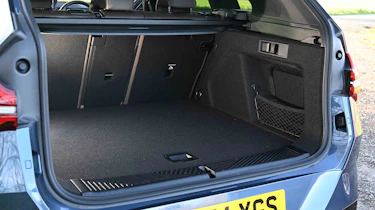
Although rivals such as the Mercedes GLC have an even larger boot than the X3, few people are going to grumble about the 570 litres the BMW offers. The low sill lip makes it fairly easy to load heavy items on board, and there’s netting to the side of the boot to hold smaller items in place. Folding the seats down creates a more level load area than in the Q5, and the 1,700-litre total volume is huge.
It’s worth pointing out that the battery pack for the plug-in hybrid 30e model reduces the overall boot capacity with the seats up by nearly 20 per cent, to 460 litres. With all the seats down, the volume increases to 1,600 litres, but that’s still significantly lower than the standard model. That’s unfortunately quite common among plug-in hybrid SUVs, because the Mercedes GLC loses nearly 25 per cent of its capacity, down from 620 litres in the regular version to just 470 litres.
Towing
As well as that roomy boot, it’s also possible to carry even more by adding a tow bar. An electrically retractable one, which can be extended at the touch of a button in the boot, is a £1,025 option.
When it comes to powertrains, the diesel is the one to have if you want to haul big weights. Officially, it can handle a braked trailer weighing up to 2.5 tonnes; that’s 100kg more than the petrol engine can manage, while the plug-in hybrid model has a lower towing limit of 2,000kg.
“The hybrid battery prevents any proper underfloor stowage, so carrying the charging cable will nibble into its modest 460-litre capacity.” - Phil McNamara, editor-at-large.
Reliability & safety
Pros |
|
Cons |
|
The BMW X3 was subjected to Euro NCAP’s testing in 2025, where it received a full five-star score. That's on par with the likes of the Audi Q5 and Tesla Model Y, both of which were also tested (a retest in the Tesla's case) in 2025. The Model Y did achieve higher scores across the board in the each category, though.
The X3's excellent outcome was partly due to the fact that this BMW comes with plenty of standard kit, including front-collision and lane-departure warning as standard. Adaptive cruise control with steering assist and blind-spot warning technology are available as options.
BMW’s customer satisfaction scores have taken a step up in recent years. The brand’s eighth-place ranking out of 31 in the most recent Driver Power best manufacturer results marked a notable improvement from 14th place the year before. That being said, Mercedes managed an excellent second-place finish.
| Euro NCAP safety ratings | |
| Euro NCAP safety rating | Five stars (2025) |
| Adult occupant protection | 88% |
| Child occupant protection | 84% |
| Vulnerable road user protection | 77% |
| Safety assist | 80% |
Buying and owning
Best buy: BMW X3 20d xDrive M Sport
The diesel is our engine of choice for private buyers, although the 30e plug-in hybrid is worth considering for company users with access to a home wallbox to keep the battery charged. M Sport trim has just enough extra design flair to make it our pick over xLine trim, although we would recommend selecting the optional adaptive suspension in order to be able to soften the ride for greater comfort.
BMW X3 alternatives
The BMW X3’s position in the compact premium SUV market puts it in line with its usual German rivals, the Audi Q5 and Mercedes GLC. Both cars are due to be replaced in the coming months, but they’ll have to be pretty special to have the better of the X3. Another alternative would be the all-electric Tesla Model Y, which is very quick and full of high-tech features. It's also highly practical with two boots, and it can be very cost-effective to run – especially if you can charge it from home.
Speaking of all-electric cars, the brand's own BMW iX3 costs a similar amount to the plug-in hybrid X3, but offers lower running costs for those who can charge at home, and reduced BiK costs for company car drivers. It also feels like a step on from the X3 in terms of its driving experience and how its infotainment works.
If you’d prefer a something you don't need to plug-in the Lexus NX is a good option that offers plenty of tech and premium kit, but isn’t as sporty to drive as the X3. The Volvo XC60 also isn't a sporty option, but it is a refined and practical option and it has been updated with a revised infotainment screen in order to keep it competitive.
BMW X3 pictures
Key updates of the BMW X3 review
16 April 2026: Updated to include impressions from our long-term testing.
Frequently Asked Questions
BMW recommends that the X3 be serviced every 24 months or 18,000 miles, whichever comes first. A three-year plan can be purchased, which costs just over £1,000 on the petrol models and closer to £1,500 for the diesel.