Omoda 7 review
The new Omoda 7 shares much with the Jaecoo 7, but is slightly cheaper with more space


Our opinion on the Omoda 7
With so much of its technology shared with the smash-hit Jaecoo 7, it would be easy to assume the Omoda 7 will be a success too. There are lots of positives; it’s slightly cheaper and more spacious than the Jaecoo, has the same PHEV system with tremendous EV range, and while Jaecoo might take a more premium approach, the Omoda doesn’t feel cheap in comparison. Clumsy driving dynamics and a fussy infotainment screen detract from the package, though.
About the Omoda 7
Alongside Jaecoo, Chery and the recently announced Lepas, Omoda is one of four sub-brands within the Chery Auto group that’s looking to take a share of the hybrid SUV market. However, it’s difficult to see how Omoda is going to stand out, not just from established manufacturers, but also from its own siblings.
The Omoda 7 itself is a sister car to the Jaecoo 7 and Chery Tiggo 7 - spotting a theme yet? The Omoda launched with the same plug-in hybrid ‘Super Hybrid System’ found in those other cars with a pure-petrol arriving shortly after - Omoda expects the PHEV to account for 75 per cent of total sales of its SUV.
The cheapest Omoda 7 is the pure-petrol at £29,965 in its sole Knight trim. The plug-in hybrid starts at £32,005 in the same spec, but you can also get it in Noble trim for £3,000 extra – making it only £165 less than the supposedly more premium Jaecoo 7 PHEV.
Performance & driving experience
Pros |
|
Cons |
|
Perhaps unsurprisingly, we found driving the Omoda 7 a very similar experience to driving the Jaecoo 7 and the Chery Tiggo 7. Like its sibling models, the Omoda 7 has clearly been set up to prioritise comfort, with the plug-in hybrid focusing on pure-electric power to boost refinement. There are plenty of faults with its driving dynamics, however.
Performance, 0-60mph acceleration and top speed
A kerbweight of 1,870kg is light for a plug-in hybrid SUV these days and the PHEV’s 201bhp isn’t anything to be sniffed at. It’s delivered by a 18.3kWh battery and 1.5-litre four-cylinder engine that’s been specially configured for the job. Go for the petrol model and the kerbweight reduces to 1,565kg (revealing how heavy the plug-in hybrid set up is), but the you only get a meagre 147bhp output.
Used - available now

2023 Ford
Puma
22,626 milesAutomaticPetrol1.0L
Cash £16,449
2022 Fiat
500
10,354 milesManualPetrol1.0L
Cash £10,299
2023 Kia
Sportage
17,223 milesAutomaticPetrol1.6L
Cash £24,299
2022 Mercedes
GLC
31,989 milesAutomaticDiesel2.0L
Cash £30,549This petrol engine is a turbocharged 1.6-litre four-cylinder and it feels sluggish on the move, especially in combination with the same dimwitted seven-speed gearbox found in other Chery Group cars.
The plug-in hybrid is far smoother and quicker. There’s enough initial shove from the electric motor’s torque on the front wheels for the Omoda 7 to feel sprightly at low speeds, though if you put your foot down for an extended period it will feel strained.
| Model | Power | 0-62mph | Top speed |
| Omoda 7 SHS-P | 201bhp | 8.4 seconds | 112mph |
| Omoda 7 petrol | 147bhp | 10.4 seconds | 118mph |
Town driving, visibility and parking
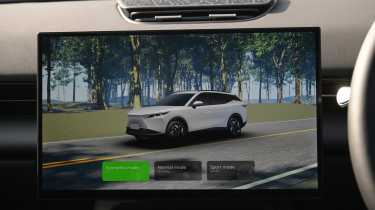
While it might be tempting to stick the Omoda 7 plug-in hybrid in its Sport driving mode, the jerkiness on the throttle becomes irritating at low speed and around town. That leaves Eco and Normal modes where the powertrain’s responses are just fine.
The steering is very light in all three drive modes, though in tight spaces the Omoda 7 feels bulkier than its 11.2-metre turning circle suggests - making three-point turns a bit of a chore. There's a certain nervousness to the feel you get through the large squared-off steering wheel.
The regenerative braking modes are never strong enough to provide one-pedal driving and most of the time there’s a disconcerting delay after lifting off the brakes and the regenerative system kicking in.
Country road driving and handling
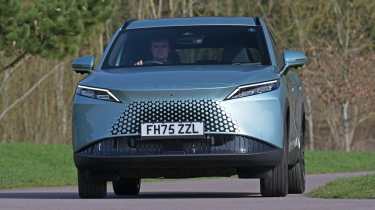
If you decide to drive the Omoda 7 with a bit of gusto, you’ll notice the soft and wallowy ride resulting in obvious body roll through the bends. Rivals like the Hyundai Tucson, Kia Sportage and the Volkswagen T-Roc are far more composed in this regard. The front wheels can sometimes struggle to put the plug-in hybrid’s 201bhp and 365Nm of torque down as well. It’s quite easy to upset the balance of the Omoda if you’re too keen, it’s much happier bobbing along at a gentle pace.
Motorway driving and long-distance comfort
Cornering and overall performance are aspects that are unlikely to trouble most Omoda 7 buyers in everyday life. What they will appreciate more is the overall refinement, which is very good. Big potholes are easily dealt with in isolation (although broken roads can unsettle the ride) and wind and road noise are kept at bay thanks partly to the noise insulating ‘silent glass’.
“The Omoda 7 isn’t much fun to drive or very confidence-inspiring behind the wheel - though the plug-in hybrid is smooth and gives the Omoda a more upmarket persona.” - Alastair Crooks, senior news reporter.
MPG & running costs
Pros |
|
Cons |
|
In the Jaecoo 7 we tested, the pure-petrol 1.6-litre engine returned just 27mpg compared to its claimed 37.7mpg WLTP combined figure. The Omoda 7 is likely to return similar fuel economy figures to its stablemate and the official CO2 emissions figure stands at 168g/km - far higher than many of its rivals, which at the very least use mild-hybrid technology to lower their emissions.
Electric range, battery life and charge time
Just like the Jaecoo and Chery alternatives, the most impressive part of the Omoda 7 is the electrical side of the PHEV powertrain. Our tests indicate that most owners will get near to the claimed 56 miles of pure-electric range provided by the 18.3kWh battery - for comparison the Hyundai Tucson plug-in hybrid offers 43 miles on a charge while the Ford Kuga PHEV manages 41 miles.
The Omoda’s regenerative braking system is effective, too. During our drive it only took 10 minutes of driving for the car to replenish 15 per cent of its battery after we set the energy recovery setting to its highest level. A useful maximum recharge rate of 40kW also means topping up the battery from 10 to 80 per cent via a public charger can take as little as 20 minutes.
| Model | Battery size | Range | Insurance group |
| Omoda 7 SHS-P | 18.3kWH | 56 miles | 32 |
Insurance groups
The Omoda 7 plug-in hybrid sits in group 32, one higher than its Jaecoo 7 sister car. The pure-petrol model is in group 27, which is fairly high when you compare it to established entry-level versions of mid-size SUVs like the Hyundai Tucson (from group 16) and the Nissan Qashqai (from group 13).
Tax
All versions of the Omoda 7 sit well below the £40,000 luxury car tax bracket for combustion cars, though standard VED road tax still applies.
The PHEV is really the only appealing option for business buyers due to its lower emissions and electric-only range. For a cheaper-to-tax alternative the only pure-electric model in Omoda’s range is the smaller E5 SUV.
Depreciation
Perhaps thanks to Omoda’s low price tag or lack of options, our depreciation experts say the Omoda 7 will retain a healthy 50 per cent of its value after three years and 36,000 miles - though that’s not quite as much as the Jaecoo 7 across the range.
It’s better than you can expect out of a Nissan Qashqai (46 to 49 per cent) or Ford Kuga (40 to 42 per cent).
Interior, design & technology
Pros |
|
Cons |
|
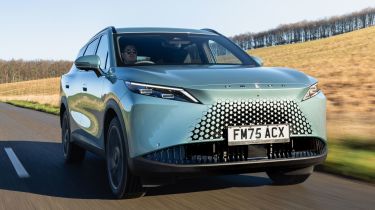
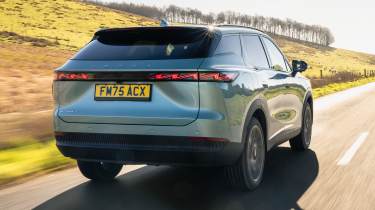
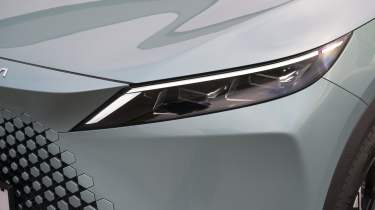
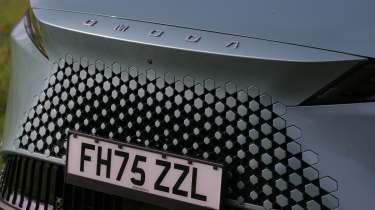
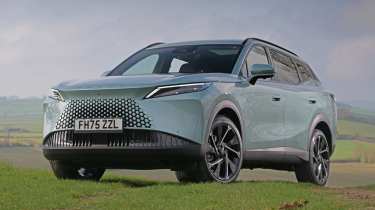
Omoda is adamant that the plug-in hybrid SUV targets a different kind of customer to its siblings. The company says the 7 is more futuristically styled than the Jaecoo, pointing out the zig-zag rear lights that are designed to look like a flourish at the end of an autograph. There’s also a rather striking front end with a hexagonal grille that seamlessly blends into the front bumper, plus a premium touch in the form of a ‘floating’ roofline.
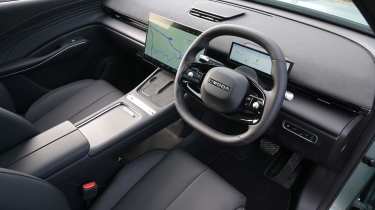
For the price Omoda is charging, the amount of standard kit on the entry-level Knight model is excellent. There’s insulating ‘silent glass’, a heated leather steering wheel, synthetic leather seats with a memory function, a 540-degree exterior camera, plus a cooled wireless smartphone charger. The Nobel trim throws-in a panoramic sunroof, a 12-speaker sound system from Sony, plus ventilation and lumbar adjustment for the front seats. Overall, Omoda is on to a winner here with the equipment count exceeding those of rivals.
Within the climate control menu on the ‘Noble’ there’s also a ‘fragrance system’ with three scents and three strengths. The three cartridges that provide each scent can be removed from under the centre console when they need to be replaced, and when we asked Omoda about the potential to add personalised fragrances in future updates, a representative said it could be possible.
Interior and dashboard design
Omoda’s senior interior designer, Michael Duerr, told us that the brand didn’t want its car to be “like a Las Vegas show” inside. Sure enough, while there is ambient lighting, the cabin looks very sterile. Duerr also referenced the ‘any colour the customer wants, so long as it is black’ line often attributed to Henry Ford in relation to interior. You can, indeed, have it in black, and that’s it.
Unlike its Starray rival from fellow Chinese brand Geely, which inexplicably has the panoramic roof control buried in the touchscreen menus, you do get a good old-fashioned switch to operate the Nobel version’s panoramic roof.
Materials and build quality
Then there’s the quality. We poked and prodded every surface and everything seemed solid and well screwed together. The few buttons that there are feel well damped and the faux leather did not look baggy at all. However, after driving just a few hundred yards, we did notice a fair few rattles and creaks. Our test car had less than 40 miles on the clock, though, so it may have been a case of bedding in.
Infotainment, sat-nav and stereo
Omoda says it wants its drivers to “keep eyes on the road and not get lost in changing things on the central screen”, but on the move that’s precisely what we felt happening to us. The 15.6-inch touchscreen is strewn with various sub-menus and at first glance it’s all a little too much. We did enjoy the screen’s super-quick response times, though.
The Noble model gets a Sony sound system - though like in other Chery Group cars where this features, it doesn’t exactly blow us away with its sound quality.
“For an extra £3,000 the Noble trim with its electric panoramic roof, 540-degree exterior camera, powered bootlid and ventilated and heated seats is a good deal - the fragrance system is quite a fun ice breaker for any passengers too." - Alastair Crooks, senior news reporter.
Boot space & practicality

Pros |
|
Cons |
|
The Omoda 7 is the second-largest car from the brand and it shows inside with its sense of space. We’d like a few more clever features to aid family life such as a 40/20/40 rear bench split instead of just a 60/40 split and a separate climate control panel for rear passengers. Overall, the Omoda should adapt well to most families' needs.
Dimensions and size
Dimensions comparison | |||
| Model | Omoda 7 | Jaecoo 7 | MINI Countryman |
| Length | 4,660mm | 4,500mm | 4,444mm |
| Width | 1,875mm | 1,865mm | 1,843mm |
| Height | 1,670mm | 1,680mm | 1,661mm |
| Wheelbase | 2,720mm | 2,650mm | 2,690mm |
| Boot space | 590 - 1,417 litres | 500 litres | 450 litres |
Seats & passenger space
Where the Omoda 7 really impresses is space: compared to rivals it’s big on the outside so it’s no surprise it’s also vast inside. Even with the lofty driving position, there’s loads of headroom and the storage cubbies up front are decently sized. In the back, there’s a flat floor and tall adults will have space to stretch out, plus there’s no drop-off in material quality back there.
Boot space
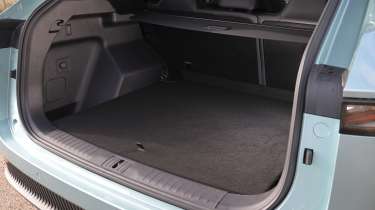
Boot space stands at a huge 590 litres - 178 more than in the Jaecoo 7 and 140 litres more than a MINI Countryman. That’s just for the plug-in hybrid too - without the battery under the boot floor the petrol option offers 49 more litres. There’s also no movable boot floor in the plug-in hybrid and aside from a fold-down hook and a power socket, there aren’t many handy features in the boot.
Towing
Even if you opt for the more powerful and heavier plug-in hybrid, the Omoda 7’s towing capacity is 750kg unbraked and 1,250kg braked.
Reliability & safety
Pros |
|
Cons |
|
Being a new brand, there’s still some trust that Omoda needs to build up here in the UK and to aid in this the Omoda 7 comes with a seven-year or 100,000-mile warranty regardless of which engine you choose. It’s the same deal offered by sister brand Jaecoo and there’s no mileage limit in the first three years. On top of this, the PHEV’s battery is covered by a separate eight-year or 100,000-mile warranty too.
Considering it’s been on sale in the UK for a few months now and that the larger Omoda 9 has already received a 5-star rating, it’s surprising that Euro NCAP hasn’t yet crash-tested the Omoda 7. Its sister car, the Jaecoo 7 performed well with a full five stars and between 81 and 80 per cent in each category so that bodes well.
The Omoda should score well for its safety assist technology as standard safety equipment as includes automatic emergency braking, lane-keep assist, rear-cross traffic alert, driver attention monitoring and traffic sign recognition.
| Euro NCAP safety ratings | |
| Euro NCAP safety rating | TBC |
| Adult occupant protection | TBC |
| Child occupant protection | TBC |
| Vulnerable road user protection | TBC |
| Safety assist | TBC |
Buying, prices and deals
Best buy: Omoda 7 SHS-P Knight
Omoda says the plug-in hybrid will easily out-sell the pure-petrol version of the Omoda 7 and it’s not hard to see why - it’s smoother to drive, has fantastic electric range and only cost a couple of grand extra to buy, which you’ll soon recoup in fuel costs.
Given how cheap the Omoda 7 is in its basic ‘Knight’ trim, we don’t think the £3,000 outlay for the Noble is worth it - the best bits are already there in terms of interior space and that plug-in hybrid system. As boring as it sounds, we’d also go for the only no-cost paint option, which is white. All the others are £600 and aside from the Lairmar Green they’re pretty dull.
Omoda 7 Alternatives
There’s a certain premium feel to the Omoda 7, especially with its sharp interior design, but it doesn’t really rival the usual suspects from BMW, Audi or Mercedes. Instead it’s priced as a value-for-money competitor to the Hyundai Tucson, Volkswagen T-Roc, Nissan Qashqai and Kia Sportage with pricing that lines up against small cars like the Renault Captur and Ford Puma.
Omoda 7 pictures:
Key updates of the Omoda 7 review
22 July 2026: Review conversion from a road test to an in-depth review.
Deals on the Omoda 7 and alternatives