Ford Puma review
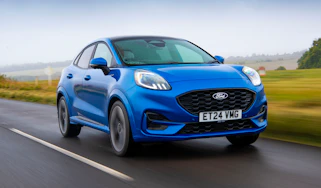
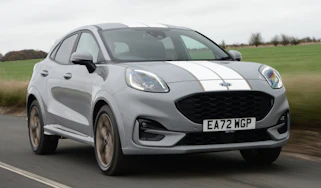
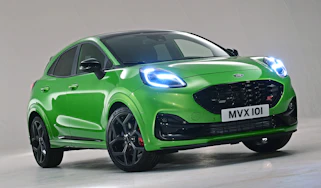
The Ford Puma remains the best-handling compact SUV in its class, even after its recent updates

Our opinion on the Ford Puma
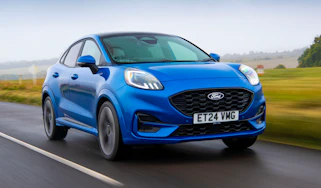
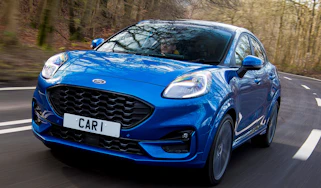
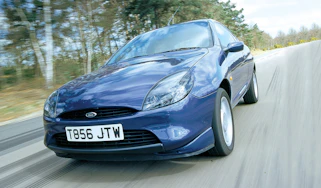
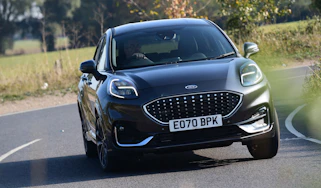
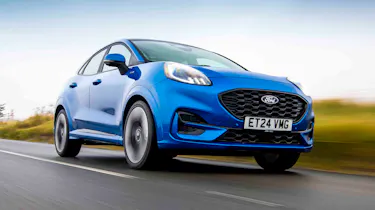
While the latest Ford Puma may have originally caused a stir by sharing its name with the fondly remembered ‘90s coupe, the current iteration has quickly won over the buying public thanks to being a practical small SUV that’s also one of the best in its class to drive. Its somewhat low-rent interior has been improved upon after a facelift in 2024, and there’s a well-priced all-electric version for those looking to reduce their running costs. All in all, the current Puma deserves its place near the top of the registration charts.
About the Ford Puma
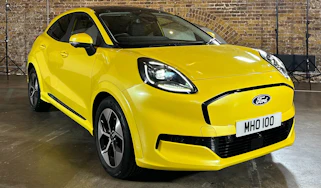
With the demise of the Ford Fiesta, the Ford Puma is now the cheapest car in the company’s line-up. It can be had with the brand’s 1.0-litre EcoBoost three-cylinder turbocharged petrol engine in various states of tune and with mild-hybrid technology to improve fuel economy and lower emissions, or you can go for the electric Ford Puma Gen-E, which we’ve covered in depth in a separate review.
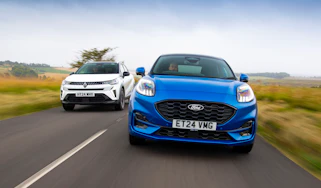
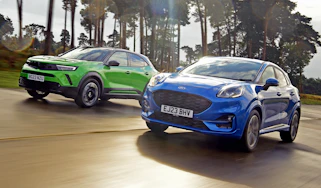
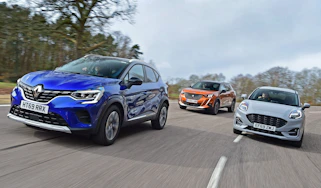
We’ve extensively tested numerous versions of the Ford Puma on UK roads, including models both before and after the 2024 facelift. We’ve pitted the post facelift Ford Puma against the Renault Captur in a twin test, and run a pre-facelift Ford Puma ST-Line for nearly 30,000 miles as part of our long term test fleet.
Performance & driving experience
| Pros |
|
| Cons |
|
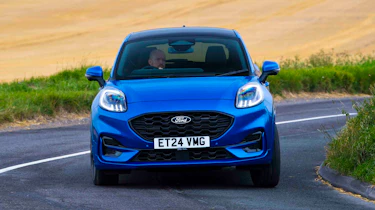
When it comes to handling, the Puma still beats of its competition when it comes to fun. However, it’s not without fault because Ford’s seven-speed automatic gearbox is very disappointing.
Used - available now


For those who aren’t as keen on driving, Ford offers the option of BlueCruise hands-free driving in the Puma. This technology will allow for ‘hands-off’ driving on designated sections of motorway. However, the system will still monitor the driver in order to ensure that they are paying attention to the road ahead in case they need to take over.
The Puma uses a mild-hybrid system to help boost performance and improve efficiency. The only downside to the mild-hybrid system is that to fill the small battery pack with energy, the Puma features brake energy regeneration. It’s set at a constant, unchangeable level that’s just about detectable when you lift off the throttle and feel the car slow more quickly than it otherwise would, and it takes a little getting used to.
Performance, 0-60mph acceleration and top speed
The slowest Ford Puma is the 123bhp manual model, which has a 0-62mph time of 9.8 seconds. Adding the seven-speed auto shaves a couple of tenths off, for a time of 9.6 seconds.
The auto-only 153bhp version of the 1.0-litre EcoBoost engine has an official 0-62mph time of 8.7 seconds, while the auto-equipped 168bhp Puma ST can accelerate from 0-62mph in 7.4 seconds. That’s with the overboost function activated, which automatically cuts in when using full throttle. At all other times, maximum output is restricted to 158bhp to help save wear and tear on the car’s running gear.
The electric Puma Gen-E does a respectable job of motivating the Puma while cutting out exhaust emissions. You can read more about this model in our dedicated in-depth Ford Puma Gen-E review…
| Model | Power | 0-62mph | Top speed |
| 1.0 EcoBoost mHEV 125 Titanium manual | 123bhp | 9.8 seconds | 119mph |
| 1.0 EcoBoost mHEV 155 ST-Line X auto | 153bhp | 8.7 seconds | 124mph |
| 1.0 EcoBoost mHEV 170 ST auto | 168bhp | 7.4 seconds | 130mph |
Town driving, visibility and parking
Many of the Puma’s controls, from the steering to the clutch, are light and precise, making it very easy to drive around town. The turning circle is excellent, and the supermini-sized dimensions make the Ford simple to place.
The automatic gearbox is smooth at low speeds, although the three-cylinder engines produce a noticeable amount of vibration both under acceleration and at idle, although you can limit the effect of the latter by utilising the standard start/stop system, which uses the electric motor from the mild-hybrid system to quickly restart the engine when required.
Country road driving and handling
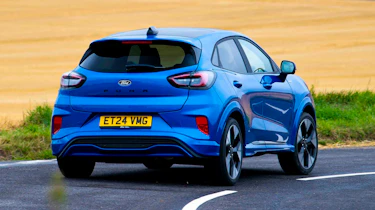
The Puma is agile, grippy and sweetly balanced, with sharp, positive steering to make even the most mundane journeys enjoyable.
While the ride is on the firm side of the class, it’s not crashy. The Puma negotiates bumps well, and even uneven and adversely cambered roads don’t thrown the car around as much as some other small SUVs.
However, we’d avoid going too high up the Puma range, because ride comfort on ST-Line X models – equipped with 19-inch wheels – is certainly treading a fine line between a sporty feeling and outright bumpiness.
People who like a car that responds quickly to inputs would do well to avoid the automatic gearbox. It’s very slow to respond when driven keenly, which means it’s frequently bogged down in the wrong gear when entering a corner. Sport mode helps because it holds a lower ratio, but that still means you’re at least one gear too high for a corner, rather than two or three when in normal mode.
This situation is compounded by the fact that there’s no manual override with the automatic transmission. If Ford offered each engine option with a manual gearbox, this wouldn’t be an issue, but the two most powerful engines – including the ST – are only available with the auto.
Motorway driving and long-distance comfort
The EcoBoost units, which can be slightly thrummy at lower speeds, settle down into a quiet cruise. Decent torque figures mean that they generally feel fairly strong when accelerating up to 70mph, too.
Unlike most of its rivals, Ford offers its supervised Level 2 self-driving technology called BlueCruise on its BlueCruise Edition and ST models. It covers 95 per cent of UK motorways, so it might be worth having if you plan on regularly tackling long motorway drives. It even works in 16 other European countries.
MPG & running costs
| Pros |
|
| Cons |
|
With a fuel economy figure of 52.3mpg and CO2 emissions of 122g/km, the Puma mHEV with the 123bhp engine and manual transmission looks promisingly frugal. We’re yet to try this version, but when we ran the 153bhp mHEV with a manual gearbox on our test fleet, we averaged 44.3mpg, which is decent, if not outstanding.
The post-facelift 153bhp 1.0-litre EcoBoost is only available with a seven-speed auto, and its economy is reduced to 49.6mpg, and emissions increase to 129g/km. That’s not far off the higher-performance ST model, which still achieves a decent WLTP-tested figure of 47.9mpg despite the extra power. Its CO2 levels are a little higher at 135g/km, though.
Those seeking the lowest running costs may wish to read our dedicated review of the fully electric Ford Puma Gen-E.
| Model | MPG | CO2 | Insurance group |
| 1.0 EcoBoost mHEV 125 Titanium | 52.3mpg | 122g/km | 12E |
| 1.0 EcoBoost mHEV 155 Titanium auto | 49.6mpg | 129g/km | 17E |
| 1.0 EcoBoost mHEV 125 ST auto | 47.9mpg | 135g/km | 21E |
Insurance groups
Insurance premiums for the Puma range should be competitive with those of rivals. The base 123bhp Titanium model comes in at group 12, moving up to group 17 for the more powerful 153bhp version of the same engine. Understandably, the hotter ST model costs the most to insure in the Puma range, coming in at group 21.
Some rivals do undercut the Puma on car insurance costs. For example, the Renault Captur starts at group 11, moving to group 16 for the more powerful 1.6-litre E-Tech hybrid. There are others, such as the MG ZS, that cost more, starting in group 16 and topping out in group 22.
Tax
Regardless of which model you choose, every Puma carries the standard rate of vehicle excise duty (VED), and no version costs more than £40,000 when new, avoiding the luxury car tax surcharge.
However, company car buyers will be better off with full hybrid rivals like the Renault Captur or Toyota Yaris Cross with their lower emissions and Benefit-in-Kind costs. Of course, Ford’s answer to that is the electric Ford Puma Gen-E, which you can read about in our dedicated review.
Depreciation
The Puma holds its value reasonably well. According to our expert data, this Ford should retain between 44 and 53 per cent of its original value after three years or 36,000 miles. For comparison, a Nissan Juke maintains 42 to 46 per cent over the same period, while a Dacia Duster retains an amazing 56 to 60 per cent.
To get an accurate valuation for a specific model, check out our free car valuation tool...
Interior, design & technology
| Pros |
|
| Cons |
|
The Ford Puma trim structure has been slimmed down when compared with the pre-facelift car. Titanium is our preferred trim featuring all the goodies you’d hope for in a small SUV, including:
- 17-inch alloy wheels
- Front and rear parking sensors
- Cruise control
- Selectable drive modes
- A 12-inch central touchscreen.
ST-Line models include a muscular bodykit, a leather sports steering wheel and alloy pedals, while the ST-Line Black Package has a black roof with black door mirror cappings, a rear spoiler, and 18-inch alloys.
ST-Line X cars also come with 18-inch wheels (albeit in a different design), privacy glass, a powered bootlid, a wireless charging pad for your smartphone and a 10-speaker Bang & Olufsen sound system.
If you’re after Ford’s self-driving tech as standard, you’ll need the BlueCruise Edition trim. It also features adaptive cruise control, blind spot assistance, advanced road sign recognition, a 360-degree camera system, and a reverse brake assist system. It also has a more advanced AEB system with cameras and radar.
The sportiest ST is also BlueCruise ready, but the main reason you’ll choose it is for its more powerful engine. The £1,000 ST handling pack comes with fancier KW coilover suspension and a unique set of 19 inch wheels.
Sometimes it’s the simplest technology that is the most useful. Ford’s Quickclear heated windscreen, a feature that first appeared on the brand’s models in the 1980s, is still a fantastic feature for the winter months.
Interior and dashboard design
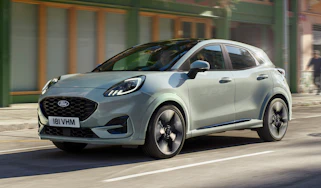
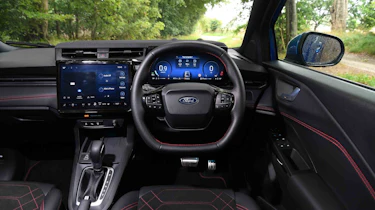
The cabin in the face-lifted Ford Puma has been overhauled to accommodate the latest version of Ford’s SYNC infotainment set-up, with the air vents moving to the top of the dash from their previous position lower down. We find this higher dashboard means forward visibility isn’t quite as clear as it once was. The steering wheel is now slightly squared-off in shape, and is similar to the item used in the latest Ford Transit Custom.
From an ergonomic point of view, the Puma now features just one steering-column stalk. It’s on the left-hand side and caters for the front and rear wipers, plus the headlight flasher and indicators. The main lighting controls are now adjusted via a panel on the dashboard to the right of the steering wheel.
There are other ergonomic compromises, too. The pad to hold a smartphone (or charge it wirelessly) isn’t very well thought out because it leans backwards towards the cabin. While a phone stays in place for the most part, it’d be more secure if it were leant forward, away from the gear selector and handbrake.
Materials and build quality
The facelift has certainly helped boost the feeling of quality inside the Puma. While a Peugeot 2008 still outshines most of the competition in terms of material finish, the Ford no longer feels like it lags behind.
There are still some hard plastics dotted around the Ford’s interior, but these aren’t as noticeable as they were before thanks to the leather-effect trim added to the dashboard and door panels.
Infotainment, sat-nav and stereo
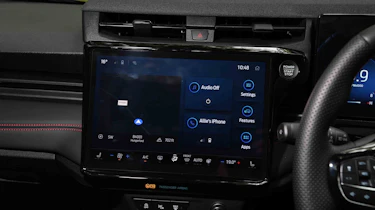
The Puma’s infotainment can feature Alexa voice control as part of its interface with the £200 premium connectivity pack. While the system is an improvement, it isn’t as good as the class-leading Renault Captur.
While it’s one of the largest in this class at 12 inches, we find the Puma’s mapping screen isn’t very detailed, and there’s a noticeable delay when booting up. The panel isn’t as responsive to touches as the Renault, either. That’s a big deal, given that the climate settings are entirely adjusted through the screen.
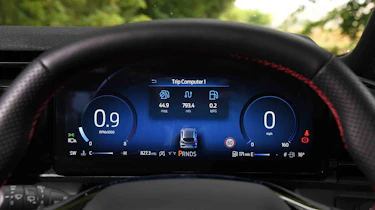
All versions feature digital dials, which are sharp and clear, but the same can’t be said of the reversing camera, which has a relatively low resolution. The Puma has four USB ports, with one USB-A socket, and the rest being USB-C connections.
A six-speaker sound system comes as standard with Titanium, but upgrade to ST-Line X, and you’ll get a 10-speaker audio set-up from Bang & Olufsen, plus a wireless smartphone charging pad.
“You can deactivate the speed limit warning beeps either by selecting the driver assistance menu on the touchscreen, or by pressing and holding the ‘LIM’ button on the steering wheel. This will show a warning on the dashboard and deactivate the limit warning after around four seconds.” - Dean Gibson, senior test editor.
Boot space & practicality
| Pros |
|
| Cons |
|
The Ford Puma isn’t class-leading for interior space and boot capacity, but given its small footprint, it makes great use of its footprint.
Like most of its rivals, the Puma is a five-door small SUV with five seats, although if you have adults to transport, it's best thought of as a four-seater with just enough room for a fifth passenger on a short journey.
Dimensions and size
The Puma is one of the smaller options in the supermini-sized SUV class. It measures 4,186mm in length (4,226mm for the ST), 1,805mm wide and stands 1,536mm tall. By comparison, the Peugeot 2008 and Mazda CX-30 are 114mm and 209mm longer, respectively.
| Dimensions comparison | |||
| Model | Ford Puma | Renault Captur | Dacia Duster |
| Length | 4,186mm (4,226mm ST) | 4,239mm | 4,343mm |
| Width | 1,805mm (1,930mm inc mirrors) | 1,797mm (2,004mm inc mirrors) | 1,813mm (2,069mm inc mirrors) |
| Height | 1,550mm (1,533mm ST) | 1,584mm | 1,656mm |
| Wheelbase | 2,590mm | 2,639mm | 2,657mm |
| Boot space | 456-1,216 litres | 422-1,363 litres (326-1,276 litres E-Tech) | 474-1,609 litres (349-1,545 litres E-Tech) |
Seats & passenger space
The driving position feels sportier than most rivals due to good seat bolsters, while there’s a great deal of adjustment in the seat and steering wheel.
Even though the combustion Pumas come with a manual handbrake – which is a rarity on new cars these days – and a fairly chunky gear selector, there’s still sufficient space in the centre console for a neat triple cup-holder arrangement.
Elsewhere, there’s a large glovebox, and the door bins are wide and deep. A storage area is located under the central armrest, and inside it is a useful small tray so that items such as keys don’t completely disappear into the void.
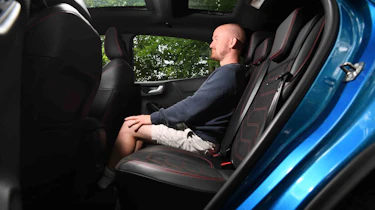
There is loads of foot space beneath the front seats for rear occupants to stretch out in, and there’s enough knee room on offer for adults. The centre seat is a little narrow, but the soft seat base makes this position more comfortable than most rivals. However, if you plan to carry tall passengers frequently, it’s best to avoid the panoramic sunroof option, because its bulky mechanism compromises headroom, and the door bins in the rear door cards are too small
Fitting a child seat is a little fiddly, because the two sets of Isofix mounts on the outer chairs are buried between the seat cushions.
Boot space
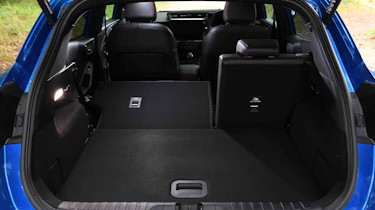
A 456-litre boot (which grows to 1,216 litres with the rear seats folded) is impressive, and the Megabox storage area beneath the boot floor provides a 68-litre plastic container. It features a drain plug, making it ideal for storing dirty items, such as boots, because you can rinse out any dirt afterwards.
A 12-volt socket in the boot area makes it possible to power a range of accessories. One slight flaw is the parcel shelf, which is a flimsy fabric sheet. We had problems with the clips breaking during our long-term test of a pre-facelift Puma.
“The best Puma for towing is the 123bhp 1.0-litre manual, with a braked caravan or trailer rating of 1,100kg. That’s disappointing next to the VW T-Roc, which can handle up to 2,000kg.” – Max Adams, online reviews editor.
Reliability & safety
| Pros |
|
| Cons |
|
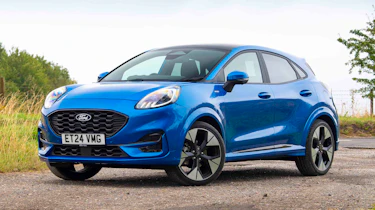
According to our latest 2026 Driver Power customer satisfaction survey, Ford Puma owners have told us their experience has greatly improved compared to last year. The Puma has shot up the rankings, from a lacklustre 47th out of 50 cars result in the 2025 best cars to own list, to 25th out of 50 in the current 2026 survey. Owners enjoyed the look of their cars, their practicality, front-seat comfort, interior storage, and infotainment systems. More work needs to be done on the powertrain and the car's safety systems, and it would be good if servicing costs could be reduced as well.
Meanwhile, the Ford brand could still be doing more, ranked 21st out of 30 manufacturers in the best brands list. Respondents liked the acceleration of their cars, the on-road handling, practicality, boot space, sat-nav, and heating systems, but they weren't so positive about powertrain smoothness and firm ride quality.
The Puma’s Euro NCAP safety rating slipped following a retest in 2022, where it was downgraded from five- to four stars. It isn’t the only small SUV to receive a four-star score; the Hyundai Bayon and Vauxhall Mokka also came up short under the same assessment. If you’re looking for rivals offering a five-star rating, then you should look at the SEAT Arona or Toyota Yaris Cross.
The Puma features plenty of safety technology, including a lane-keeping aid with lane departure warning, autonomous emergency braking (AEB) with pedestrian and cyclist detection, and post-collision braking. Other useful features include auto headlights, rain-sensing wipers and a tyre pressure monitoring system.
Those wishing to upgrade further can opt for the Driver Assistance pack (around £1,000 for manual cars), which adds a blind spot warning, adaptive cruise control and a rear-view camera, among other features. Those choosing the automatic will need to add the more expensive £1,200 BlueCruise Capable Driver Assistance pack, which includes the same features but adds the brand's BlueCruise 'hands-free' driver assistance system as part of a 90-day trial period. After that, you'll need to pay a subscription fee to continue using this feature.
| Euro NCAP safety ratings | |
| Euro NCAP safety rating | 4 stars (2022) |
| Adult occupant protection | 75% |
| Child occupant protection | 84% |
| Vulnerable road user protection | 70% |
| Safety assist | 69% |
Buying and owning
Best buy: Ford Puma 1.0 EcoBoost mHEV Titanium
Petrol-powered Pumas start at just over £27,000 for the Titanium trim and reach up to £34,000 for the BlueCruise and ST versions.
We believe that the entry-level Titanium model with a manual gearbox is the best of the bunch. Not only is it the cheapest Puma, but the entry-level model still offers family-friendly space, a generous helping of standard kit and an enjoyable level of performance. We’d avoid the automatic gearbox unless you really need one, because it can be frustratingly dimwitted in its operation.
If you fancy having a Ford Puma, our Buy a Car service can help you configure your ideal Ford Puma and receive great offers from our network of dealerships, take a look at the best Puma leasing deals or choose from a huge selection of top-notch used Puma models. Need to sell your car? Be sure to visit our Sell My Car page.
Ford Puma alternatives
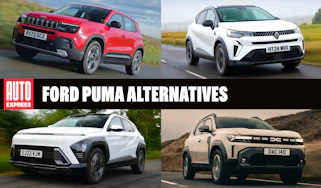
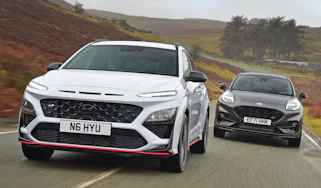
The Citroen C3 Aircross, Hyundai Kona, Nissan Juke, Peugeot 2008, Renault Captur, SEAT Arona, Toyota Yaris Cross, and Vauxhall Mokka are just some of the many similarly priced competitors that the Puma must contend with. If driving enjoyment is your priority, none of these models can beat the Ford, but several do outshine it when it comes down to a crucial SUV quality: practicality.
Latest deals on the Puma and rivals
Ford Puma Owner Reviews
Here’s what owners in our Driver Power survey thought of the Ford Puma.
| What they like | What they don't like |
| “The Recaro seats in the front are comfortable, and the overall finish has a classy look about it.” | “My car has suffered from total power failure on the motorway several times, and the dealer is useless.” |
| “My Puma was good value for money, although it was a little more expensive than I was expecting.” | “The only thing that lets it down is forward visibility. The A-pillars could do with being narrower.” |
| “The top-of-the-range B&O 10-speaker hi-fi is about as good as you can get in a car. It sounds amazing.” | “The build quality is not very impressive, with erratic shutlines and a misaligned tailgate spoiler.” |
| “For an economical 1.0-litre, three-cylinder engine, it gives the Puma impressive acceleration.” | “The battery continually drains, so the car won’t start. But the dealer says there’s nothing wrong.” |
| “I really like the styling inside and out, the driving position and the car’s stability when driving at speed.” | “So much is right, but Ford’s penny-pinching and the obvious lack of quality control are a real concern.” |
| “It’s amazing. It drives like a dream, which is why I’d recommend to anyone that they consider a Puma.” | |
| “It’s a great car to drive, with impressive acceleration for a 1.0-litre engine. The roadholding and handling are also good, and driving on twisting country roads is enormous fun.” | |
| “The quality of the finish is decent, although the cabin is a bit dark. The front seats are really comfortable, though, and particularly supportive when cornering.” | |
| “There are lots of decent-sized cubbyholes, and extra space under the boot floor is the biggest in its class. I carry rear-seat passengers on a regular basis and legroom is more than acceptable, with no complaints from adults in the back, none of whom are especially short.” |
Ford Puma ST-Line: long-term test
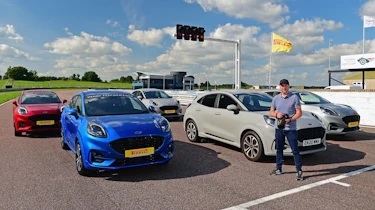
Senior photographer, Pete Gibson, put almost 30,000 miles on a pre-facelift Ford Puma 1.0 mHEV 155 ST-Line back in 2021. He really enjoyed driving the Puma, finding it to be more impressive than some of the high-end performance cars he was snapping.
He found the washable box under the boot floor was a big help with his children’s muddy shoes, and there was enough space to store all his camera gear. A larger fuel tank would’ve been welcome, and the parcel shelf broke during his first outing with the car.
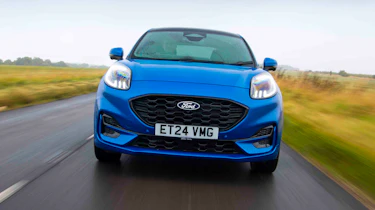
Ford Puma review pictures
Key updates of the Ford Puma review
14 July 2026: Update with the latest 2026 Driver Power information
13 May 2026: General update with latest pricing and valuation data
9 December 2025: Update to include information about Ford’s BlueCruise driving technology
Frequently Asked Questions
Ford provides a three-year, 60,000-mile warranty, which can’t match Kia’s seven years or 100,000 miles policy, MG’s seven years or 80,000 miles guarentee, or Hyundai’s five year, unlimited mileage package.
New & used Ford Puma deals
More reviews
Car group tests
In-depth reviews
Which Is Best