Volkswagen Golf review
The Volkswagen Golf remains a solid choice in the compact hatchback market

Our opinion on the Volkswagen Golf
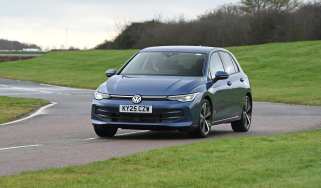
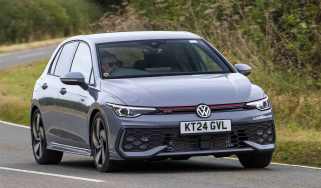
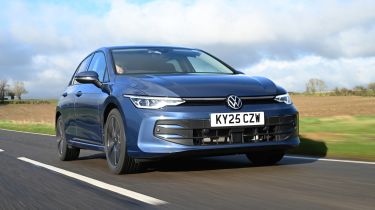
The Volkswagen Golf is a family car icon thanks to its great all-round ability and classless design. Some poor decisions with the eighth-generation model meant it wasn’t as user-friendly as its predecessor, but the facelifted VW Golf Mk8.5 introduced in 2024 addressed most of these quibbles. The ride quality is a little compromised over poorer surfaces, there’s some intrusive road noise at speed with larger wheels, and cabin quality isn't head and shoulders above its rivals. While the VW Golf is still a decent choice, it’s a little behind rivals such as the Honda Civic, Toyota Corolla and Skoda Octavia.
About the Volkswagen Golf
The Golf name is second only to the Beetle in the history of Volkswagen in terms of importance. It’s been in production for more than five decades, and more than 37 million examples have been sold worldwide, making it a truly iconic family car – its ubiquity even led VW to use the phrase “like a Golf” in an ad campaign a few years ago.
Now in its eighth generation, the standard Golf comes only as a five-door hatchback, with the three-door and estate options no longer offered. There's a range of petrol and hybrid powertrains available, but diesel has been quietly dropped. Trim levels range through Life, Match, Style, R-Line and Black Edition, while VW still offers plenty of individual options to tailor a Golf to your personal specification.
Used - available now


At the top of the range, there are three performance variants: the plug-in hybrid GTE, the Volkswagen Golf GTI hot hatch and the fire-breathing four-wheel-drive Volkswagen Golf R. The regular line-up consists of five trim levels and five engines that include two petrol, two diesels, and a company car tax-friendly plug-in hybrid.
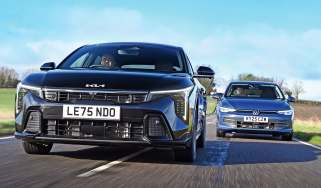
We've driven plenty of different versions of the latest Golf, with our most recent test being of a 1.5 TSI Match Volkswagen Golf against a Kia K4 in a twin test. We've also run a VW Golf R in a long-term test, and tested the latest plug-in hybrid VW Golf GTE against the Toyota Prius.
Performance & driving experience
Pros |
|
Cons |
|
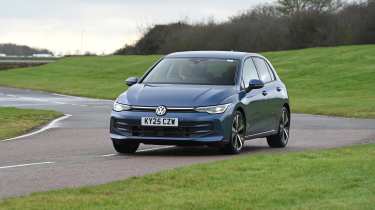
While diesel is no longer offered, you’re still spoilt for choice when it comes to engine options in the Golf, because there are numerous petrol and plug-in hybrid choices. Unlike the Peugeot 308 or Vauxhall Astra, there’s no electric version, but the brand can point you in the direction of the Volkswagen ID.3, which offers a zero-emissions option in the Golf’s class.
There’s a six-speed manual fitted as standard to 113bhp versions of the 1.5 TSI petrol, while the 148bhp 1.5 TSI has a choice of manual or seven-speed dual-clutch automatics. The plug-in eHybrid and GTE models feature a six-speed dual-clutch automatic. All of these cars are front-wheel drive, with no option of the brand's 4MOTION four-wheel drive system.
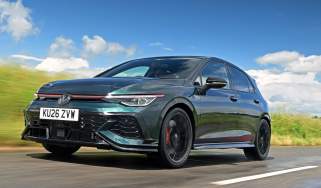
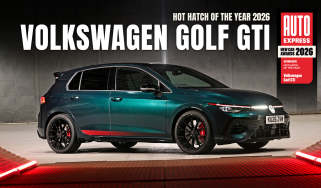
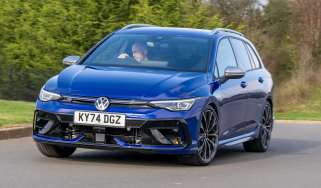
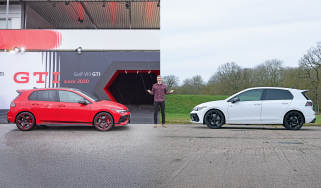
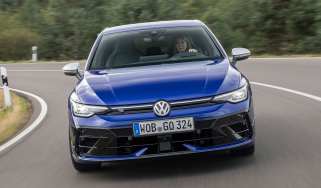
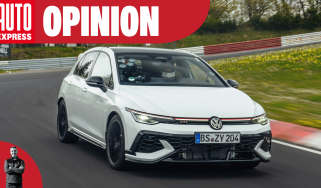
There are also a couple of Golfs for keen drivers, starting with the evergreen Volkswagen Golf GTI and potentially the licence-losing Volkswagen Golf R, which you can read about in our respective individual reviews.
| Model | Power | 0-62mph | Top speed |
| Golf 1.5 TSI | 113bhp | 9.9 seconds | 126mph |
| Golf 1.5 TSI DSG | 148bhp | 8.5 seconds | 126mph |
| Golf 1.5 eHybrid | 201bhp | 7.2 seconds | 137mph |
Performance, 0-60mph acceleration and top speed
The entry-level 1.5 TSI is a replacement for the older 1.0-litre three-cylinder petrol, and while it has a similar output, at 113bhp, the larger capacity boosts torque, so it’s more flexible to use. It’s fine for town work, although it needs some stoking to get up to motorway speeds. The more powerful 148bhp 1.5 TSI has a broader spread of ability and a quicker 0-62mph time of 8.5 seconds.
Those after plug-in hybrid power can pick from the 201bhp eHybrid or 268bhp GTE. The former is a swift performer, with a 0-62mph sprint of 7.4 seconds, while the GTE plug-in hybrid is pretty rapid, taking just 6.6 seconds to complete the 0-62mph dash.
The GTI model is even quicker at 5.9 seconds, while the Volkswagen GTI Clubsport races to the same benchmark in 5.6 seconds. At the top of the tree is the hot R, which is a second quicker with a time of 4.6 seconds.
Town driving, visibility and parking
Undoubtedly, the most important quality of a family hatchback is its ease of use, and more than ever, the Golf is a car anyone can hop into and immediately feel comfortable with.
The mild-hybrid technology on the 1.5 TSI automatic smooths out some of the rough patches that we’ve previously noticed with VW’s DSG gearbox – particularly when moving off or reversing into a tight parking space.
The Golf’s steering is nicely weighted and fairly precise, but it doesn’t offer much feedback and is quite slow off-centre. In some situations, this means that the Golf doesn’t feel like the most agile hatchback on the market, but it’s not a deal breaker.
Country road driving and handling
Historically, one of the VW Golf’s strengths has been to offer a chassis that delivers good body control through corners without compromising ride comfort on a bumpy road. Those characteristics continue with the updated Mk8.5; it’s not the firmest model in its class, but there’s sufficient control for big bumps to be dealt with in a single bounce of the springs, leaving the car feeling stable and sure-footed.
While some rivals handle more sharply, the Golf’s set-up is very well judged for Britain’s bumpy roads. The balance is impressively neutral, and grip, especially on the front axle, is strong, helped on some models by VW’s XDS electronic diff lock that gently brakes the inside front wheel to help the car turn in more sharply.
Motorway driving and long-distance comfort
The Golf isn’t the most refined car in its segment at the national limit – the Peugeot 308 has it narrowly beaten here, thanks to a touch less road noise – but the VW’s high-speed stability is class-leading. A strong engine line-up also works in its favour at higher speeds. Across the board, the power delivery is smooth, and the engines are refined.
"One of the great things about the Golf is the range of engines that are available. You can choose between power and economy, yet even the most frugal units are still flexible, while the 2.0-litre turbocharged units at the other end of the spectrum are surprisingly economical when you consider their ability." - Dean Gibson, senior test editor.
MPG & running costs
Pros |
|
Cons |
|
Officially, the 114bhp 1.5 TSI petrol achieves 53.6mpg, while our preferred 148bhp 1.5 TSI isn’t far behind its less potent sibling at 52mpg. We think that's so impressive given its extra flexibility that we find there’s little reason not to go for the more powerful version.
Volkswagen has introduced many features to improve the Golf’s green credentials. Plug-in and mild-hybrid versions, stop-start systems and cylinder deactivation feature in the model line-up. The mild-hybrid 148bhp 1.5 eTSI does use less fuel than its non-hybrid equivalent, with a figure of 54.9mpg quoted, while we managed 47.4mpg in this model when we tested it against the Kia K4 hatchback. In comparison, the Kia managed 39.7mpg on similar roads.
As standard, the Golf has a 50-litre fuel tank, and if you match our test economy, that means a range of 520 miles is feasible.
| Model | MPG | CO2 | Insurance group |
| Golf 1.5 TSI 115 | 53.3mpg | 120g/km | 17 |
| Golf 1.5 TSI 150 | 52.0mpg | 124g/km | 22 |
| Golf 1.5 TSI eHybrid | 256.8mpg | 25g/km | 26 |
Electric range, battery life and charge time
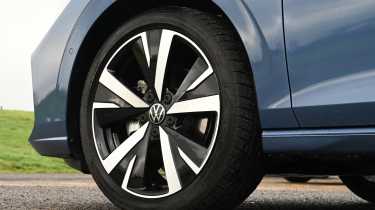
Both the Golf eHybrid and GTE use a relatively large 25.7kWh (19.7kWh usable) drive battery. In the eHybrid, this provides a claimed range of up to 88 miles, while the quicker GTE with its bigger wheels sees the range drop to 81 miles. Either plug-in hybrid should make it attractive to company car users who aren’t yet ready to switch to a full EV, although the low benefit-in-kind (BiK) rates of PHEVs will become less attractive from 2028.
Rapid DC charging is on offer in the Golf, although a peak speed of 40kW means a 20 to 80 per cent charge still takes around half an hour. It’ll be much more cost-effective to use a 7.4kW home wallbox on a cheaper overnight tariff, and this should take around four hours for a full charge.
| Model | Battery size | Range | Insurance group |
| Golf 1.5 TSI eHybrid | 25.7kWh | 88.2 miles | 26 |
| Golf 1.5 TSI GTE | 25.7kWh | 81.4 miles | 30 |
Insurance groups
The entry-level Golf Match 1.5 TSI starts from group 17 insurance, rising to 26 for the eHybrid and group 30 for the GTE. The performance versions climb much higher; the GTI is rated at group 31, and the Golf R is group 33.
Tax
The lowest rate of Benefit-in-Kind (BiK) company car tax is reserved for the Golf eHybrid and GTE models, with emissions of 25g/km and 30g/km, respectively, under the latest emissions testing regime. Presently, both the eHybrid and GTE attract a BiK rate of 7 per cent in the '26/'27 tax year, but this will rise to 8 per cent in the '27/'28 tax year, up to 18 per cent for the '28/'29 tax year.
The lower-powered petrol has emissions figures similar to those of the 148bhp version, and both currently attract a BiK rate of 30 per cent.
Depreciation
According to our market data, the Golf is expected to maintain between 40 and 48 per cent of its original value over a period of three years or 36,000 miles.
In comparison, the Vauxhall Astra is only likely to retain between 32 and 41 per cent of its value, while the slightly more costly Toyota Corolla is expected to maintain between 46 and 48 per cent.
Interior, design & technology
Pros |
|
Cons |
|
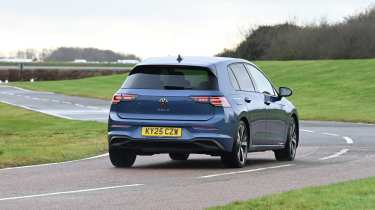
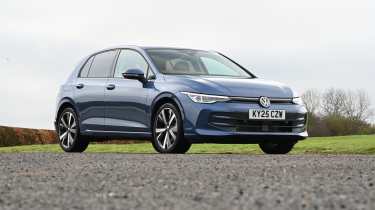
The overall profile of the Golf is still unmistakable, but the latest facelifted version features many subtle detail changes that give it more visual impact than the previous Mk7 model.
Interior and dashboard design
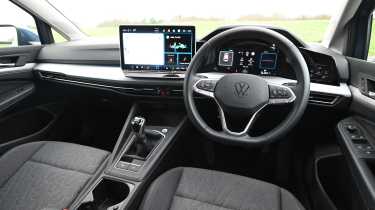
When the Mk8 first arrived, we found the cabin layout quite disappointing, with its reliance on touch-sensitive controls. However, a lot of the issues have been addressed in the Mk8.5 version. Take the touch-sensitive steering wheel controls, for example. These would be easy to knock when steering, but they’ve since been replaced by actual buttons, so this no longer happens, and they are far more intuitive to use on the move.
However, the main volume control and temperature adjusters are still sliders set below the touchscreen. This is less of a negative than before, though, because they are now backlit and a little more responsive. At least there are proper volume-control buttons on the steering wheel.
Materials and build quality
Initially, the Golf Mk8’s cabin was a let-down when compared with its Mk7 predecessor. The materials used didn’t feel quite as posh as we’ve come to expect from the famous nameplate, especially when you consider the premium that VW charges for the Golf when compared with its rivals.
Not too much has changed on that front with the Mk8.5, so while it all feels fairly well put together, rivals such as the Peugeot 308 and even the Skoda Octavia feel more expensive inside.
Infotainment, sat-nav and stereo
There’s a 13-inch Discover touchscreen system as standard, and while it doesn’t quite sit as neatly on the dash as the digital instrument cluster, it’s a welcome improvement over the system it replaces.
The latest screen has faster loading times, an easier-to-navigate menu layout, and, with its larger size, the climate controls are now permanently displayed at the bottom of the screen and are easy to access and use when on the move. We’d rather have physical controls for quick temperature adjustments, but the revised setup is much better.
Many of the Golf’s driver-assistance systems have been tweaked and are quickly accessible via a shortcut at the top of the touchscreen. Park Assist can now detect if a space is large enough for the car as it drives beside it. If it is, the VW can drive itself into the bay by adjusting the drive and steering. A 360-degree camera system is available as a £600 option on entry-level Life trim if you’d rather do it yourself but need a better view of your surroundings.
"There’s a sense of familiarity when you get behind the wheel of a Golf, because the basic layout has barely changed in more than 50 years of production, giving the latest Mk8 model a direct connection with every generation that has come before it." - Dean Gibson, senior test editor.
Boot space & practicality
Pros |
|
Cons |
|
Previous generations of the Volkswagen Golf have been available with three or five doors, as an estate and even a convertible, but the latest generation has slimmed down to just a five-door hatchback bodystyle. The end of the estate also means that the pseudo-SUV Volkswagen Golf Alltrack with four-wheel drive has also been dropped.
Dimensions and size
The Golf Mk8 grew a few centimetres over the Mk7, and the mid-life update has left the overall dimensions alone. As a result, the Golf is slightly smaller than some of its rivals, with the Vauxhall Astra and Kia K4 being longer and wider than the German hatch.
| Dimensions comparison | |||
| Model | Volkswagen Golf Mk8 | Vauxhall Astra | Honda Civic |
| Length | 4,282mm | 4,374mm | 4,560mm |
| Width | 1,789mm | 1,860mm | 1,802mm |
| Height | 1,483mm | 1,441mm | 1,408mm |
| Wheelbase | 2,620mm | 2,675mm | 2,734mm |
| Boot space | 381-1,237 litres | 422-1,339 litres | 409-1,187 litres |
Seats & passenger space
The driving position is spot on, while a wide range of adjustment in both the front seat and the steering wheel makes it easy for most people to get comfortable behind the wheel. Electric front-seat adjustment with memory settings can be had for £825, which might be useful if you share the car with another driver and want to quickly recall your seating position. The ability to raise the seat up high, if necessary, and the small windows in the windscreen pillars mean better visibility than in most rivals.
There are some well thought-out storage areas, from the large glovebox to a dedicated smartphone slot complete with wireless charging. The latter is angled forward, so your device can’t fall out of place while driving. The door bins are large and are carpeted both front and rear to stop items from rattling about. That does mean they’re not a great place to store snacks, though.
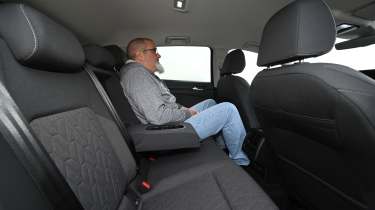
Adults will find a reasonable amount of kneeroom compared with most rivals, while the flat roofline means that even taller people have space above their heads. The outer seats are quite sculpted and are a little more upright than in other rivals.
If you need to squeeze three people in the back, the occupant of the middle seat will find there’s a high central tunnel they’ll need to straddle, forcing their feet into the space of the other two occupants.
Storage is decent, with map pockets and smaller smartphone slots on the back of the front seats. If only two people are sitting in the rear, there’s a fold-down central armrest with a pair of cup-holders.
A pair of Isofix child seat mounting points are provided on the outer positions of the rear bench seat, plus the front passenger seat. The hooks in the back are hidden behind some easily removable plastic tabs.
Boot space
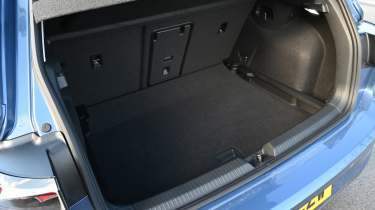
A 381-litre boot capacity isn’t the largest available in the segment, but it is a neatly designed shape with a fairly low loading lip. An adjustable-height boot floor is also available, helping to create a level load area in its highest position when the rear seat backs are folded down. When in this configuration, the hatchback’s overall storage capacity increases to 1,237 litres.
Just be aware that the R model has a smaller 341-litre boot due to modifications required in order to accommodate the four-wheel drive system. The battery pack in the plug-in eHybrid and GTE models takes up even more space under the boot floor, reducing capacity to 273 litres.
Towing
If you're planning on using your Golf for towing, then you'll be best served with the 148bhp 2.0-litre diesel that can tow a braked trailer or caravan of up to 1,600kg, or either the eHybrid and GTE plug-in hybrid models that can pull up to 1,700kg.
The 148bhp 1.5 TSI petrol and 114bhp 2.0 TDI diesel can haul around 1,500kg, while the 114bhp 1.5 TSI has 1,300kg of towing ability – although we suspect it’ll feel a bit underpowered up hills. Surprisingly, the Golf GTI and Golf R are both rated to tow, with max weights of 1,600kg and 1,700kg, respectively.
"It’s a shame that there aren’t as many bodystyles for the Golf as there used to be. The three-door hatchback disappeared while the Mk7 was still in production, and as for the estate, this did return for the eighth generation, but only on the Continent, because it’s not available in right-hand drive." - Dean Gibson, senior test editor.
Reliability & safety
Pros |
|
Cons |
|
The ownership experience seems to be improving for VW Golf owners, because it moved from second-from-bottom in last year's Driver Power customer satisfaction survey, to 41st out of the best 50 cars to own according to the 2026 results. There are still issues with the infotainment system, its balance of physical and touch-sensitive controls, and how user-friendly (or not in this case) its controls are. The high cost of servicing and running the Golf was also a point of contention with owners. They did like the exterior styling of their cars, the smoothness of its drivetrain, visibility from the driver's seat, and the quality of its ride.
In the best manufacturer rankings, Volkswagen climbs one place to 26th out of 30 in the 2026 results, but more still needs to be done. Mirroring the findings of the Golf, high running costs and the infotainment system were causes of concern, but owners liked the fit and finish of their cars, and boot capacity was another high point.
The Golf has a strong reputation for being safe, and the Mk8.5 comes as standard with plenty of safety kit such as adaptive cruise control, a driver fatigue-detection system, a road sign display system, and an autonomous braking feature that intervenes in an emergency to help reduce the possibility of accidents.
It also features Volkswagen’s advanced Car2X driver-assistance system. The tech communicates wirelessly with other similarly equipped vehicles, and is able to warn drivers of problems such as roadside hazards, broken-down cars, and vehicles ahead that have applied emergency braking. The system also uses the information it receives to detect when the end of a traffic jam is coming up, and is then able to re-engage the car’s adaptive cruise control once the traffic clears.
Euro NCAP put the latest Golf through its safety tests in 2019 and reassessed it in 2022 to ensure the earlier score was still relevant with a more rigorous testing procedure. In both instances, the popular hatch was judged to have a top five-star rating, although the Honda Civic that was also tested in 2022 achieved higher scores in the adult, vulnerable road user and safety assistance categories. At least the Golf did much better than the Peugeot 308, which only got four stars out of five.
| Euro NCAP safety ratings | |
| Euro NCAP safety rating | Five stars (2025) |
| Adult occupant protection | 80% |
| Child occupant protection | 86% |
| Vulnerable road user protection | 65% |
| Safety assist | 79% |
Buying and owning
Best buy: Volkswagen Golf 1.5 eTSI DSG Match
There has often been a premium to pay for a Golf over rivals such as the Vauxhall Astra, and the current VW starts from around £29,000, which is some £1,050 more than its rival. That’s for a Golf in Life trim, while a small increase of around £200 will get you behind the wheel of a Match version with a significant increase in standard kit. R-Line adds sportier looks and costs from around £32,500, while Style and Black Edition cost close to £33,500.
There’s also the hot plug-in hybrid GTE for around £40,000. The perennial GTI starts from £42,000, while the GTI Clubsport costs around £44,500 and the limited-run Edition 50 is just over £48,000. The quickest Golf R and R Black Edition models start from £46,000 and £48,500, respectively.
We think it’s worthwhile upgrading from the entry-level Life model to the better-value Match version because you get a few more useful features, plus this trim is available with our preferred 148bhp 1.5-litre petrol engine, whereas the less expensive Life only comes with a 114bhp version of the same engine that lacks the flexibility of its more potent sibling.
We’d recommend adding the Winter Pack (around £600) if you can, because a heated steering wheel and front seats are nice features to have on a cold morning. The surround-view camera pack (around £400) isn’t a bad choice if you want to get a top-down view of the car in order to help spot and hopefully avoid any kerbs.
With plenty of stock available at dealers across the UK, there are savings to be had on the Golf in any of its guises, and you can find the best Volkswagen Golf deals via the Auto Express Buy a Car service.
Volkswagen Golf alternatives
As mentioned above, the VW Golf faces competition not only from rival manufacturers, but also from the SEAT Leon and Skoda Octavia within its own stable. Other challengers include the Kia K4, Hyundai i30, Honda Civic, Mazda 3, Peugeot 308 and Vauxhall Astra, while the Ford Focus, a long-time class leader, is now only available from dealer stock. For those looking towards the premium end of the market, there’s the Audi A3 (another car based upon the same platform as the Golf), Mercedes A-Class and BMW 1 Series.
Anyone interested in a hybrid car but doesn’t fancy plugging in should consider either the excellent Honda Civic, or the frugal Toyota Corolla.
Volkswagen Golf pictures
Key updates of the Volkswagen Golf review
7 July 2026: General update with the latest Driver Power results
Frequently Asked Questions
Every VW comes with a 3-year or 60,000-mile manufacturer's warranty. That's not all that impressive these days, and is even beaten by the brand's own Cupra stablemate.
Deals on the Golf and alternatives