Volkswagen ID.4 review
The Volkswagen ID.4 is a practical electric SUV with a decent range, though it falls short of class-leading rivals
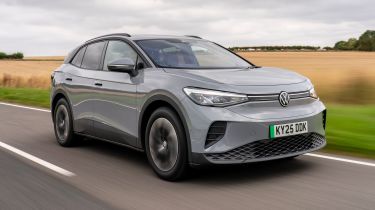

Our opinion on the Volkswagen ID.4
The Volkswagen ID.4 won’t set pulses racing, but that’s not really the point of this all-electric SUV. It offers more usable space than its smaller ID.3 sibling, along with a comfortable ride and practical electric driving range that makes it easy to live with. It’s not the most engaging EV to drive, and you’ll notice some of the trim inside is a little cheaper-looking than you might expect compared with its closest rivals, but overall, the Volkswagen ID.4 is a good, if not class-leading, electric family car.
About the Volkswagen ID.4
The ID.4 uses the VW Group’s versatile EV-specific MEB architecture, which also underpins the Volkswagen ID.5 coupe-SUV, Volkswagen ID.7 hatch and estate, the Volkswagen ID. Buzz MPV, as well as the Audi Q4 e-tron, Cupra Born, Skoda Enyaq and others. Even the Ford Explorer and Ford Capri are MEB cars thanks to a platform-sharing deal.
The regular ID.4 comes with either a 58kWh, 77kWh or 79kWh battery capacity. The smaller battery cars are dubbed Pure, while Pro and GTX models get the larger packs. Most versions have a single motor driving the rear wheels, but there are also 4Motion variants with all-wheel drive and two motors. The quickest GTX Edition is four-wheel drive only.
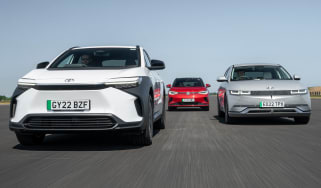
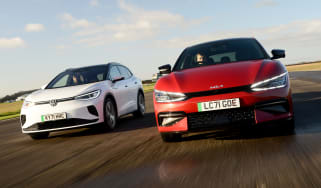
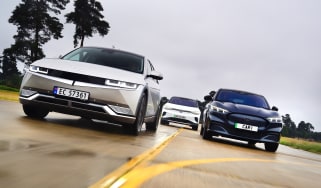
We’ve tested the ID.4 extensively, whether it be in individual road tests or as part of a larger group test against key rivals. Our latest group test saw us pitching an ID.4 against a Hyundai Ioniq 5 and Toyota bZ4X, but we’ve also pitted an ID.4 GTX version against the Kia EV6 along with another triple test involving a rear-wheel drive 77kWh ID.4 against a Ford Mustang Mach-E and Hyundai Ioniq 5.
Performance & driving experience
Pros |
|
Cons |
|
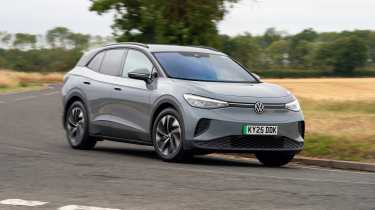
Volkswagen has tailored the ID.4’s driving experience to differ from similar electric cars. Torque is limited to help deliver smoother progress, and while this impacts the car’s sprinting ability compared to livelier Tesla Model Y or Volvo EX40 rivals, we think this suits the car’s family load-lugging bias better.
Used - available now


Piloting the ID.4 will ultimately feel familiar to anyone who has previously driven a mainstream VW model, past or present. Don’t expect too much in the way of driving enjoyment, and you won’t be disappointed.
| Model | Power | 0-62mph | Top speed |
| ID.4 Match Pure 58kWh | 187bhp | 8.5 seconds | 99mph |
| ID.4 Match Pro 79kWh | 295bhp | 6.1 seconds | 112mph |
| ID.4 4MOTION Match Pro 77kWh | 282bhp | 6.7 seconds | 112mph |
Electric motors, 0-60mph acceleration and top speed
Pure versions of the ID.4 with the smaller 58kWh battery develop 187bhp with 350Nm of torque. We’ve found this version feels far from underpowered, with a 0-62mph time of 8.5 seconds being perfectly adequate for a family car. The top speed is 99mph.
Because ID.4 models without 4Motion all-wheel drive send power to the rear wheels, there aren’t the issues putting power down on the road that you’ll find with front-wheel drive rivals. Even in wet conditions, you won’t experience the sort of wheelspin that the Renault Scenic suffers from.
Pro models with the larger battery pack are rear-wheel drive as standard, but can be had with all-wheel drive. As standard, there’s up to 295bhp on tap with a substantial 545Nm of torque for a 0-62mph sprint of as little as 6.1 seconds. Even in light of what we said about VW dialling back the power delivery in the ID.4 for smoother progress, these models feel very fast for a family SUV, and they’ll continue on to 112mph. Choosing a 4Motion four-wheel drive model shaves 0.6 seconds off that 0-62mph time thanks to the extra traction. The top speed remains unchanged, though.
The GTX Edition is the most performance-focused model in the ID.4 range. It comes with 335bhp and 679Nm of torque and four-wheel drive. The 0-62mph time of 5.4 seconds is rapid, though there are quicker mid-size electric SUVs, such as the Tesla Model Y.
Town driving, visibility and parking
The view out of the ID.4 is pretty good, with no serious impediments to seeing what’s happening around the car. A rear camera is standard on all models, and there’s a sound to help warn pedestrians that the ID.4 is in motion.
The Match trim adds Park Assistance Plus, with front and rear parking sensors that provide an audio warning when obstacles are detected. We felt they were a little overzealous, often suggesting an impact was imminent when there was actually room to spare. In most cases, it’s better to be safe than sorry, but you can switch off the reverse auto brake feature via a menu displayed in the reversing camera feed, which is especially helpful for those reversing up an inclined driveway.
Opting for a rear-wheel-drive version allows for a tighter turning circle than the four-wheel-drive 4MOTION models because there’s no electric motor sandwiched between the front wheels to reduce the steering lock available. It’s another reason we think cheaper rear-wheel-drive cars make the most sense.
Country road driving and handling
The ID.4’s steering is slow and light, contributing to an easy-going feel in normal driving that many buyers will appreciate, but there are plenty of alternatives that perform better than the Volkswagen on faster or twisty roads where drivers want sharper responses.
Switching to the Sport drive mode adds some directness and reassuring weight to the steering, but the suspension remains on the soft side, contributing to a noticeable amount of body lean in the bends. The ID.4 is a car that is better driven in a relaxed manner. We even found the sporty GTX model underwhelming from a driving-engagement perspective; aside from straight-line speed, it hardly feels any more dynamic than the lesser ID.4 models.
We wish there were more settings for the regenerative braking system. There are only two modes, and neither is strong enough to allow the one-pedal driving that can be so helpful in stop-start traffic - improving efficiency and meaning that you rarely have to use the brake. The Nissan Ariya, Renault Scenic and others offer full one-pedal driving modes.
Motorway driving and long-distance comfort
Comfort is much more of an ID.4 strong suit. Lots of EVs have quite busy low speed rides and jiggle across rough surfaces, but this Volkswagen smoothes things out very well. It doesn’t crash into bigger potholes or severe speed bumps, and we found the ID.4 has a better low-speed ride than the Ford Mustang Mach-E and the Hyundai Ioniq 5 during our head-to-head testing.
On longer motorway trips, things are just as smooth, and we have no complaints about refinement, either. There’s every excuse to utilise the adaptive cruise control and let the ID.4 glide on to your destination in complete comfort.
“There’s a lot of adjustment in the driving position and loads of headroom that taller drivers will appreciate. VW’s annoying steering-wheel buttons are still too easy to press accidentally while driving, however.” - Steve Walker, head of digital content.
Range, charging & running costs
Pros |
|
Cons |
|
In order to remain competitive, several members of the ID.4 line-up have received higher-capacity 58kWh and 79kWh battery packs in 2026. However, 4MOTION models have retained the existing 77kWh unit. The key result of this is a modest but useful boost in range.
The ID.4’s base Pure 58kWh battery provides enough juice for a range of up to 268 miles. If you want to go further between charging sessions, the Pro has the ID.4’s best range figures in rear-wheel drive form. This can cover up to 351 miles, depending on your chosen trim level.
The dual-motor 4Motion versions stick with the existing 77kWh battery pack, and the maximum WLTP combined range stands at 341 miles. This is a fairly light reduction considering the additional weight and inefficiencies of four-wheel drive. The high-performance GTX Edition is also fitted with the 77kWh battery, but its increased performance means a lower claimed range of 325 miles.
During a test in average UK temperatures, our 77kWh test car managed to return around 3.4 miles per kilowatt-hour, equating to a real-world range of 262 miles. We saw similar results when we put an ID.4 GTX against the Toyota bZ4X and Hyundai Ioniq 5 in warmer summer weather. An interesting and slightly worrying quirk we noted during our testing of the ID.4 in the summer was that switching on the air-con reduced the range by 27 miles.
The first time we drove the ID.4 GTX, it was in colder conditions, and it returned 2.7mi/kWh, demonstrating the effects of cold weather on the EV's range.
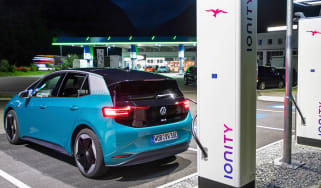
The ID.4’s maximum charging speed depends on which version you have. The 58kWh battery peaks at a DC rate of 105kW, which results in a 10 to 80 per cent top-up time of 26 minutes. A full charge from a typical 7.4kW home wallbox charger will take around eight hours.
Both 77kWh and 79kWh units can handle rapid charging of up to 165kW, but their larger capacities mean a slightly slower 10 to 80 per cent charge time of 29 minutes. Charging from empty at home will take just shy of 11 hours.
It’s worth noting that rivals like the Hyundai Ioniq 5 and Kia EV6 can reach a peak speed of 233kW and can be topped up even faster.
| Model | Battery size | Range | Insurance group |
| ID.4 Match Pure 58kWh | 58kWh | 265 miles | 24 |
| ID.4 Match Pro 79kWh | 79kWh | 347 miles | 33 |
| ID.4 4MOTION Match Pro 77kWh | 77kWh | 341 miles | 34 |
Insurance groups
The Volkswagen ID.4 is generally in keeping with its key rivals when it comes to insurance costs, but the entry-level Pure model won’t be too horrendous to cover in group 24 out of 50. The rest of the line-up lingers between groups 33 and 39, which is fairly similar to the Renault Scenic in groups 33 to 34. Meanwhile, the ID.4’s sister car, the Ford Explorer, sits in groups 21 to 33.
Check if your car needs an MoT and view its complete history with our MoT History Checker...
Tax
Driving a battery-powered car brings a lower tax burden. Business users choosing the ID.4 will benefit from the lowest applicable Benefit-in-Kind company car tax rate, not to mention the cheapest rate of VED road tax. A number of versions also dip under the £50,000 bar to avoid the electric luxury car tax. Be aware, though, that the ID.4 will be faced with the planned eVED pay-per-mile tax when it comes to fruition in 2028.
Depreciation
Our market data suggests that over a typical three-year/36,000-mile ownership period, the ID.4 will retain 35 to 42 per cent of its original value. Unfortunately, this is a rather weak performance compared to several key rivals. For example, the Renault Scenic holds 53 per cent, while the closely related Ford Explorer manages 47 to 54 per cent.
To get an accurate valuation for a specific Volkswagen ID.4, check out our free car valuation tool...
Interior, design & technology
Pros |
|
Cons |
|
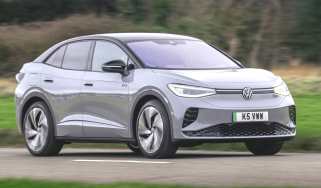
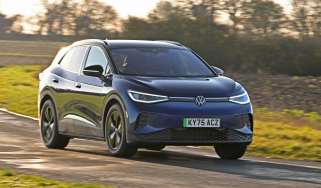
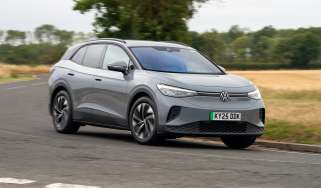
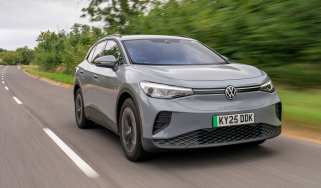
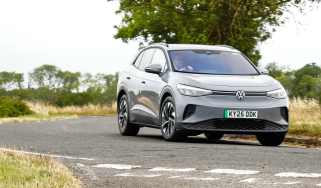
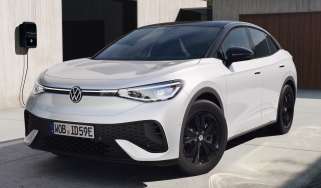
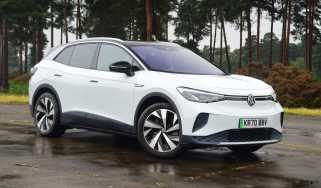
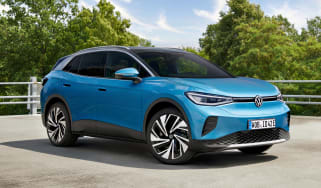
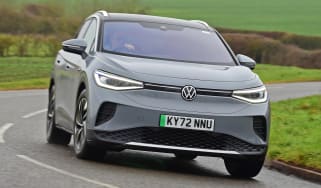
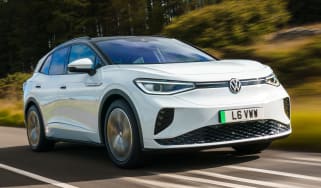
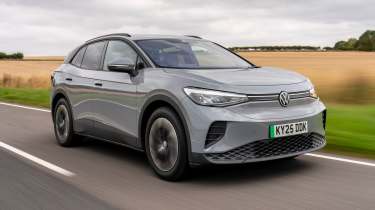
From the outside, the ID.4 looks smart enough, with its sleek, stylish lines helping to create a premium air. It’s not the most exciting shape on the road, but VW’s electric car design themes are in place.
The ID.4 range is complicated by the Pure and Pro powertrain options having slightly different levels of equipment. All the base Essential trim models come with the following:
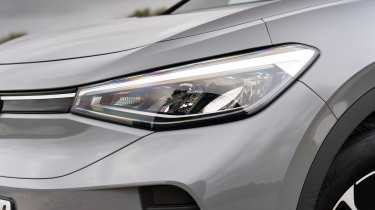
- LED headlights
- Discover Pro infotainment
- Heated front seats
- Keyless entry and start
- Ambient interior lighting
- Rear view camera
- Dual-zone air-conditioning
Pro Essential trim adds a set of ‘Play & Pause’ aluminium pedals over the standard ones.
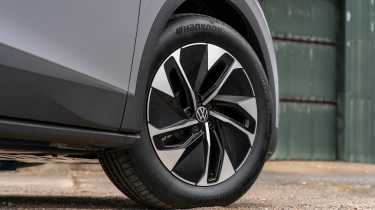
Match versions have a little extra kit, including 19-inch alloy wheels, an electric tailgate, and rear privacy glass, while Pro Match cars get adaptive LED headlights, exterior ambient lighting, rear LED tail lights with dynamic indicators, and the ‘Play & Pause’ alluminium padals. Black Edition cars have black styling elements and some upmarket equipment, including a panoramic glass roof and massaging front seats. The GTX Edition is fully loaded, featuring a head-up display and a raft of extra driver assistance features.
Interior and dashboard design
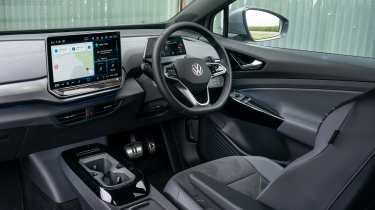
It’s a shame that this quality feel from the exterior isn’t quite carried over into the ID.4’s cabin. The ID.4 has a simple, clean design, but there’s little of the flair that rival models like the Renault Scenic and Peugeot E-3008 manage to include.
One of the irritations we originally had with the ID.4's cabin was the steering wheel’s touch-sensitive controls, which were awkward to use and too easy to press by accident when turning the wheel. However, as part of the 2026 refresh, the brand has replaced these with good old-fashioned buttons, meaning that accidental activation of the cruise control is far less likely.
Materials and build quality
Look closely, and you’ll notice that the VW’s material quality is no better than average. There’s a lot of piano black plastic and only a few splashes of aluminium to lift the rather drab tone. Build quality seems strong enough, but it feels to us like VW needs to do better to regain its reputation for classy car interiors.
Infotainment, sat-nav and stereo
A large 12.9-inch central touchscreen is now standard on all ID.4 models, and it controls virtually everything in the cabin. This also includes many of the climate control settings, which is a frustrating design decision in our opinion. There are touch-sensitive slider switches for the temperature and fan under the screen, but they can be awkward to use while driving.
The infotainment system itself is far slicker than the one the ID.4 featured at launch. Clearer menus and shortcut buttons have improved the user experience, but it’s still not one of our favourite setups. Skoda utilises similar Volkswagen Group software but supplements it with additional physical buttons and dials to make quick adjustments on the move easier.
Loading times for the infotainment system are quick, though - particularly with route mapping. We also like the small 5.3-inch digital instrument display mounted to the steering column, which adjusts with the steering wheel so it’s always visible. Wireless Apple CarPlay and Android Auto are convenient and useful features that work better than the built-in software - as is the case with most new cars today.
“The problem for the German firm is that many rival models in this space now match VW for materials and build quality while offering more interesting designs.” - Steve Walker, head of digital content.
Boot space & practicality
Pros |
|
Cons |
|
Family life with the ID.4 should be pretty straightforward because it offers superb practicality. In addition to the spacious interior, there are lots of storage areas and cubbies, with the central bin providing a wireless charging pad for your smartphone.
Other handy standard features include a rear centre armrest with two cupholders, rain-sensing wipers, a rear-view camera and a keyless go function.
Dimensions and size
The ID.4 is shorter than the Hyundai Ioniq 5 but longer than the Renault Scenic and Ford Explorer. It’s a little narrower than most of its direct rivals, however, which helps to make the ID.4 a little easier to pilot around town and park in tight spaces.
| Dimensions comparison | |||
| Model | Volkswagen ID.4 | Renault Scenic | Ford Explorer |
| Length | 4,584mm | 4,470mm | 4,468mm |
| Width | 1,852mm | 1,864mm | 1,871mm |
| Height | 1,640mm | 1,571mm | 1,630mm |
| Wheelbase | 2,771mm | 2,780mm | 2,770mm |
| Boot space | 543 litres | 545 litres | 470 litres |
Seats & passenger space
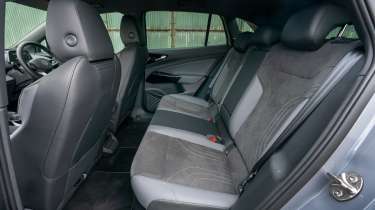
The driver and front passenger have plenty of space, with decent head and legroom. Rear-seat passengers will have no problem getting comfortable, and the flat floor allows three adult occupants to sit across the rear bench with little complaint.
Parents will be pleased to know that in addition to two Isofix points on the outer positions of the second row, the ID.4 also has a child seat mounting point on the front passenger seat, giving greater flexibility in where you can put your children. Check that the passenger airbag is disabled when using a rear-facing child seat position, though.
Boot space
Practicality is a real strength of the ID.4. Its useful 543-litre boot capacity betters that of the Ford Explorer, which only has 470-litres, and the Hyundai Ioniq 5, which has 527 litres. Folding the ID.4’s rear seats unlocks a vast 1,575 litres of space, but the seats don’t fold completely flat, leaving an incline to overcome when loading longer items.
Loading larger items is made easier by the relatively low boot lip and the square space inside. The Renault Scenic has slightly larger boot space overall, but the ID.4’s is a lot more uniform and useful in shape when it comes to packing.
Towing
All rear-wheel ID.4 models have a maximum braked trailer load limit of 1,000kg, while the four-wheel drive 4Motion cars up this to 1,800kg. This higher figure includes the sporty GTX Edition. This makes the four-wheel drive models some of the strongest electric tow cars, but they are matched by the Kia EV6.
“The deep seats and flat floor offer plenty of space, while the Black Edition’s panoramic glass roof brightens the otherwise black interior.” - Dean Gibson, senior road test editor.
Reliability & safety
Pros |
|
Cons |
|
Overall safety is worth highlighting because the ID.4 achieved a full five-star rating when crash tested by Euro NCAP both in 2021 and when it was retested under tougher criteria in 2025.
Standard safety kit for all ID.4 versions includes adaptive cruise control, autonomous emergency braking with cyclist and pedestrian detection, a driver fatigue alert system, dynamic road sign display and a lane-keep assist function.
However, while Euro NCAP’s testers are a happy bunch, it’s a different story with VW owners. The ID.4 didn’t appear in the 2026 Driver Power best cars to own list, but the brand wound up in a pretty meagre 26th out of 30 in the best manufacturer results. This placed Volkswagen far behind several rivals like Tesla (3rd), Vauxhall (6th), and Renault (9th). In fact, the only Volkswagen brand to perform even worse was Cupra in 27th place.
| Euro NCAP safety ratings | |
| Euro NCAP safety rating | 5 stars (2025) |
| Adult occupant protection | 89% |
| Child occupant protection | 87% |
| Vulnerable road user protection | 84% |
| Safety assist | 76% |
Buying, prices and deals
- Best buy: Volkswagen ID.4 Pro Essential
In its base Pure Essential spec, the Volkswagen ID.4 starts from around £37,000, but it’s an obvious choice to go for 79kWh Pro battery when you realise that the Government’s electric car grant (ECG) takes care of the additional cost. The overall driving range is better with the Pro, and you’ll get a boost in power as a bonus. We probably wouldn’t wander up through the trim levels, because the base model has enough kit for day-to-day needs.
The 4Motion models at the top of the range won’t be worth the extra outlay for most buyers, either, as the standard rear-wheel drive models offer better efficiency and manoeuvrability. We’d only opt for four-wheel drive if you need to tow a particularly heavy trailer.
If you’re interested in getting an ID.4, our Buy A Car service can help. You can configure your ideal Volkswagen ID.4 now to get top offers from local dealers, and check out the latest VW ID.4 leasing deals. You can even sell your existing car for a great price with Auto Express Sell My Car.
Volkswagen ID.4 alternatives
Being an electric mid-size family SUV, the ID.4 has plenty of rivals. It competes with the accomplished Skoda Enyaq and Audi Q4, which use the same VW Group platform, as well as the Ford Explorer, which employs the same technology.
The talented Korean duo of the Hyundai Ioniq 5 and Kia EV6 are always in the frame, while the Nissan Ariya, Renault Scenic and Peugeot E-3008 are also appealing options. The Tesla Model Y also remains very popular with its unique technology and Tesla's Superchargers to back it up.
Volkswagen ID.4 pictures
Frequently Asked Questions
Volkswagen offers a standard three-year warranty, although it does provide breakdown cover throughout this period for ID models. The battery pack comes with its own eight-year/100,000-mile cover.
Deals on the Volkswagen ID.4 and alternatives
More reviews
Car group tests
Road tests
Which Is Best