Jaecoo 7 review
The Jaecoo 7 delivers plenty of space and an upmarket appearance at a competitive price

Our opinion on the Jaecoo 7
Despite the Jaecoo 7 not having been in the UK very long, it's quickly established a following with car buyers who value its affordable price, interior space, and generous equipment list. It's even displaced the popular Ford Puma in the new car registration charts
About the Jaecoo 7
Jaecoo is a brand owned by Chery, which is China’s biggest car exporter, and has been for the past 20 years or so. Chery also sells cars in the UK, as does its other sub-brand, Omoda. Jaecoo is meant to be seen as the tough yet premium member of the family.
The line-up is pretty simple with three powertrains to choose from: a front-wheel drive 1.6-litre petrol with two- or four-wheel drive, a 1.5-litre hybrid or a 1.5-litre plug-in hybrid. Each variant comes with two trim levels, but these differ slightly depending on your chosen powertrain. A unique range-topping Luxury Black model is also available if you choose the PHEV.
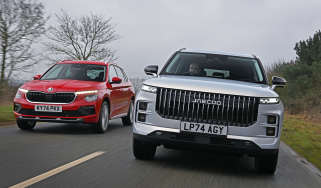
The Jaecoo 7 has some very well-established competition to face in the SUV world, as seen in our twin test of a 1.6 DCT Deluxe Jaecoo 7 against a Skoda Kamiq.
Performance & driving experience
Pros |
|
Cons |
|
The Jaecoo 7 is the brand’s first foray into the UK market, and it’s very much a case of ‘hit and miss’ with the overall driving experience. It doesn't really excel in any one area, and for everything it does well, there’s something else that disappoints.
Used - available now


One thing to note is that most versions come with front-wheel drive. However, you get get a four-wheel drive Jaecoo 7 – but only with the petrol engine and not with the hybrid or plug-in hybrid versions.
Performance, 0-60mph acceleration and top speed
The least expensive model in the range is equipped with a 1.6-litre turbocharged petrol engine, which makes 145bhp and 275Nm of torque and gets from 0-62mph in a fairly average time of 10.3 seconds. Switch the engine on, and it sounds a little noisy at idle. It’s also loud on other occasions, but these aren’t always its own doing; instead, it’s the fault of the laggy seven-speed automatic gearbox.
It's lethargic when moving off from rest, and makes the four-cylinder petrol unit groan as it pulls away. You can take manual control of the shifts, but doing so doesn’t improve things.
Given its claimed power figures, the Jaecoo 7 never feels as lively as you might expect. A Volkswagen Group car with a 1.5 TSI petrol engine offers similar power and torque stats, but feels quicker – even in models that match the Jaecoo’s size.
The petrol-powered 7 is available with four-wheel drive if you opt for the fancier Luxury trim, but this will be a tough model for most buyers to justify. The extra driven wheels blunt performance even more: the 0-62mph time increases by 1.5 seconds to 11.8 seconds, although the trade-off is more standard kit inside.
However, adding electrification to the mix generally improves things. Both the hybrid (SHS-H) and plug-in hybrid (SHS-P) versions offer much better straight-line speed than the standard petrol model, with an 8.3-second 0-62mph time for the hybrid and a marginally slower 8.5-second time from the heavier PHEV model.
| Model | Power | 0-62mph | Top speed |
| Jaecoo 7 1.6T Deluxe (2WD) | 145bhp | 10.3 seconds | 112mph |
| Jaecoo 7 1.5 SHS-H Pure | 221bhp | 8.3 seconds | 112mph |
| Jaecoo 7 1.5 SHS-P Luxury | 201bhp | 8.5 seconds | 112mph |
Town driving, visibility and parking
Slightly dull handling isn’t the end of the world, but elsewhere the Jaecoo 7 trails most rivals for sophistication. At low speeds around town, the ride can be a touch fidgety, but the petrol model isn’t quite as bouncy as the heavier plug-in hybrid.
The steering is very light, which makes parking fairly easy, with low-speed manoeuvres aided by the surround-view camera. This includes a system that can provide images of the road beneath the wheels, so you know how close they are to kerbs and other obstacles.
Country road driving and handling
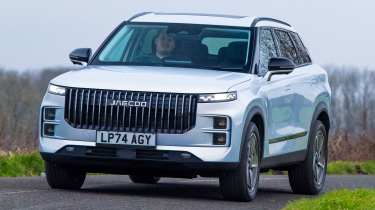
Keen handling isn’t the most important consideration for a family car, and in this respect, the Jaecoo 7 is just about adequate. Aside from the lifeless steering and the body getting thrown around by mid-bend bumps, it’s a fairly neutral and predictable – if slightly sluggish – car to drive through corners.
But it’s the ride that is the major issue. The car exhibits noticeable bounce at higher speeds, and shocks are transmitted into the cabin more abruptly than in other rivals.
Motorway driving and long-distance comfort
Having a long seventh gear is normally a good thing for motorway work, because it means the engine revs drop at a cruise, improving refinement and reducing fuel consumption. At 70mph, the engine settles down to a fairly hushed 2,000rpm in seventh gear, but whenever you need any throttle – such as on an incline – the gearbox will kick down to sixth to maintain its speed, only to shift up again too early, which in turn forces it to kick down and repeat a rather frustrating process.
On steeper inclines, our test car occasionally dropped down to fifth gear, so progress wasn't very smooth as a result. It’s a bit of a shame, because road noise and engine noise are as muted as in most other similarly priced petrol-powered cars.
MPG & running costs
Pros |
|
Cons |
|
For all of the engine’s issues, by far the worst problem with the pure petrol-powered Jaecoo 7 is its fuel consumption. Over the course of 300 miles or so, we averaged just over 27mpg, which is significantly down on its 37.7mpg WLTP combined figure, and is a figure that would leave us underwhelmed in a performance car with more than double the power – never mind a family-oriented SUV where running costs should be a priority.
The absolute best we recorded on any trip was 44mpg, but that was in a 50mph average speed section of motorway. Up the ante to 60mph or 70mph, and you’re looking at mid-to-high 30s mpg. On a similarly gentle motorway run, a Skoda Kamiq 1.5 TSI is capable of more than 50mpg, and it provides stronger performance.
The full-hybrid model carries a much more attractive claim of 51.4mpg on the WLTP combined cycle. However, we’re yet to test whether it can live up to this promise in the real world.
| Model | MPG | CO2 | Insurance group |
| Jaecoo 7 1.6T Deluxe (2WD) | 37.7mpg | 169g/km | 24 |
| Jaecoo 7 1.5 SHS-H Pure | 51.4mpg | 125g/km | 29 |
| Jaecoo 7 1.5 SHS-P Luxury | 403mpg | 23g/km | 32 |
Electric range, battery life and charge time
For the plug-in hybrid model, Jaecoo has designed the powertrain to ensure its 18.3kWh battery never runs flat. Of course, it achieves this by having the engine generate energy, but it means you’ve always got juice in the battery for running in EV mode, such as through town. According to the brand, you should be able to cover 745 miles on a full battery and a single tank of petrol.
However, even if the Jaecoo 7 SHS-P was as efficient as the brand claimed, you might never realise this because the car only shows how it has performed over the previous 50km (31 miles).
If you want to make the most of the EV driving capabilities, fully recharging the Jaecoo 7 SHS-P using a standard home wallbox takes nearly seven hours. It can be plugged into a public DC rapid charger, but these are much more expensive and with a maximum charging speed of 40kW, a 30 to 80 per cent top-up still takes 40 minutes.
| Model | Battery size | Range | Insurance group |
| Jaecoo 7 1.5 SHS-P Luxury | 18.3kWh | 56 miles | 31 |
| Jaecoo 7 1.5 SHS-P Black Luxury | 18.3kWh | 56 miles | 31 |
Insurance groups
The all-wheel-drive model falls into a lower insurance group than the front-wheel-drive petrol variant, with the pair in groups 23 and 24 (out of 50), respectively. The hybrid model takes a jump up to group 29, while the plug-in hybrid suffers from the highest premiums in group 31.
These insurance groups aren’t too outrageous for a mid-size SUV, but the Hyundai Tucson dips as low as group 16, while the Skoda Karoq starts from group 19.
Tax
Every Jaecoo 7 manages to duck below the £40,000 combustion luxury car tax bracket, but the standard rate of VED road tax still applies as always.
The PHEV may be the most appealing model in the eyes of business buyers due to its lower emissions and electric-only running, but the biggest company car tax savings come from driving a fully electric car. One of the closest zero-emission alternatives is the Jaecoo E5, but there’s also the closely related Omoda E5 to consider.
Depreciation
Our market data indicates the Jaecoo 7 should hold on to around 47 per cent of its original value after three years or 36,000 miles, which is similar to that of the Skoda Kamiq.
That's a little below the Nissan Qashqai, which maintains between 47 and 50 per cent of its original value, and the Tucson, which is expected to still be worth between 48 and 53 per cent over the same ownership period.
Interior, design & technology
Pros |
|
Cons |
|
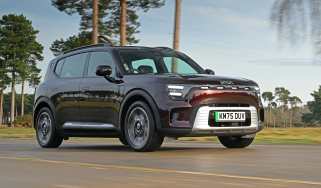
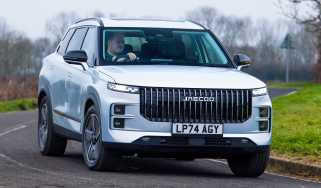
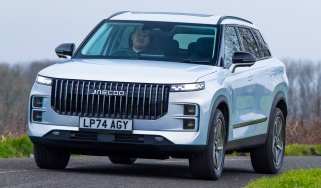
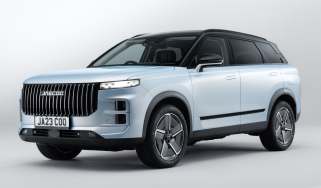
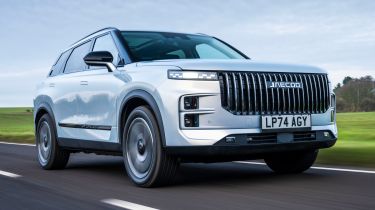
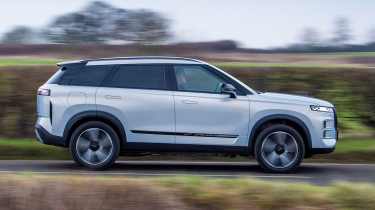
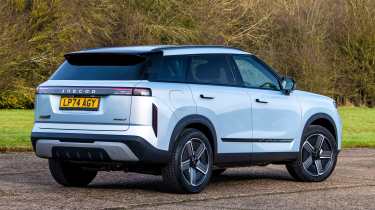
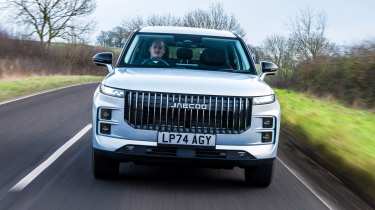
While some Chinese newcomers, including the Jaecoo 7’s Chery group stablemate, the Omoda 5, look a little anonymous, the Jaecoo has some features that help it stand out from the crowd. To either side of that huge front grille lie headlights with square LED elements, which look almost Audi-like.
Elsewhere, there’s clearly a lot of Range Rover influence, even down to small details such as the electrically retractable door handles. One thing that lets the side down are the 19-inch alloy rims, which make the 7 look rather ‘under-wheeled’.
One of the Jaecoo’s key strengths is its generous standard kit. Every model gets 19-inch alloy wheels, LED headlights, a 10.25-inch instrument cluster, synthetic leather upholstery and front heated seats. Upgrade to the Luxury trim (available on four-wheel-drive petrols and the PHEV), and you gain an eight-speaker Sony sound system, ventilated front seats and heated rear seats, a head-up display and a heated steering wheel.
Many cars have ambient lighting, and the Jaecoo 7 is no exception. You can select from a range of colours to personalise the gentle hue that glows from several places on the doors and the dashboard.
Interior and dashboard design
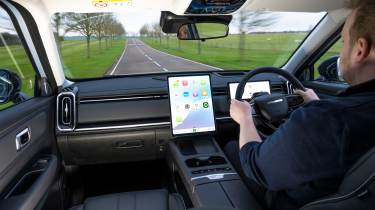
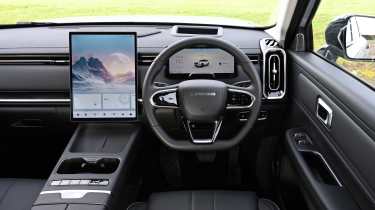
The Land Rover design inspiration continues inside. The steering wheel’s squared-off central boss and chunky spokes have more than a whiff of Range Rover Evoque about them, while the metal-effect door pulls with exposed screw heads remind us of the Land Rover Defender. The overall dash design is fairly minimalist, but too much so – there are very few physical switches for useful features such as climate control or even a rear window heater. A huge panoramic sunroof helps to make the cabin feel light and airy, though.
Materials and build quality
If you stick with the petrol engine, the dashboard features an oversized gear selector that looks like a spare part from a Transformer, a large drive-mode dial and some physical shortcut buttons.
The hybrid and plug-in Jaecoo 7 models instead have a column-mounted gear selector and a row of buttons on the centre console. Soft-touch plastics help to give an impression of reasonable perceived quality at first glance in every 7, and overall, this SUV feels on par with other cars available for similar cash.
Infotainment, sat-nav and stereo
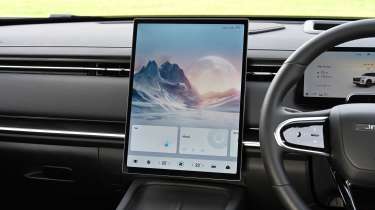
The base petrol Jaecoo 7 is equipped with a 13.2-inch screen, slightly down on the 14.8-inch display in the four-wheel-drive, hybrid and PHEV versions. As with the larger option, it’s a little frustrating to use. While the screen is fairly responsive and the loading times are okay, the interface isn’t so great.
Small icons on the home page don’t make the most of the large display, and when pairing Android Auto or Apple CarPlay, the native controls disappear completely. That includes the heating, which can only be adjusted through the screen, so you have to get out of your smartphone system back to the home screen to adjust the temperature, for example.
There is also some oddness to the in-car interfaces. When you change drive modes, for example, the in-car assistant will notify you; switching to Sport will cause a voice to announce, “Sport Mode!” It’s a charming quirk initially, but we suspect that it would become a bit irritating after a while. The digital driver’s display, meanwhile, looks sharp, but its information is scattered haphazardly across the screen.
"You can set the ambient lighting to flash in sync with the music. We use ‘with’ in the loosest sense – when we tried it, it didn’t really seem to keep time to the rhythm, but flashed on and off and changed colours at random. This is every bit as distracting as you might think." – Alex Ingram, Auto Express special contributor.
Boot space & practicality
Pros |
|
Cons |
|
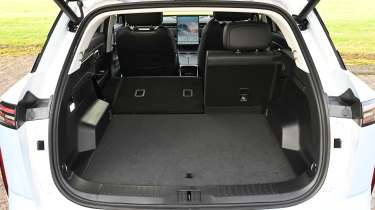
The Jaecoo 7 is a large car for the money, and those generous exterior proportions translate into lots of space inside. But some smaller B-segment cars run it close for cabin capacity, and take up less space on the road.
Dimensions and size
The Jaecoo 7 is similar in length and width to the Hyundai Tucson and Kia Sportage, but it’s still taller than both of those rivals.
| Dimensions comparison | |||
| Model | Jaecoo 7 | Skoda Kamiq | MINI Countryman |
| Length | 4,500mm | 4,241mm | 4,444mm |
| Width | 1,865mm | 1,793mm | 1,843mm |
| Height | 1,680mm | 1,534mm | 1,661mm |
| Wheelbase | 2,670mm | 2,650mm | 2,690mm |
| Boot space | 500 to 580 litres | 400 litres | 450 litres |
Seats & passenger space
A high driving position and a decent range of adjustment for the seats and steering wheel are plus points, but the driving position feels a touch offset, with your feet a little further to the right than seems natural. Comfortable headrests are very wide and gently curved, which, as with some of the exterior styling, feels inspired by certain Range Rover products. Less impressive is the view out of the back; the rear window is tiny.
Storage space isn’t in short supply, with the Jaecoo offering a deep and cooled central bin between the front seats. Ahead of that, there is space for two smartphones (one spot has cooled wireless charging) on a raised centre console. Below this is a large storage area. The door bins are wide, but a little shallow, yet the glovebox is reasonably roomy. There’s even a small shelf to store a tissue box, and a small slot above it works as a tissue dispenser.
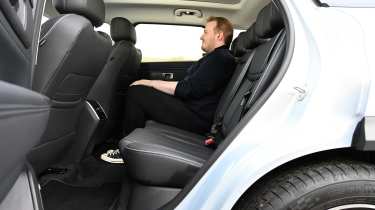
If you regularly need to carry four or more tall people, the Jaecoo is very hard to knock. Compared with most of its similarly priced competition, the 7 has acres of space in the back, offering impressive headroom and legroom. The cabin also feels wide enough to accommodate three people without much trouble, but the backrest of the centre seat is extremely hard, so it won’t be as comfortable, unlike the outer seats, which are soft and supportive.
Big doors and Isofix points that are easy to access behind large, plastic covers should make it fairly easy to install a child seat in the back. The only criticism is that, considering how much larger on the outside it is than some B-segment rivals such as the Skoda Kamiq, the Jaecoo 7 is not vastly more spacious for occupants.
Boot space
A 500-litre boot (580 litres for the entry-level petrol version without four-wheel drive) is very spacious when compared with cars of a similar price. Access is via a standard powered tailgate, and the load bay comes with a 12-volt socket and a couple of tethering points. The rear seats fold in a 60/40 split, which is fairly typical for the class, but isn’t quite as flexible as the 40/20/40 split used by more premium (and pricier) rivals such as the BMW X1.
Towing
Only the hybrid and PHEV Jaecoo 7s are rated to tow. These models can handle up to 1,500kg, which is on par with rivals like the petrol versions of the Hyundai Tucson and Kia Sportage. If you want to tow more, you’ll need something like the SEAT Ateca 1.5 TSI, which manages up to 1,800kg.
"The two-wheel drive petrol version has the largest boot, but it's not especially well thought out due to the non-adjustable height boot floor, meaning you can't make the luggage area nice and flat when the back seats are folded, which is especially annoying when loading longer items." – Max Adams, online reviews editor.
Reliability & safety
Pros |
|
Cons |
|
Euro NCAP awarded the Jaecoo 7 its maximum five-star rating when tested in 2025. That puts it ahead of similarly priced four-star rivals like the MG ZS, and Renault Symbioz. If you want an even safer alternative, you’ll have to pay a little bit more and get a Toyota C-HR, which scored higher than the 7 in all categories, except the safety technology section.
There was one caveat to the Jaecoo 7’s NCAP score, because it was penalised in the side pole and barrier tests due to the side curtain airbag not deploying correctly after getting caught in the C pillar trim. This problem was investigated and has since been rectified.
It is worth noting that this NCAP rating only applies to the plug-in hybrid model because that was the only version tested, but we doubt the lighter petrol version would be any less safe.
The 7 is equipped with a range of standard safety assistance technologies, including adaptive cruise control, blind-spot detection, and emergency lane-keeping.
| Euro NCAP safety ratings | |
| Euro NCAP safety rating | Five stars (2025) |
| Adult occupant protection | 81% |
| Child occupant protection | 80% |
| Vulnerable road user protection | 80% |
| Safety assist | 80% |
Buying, prices and deals
Best buy: Jaecoo 7 1.5T SHS-H Pure
Starting prices for the Jaecoo 7 range from just over £30,000 for the petrol-powered model and rise to just shy of £35,000 for the PHEV. Oddly, though, the full-hybrid is actually the cheapest model from around £29,200.
The Jaecoo 7 is already so well-equipped that there isn’t much scope for personalisation. It comes down to the exterior colours, because all but the no-cost white are £600 options, while a contrasting roof adds another £600. We’d suggest sticking with a single colour, because a contrasting colour doesn’t dramatically alter the way the car looks.
Due to its lower starting price and increased power and efficiency, we suggest opting for the hybrid model. Although the Deluxe trim level adds a lot of fancier kit, it adds nearly £4,000 to the price tag.
You can save on the list prices if you build your ideal Jaecoo 7 through the Auto Express Buy A Car service, where you’ll get top offers from local dealers. You can also check out the latest Jaecoo 7 leasing deals.
Jaecoo 7 alternatives
The Jaecoo 7 is aimed as a rival for models such as the Audi Q3, BMW X1 and MINI Countryman, but at a knockdown price. The reality is that it can’t compete with any of these more polished competitors, and we’d consider it more as a budget alternative to the likes of the Hyundai Tucson, Nissan Qashqai and Kia Sportage.
It’s similar in size to those cars, but the price tag positions the Jaecoo 7 in the small SUV sector, competing with cars such as the Skoda Kamiq, Renault Captur, and Peugeot 2008. Other Chinese cars, including the MG HS and the similar Omoda 5, are also rivals.
Jaecoo 7 pictures
Key updates of the Jaecoo 7 review
22 July 2026: General update with latest valuation information
20 May 2026: Hybrid powertrain details and latest pricing information.
9 December 2025: Update to include the latest Jaecoo 7 road testing results against rivals.
Frequently Asked Questions
There’s a long seven-year/100,000-mile warranty for the Jaecoo 7, which matches the longest amount of cover available in the new car market. What’s more, it’s backed up by seven years of roadside assistance, too.
Deals on the Jaecoo 7 and alternatives