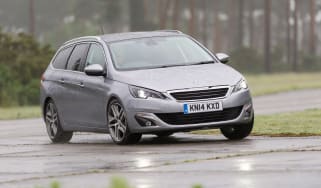
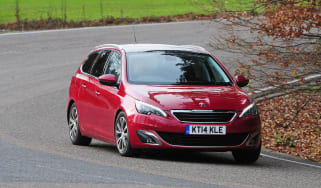
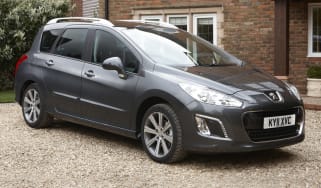
Peugeot 308 SW review
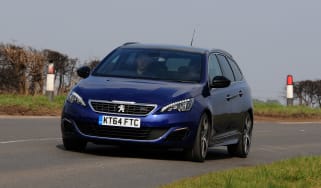
With eye-catching looks, impressive interior quality and a selection of electrified powertrains, the Peugeot 308 SW is an attractive family estate car


Our opinion on the Peugeot 308 SW
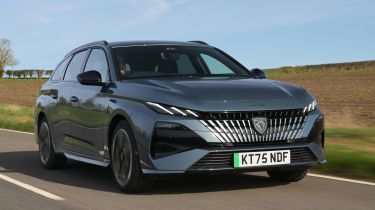
For those in the market for a stylish and practical family car with a premium-feeling interior that, crucially, isn't an SUV, the Peugeot 308 SW is certainly worth considering. The already-sleek estate car is even more eye-catching now, thanks to its mid-life makeover, meanwhile with full-hybrid, plug-in hybrid and pure-electric versions available, customers can pick whichever suits their needs and lifestyle best.
However, the 308 SW (as with its hatchback 308 sibling) doesn’t offer quite as much rear passenger space as some of its rivals, and there are a few load-lugging wagons, such as the Skoda Octavia Estate, that can carry even more junk in their trunks, which is the main reason you’d choose this type of car. Also the £10k price cut the electric E-308 SW has received makes it a far more attractive alternative to the endless number of EV SUVs on the market now, but the Peugeot’s range and rapid-charging abilities can't match those of its higher-riding rivals’.
About the Peugeot 308 SW
It can feel like estate cars are becoming a thing of the past when even the Ford Focus Estate is now dead and buried. However, the old-fashioned load-lugger is persevering, and there are new ones on the horizon, including the Subaru E-Outback and a Polestar 4 wagon. Meanwhile, the Peugeot 308 SW has been given an even sharper new look and some sizable price cuts to keep it in the fight against the army of family SUVs on the market now.
Used - available now


As well as a nip and tuck, during its mid-life refresh the 308 SW also dropped its pure-petrol engine and the diesel version has yet to rejoin the line-up. So for now, customers have a choice of two hybrid powertrains or the all-electric, snappily named E-308 SW. There are also three trim levels: Allure, GT and GT Premium.
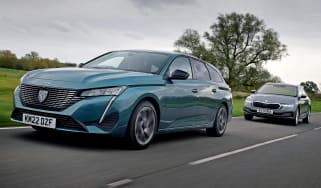
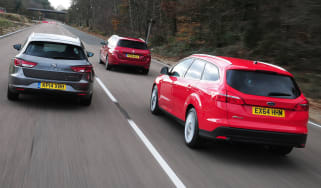
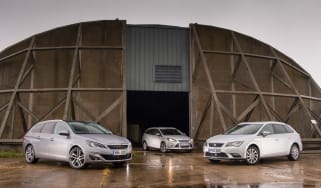
We’ve spent a lot of time (and miles) behind the wheel of the Peugeot 308 SW, as we lived with the hybrid version for a few months and found it to be a great all-round family car. However, we’ve also pitted the stylish French wagon against the award-winning Skoda Octavia Estate in a twin test, which it sadly lost due to cramped back seats which makes it a less practical family car than the more spacious Octavia.
Peugeot 308 SW prices and latest deals
The Peugeot 308 SW is available from just over £31,000, which is slightly higher than the Skoda Octavia Estate, however the base version features a pure-petrol engine and a manual gearbox. To get the Skoda with mild-hybrid power and an automatic transmission similar to the entry-level Peugeot, you’ll need to pay closer to £32,000.
Meanwhile, the E-308 SW starts from a little under £31,000, which is more than £10,000 less than it used to cost, thanks to a massive price cut and the Government’s Electric Car Grant (ECG), which knocks £1,500 off for customers.
That puts it in the same price bracket as other zero-emissions family cars such as the Skoda Elroq, MINI Countryman and Nissan Leaf SUVs, or Volkswagen ID.3 and Renault Megane hatchbacks. So the E-308 SW has to stand out, and this being a Peugeot, it knows how.
Performance & driving experience
Pros |
|
Cons |
|
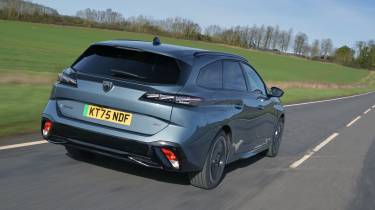
Peugeot’s reputation for delivering cars that are great to drive has taken a hit in recent years. The French firm’s back catalogue, from superminis to big saloons, was brimming with machines that served up fine handling and a cushioned ride, but its latest run of contenders has been rather average. Happily, while the 308 SW isn’t exactly a return to form, it is a capable and composed choice that isn’t as far behind the class leaders as you’d think.
That said, one of our biggest gripes with the 308 hatchback and estate is its eight-speed automatic transmission. While it’s smooth enough, it’s not the sharpest gearbox in the pack and can take a moment to get its act together when you need it to. It’s especially frustrating at low speeds, such as when attempting to pull away from a junction. Fortunately, only the diesel version will get the rather awkward gearbox.
| Model | Power | 0-62mph | Top speed |
| Peugeot 308 SW Hybrid 145 | 143bhp | 9.3 seconds | 130mph |
| Peugeot 308 SW Plug-in Hybrid 195 | 193bhp | 7.9 seconds | 140mph |
| Peugeot E-308 SW | 154bhp | 9.9 seconds | 106mph |
Performance, 0-60mph acceleration and top speed
The entry-level 308 SW hybrid features a 1.2-litre three-cylinder petrol engine while hybrid assistance is provided by an electric motor built into the car’s six-speed dual-clutch automatic transmission. This version produces 143bhp and 230Nm of torque; enough for 0-62mph in 9.3 seconds.
The 308 SW plug-in hybrid gets a 1.6-litre four-cylinder engine plus a much more powerful e-motor, which together deliver 193bhp and 300Nm of torque, cutting the car’s 0-62mph time down to 7.6 seconds. The PHEV can also hit up to 84mph in EV mode.
The E-308 SW’s front-mounted e-motor delivers 154bhp, which is sufficient to keep up with traffic, but this car feels slow by family EV standards and takes 9.9 seconds from 0-62mph. There’s a bit more oomph when you switch to Sport mode, but giving this car a little more power would have gone a long way.
Town driving, visibility and parking
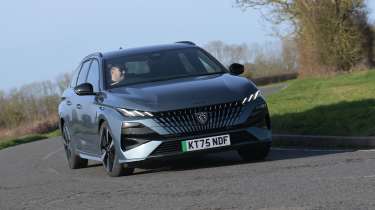
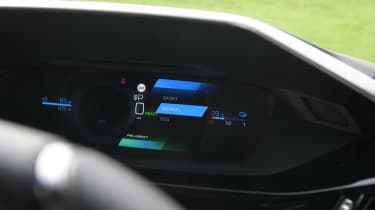
On the move, the 308 is fairly nimble in and around town, with its quick steering providing good feel and precision, although having to set the very small i-Cockpit steering wheel so low in order to read the instrument dials won’t be to everyone’s tastes. Both the driver and passengers will find the ride perfectly comfortable, though, with the 308 SW’s suspension set-up able to adequately smooth out any bumps in the road.
The E-308 SW has gained an adjustable regenerative braking system at last, with paddles between the steering wheel offering three strength levels, which we’d describe as ‘unnoticeable’, ‘barely noticeable’ and ‘fairly noticeable’ in terms of how quickly the car slows when you lift off the accelerator, and even the strongest setting does so very gently. There’s no one-pedal driving mode though or, more bizarrely, an auto-hold function which would help make driving in stop-start town traffic less stressful.
Country road driving and handling
On faster roads, the 308 SW flows with a pleasing poise and neutrality thanks to decent grip, while body movements are fairly well contained and the steering is direct. The recently deceased Ford Focus Estate was more agile and engaging to drive, but the Peugeot does have more than a hint of the nimble responses and supple ride that used to be a calling card of its famed family cars of the eighties and nineties.
Motorway driving and long-distance comfort
The Peugeot rides well on the UK’s pockmarked roads and does a good job absorbing the impacts from potholes, although you’ll hear a loud thud whenever you go over one. A fair amount of road noise comes into the cabin as well, and on uneven surfaces the car starts to fidget.
MPG, emissions & running costs
Pros |
|
Cons |
|
The base 308 hybrid is best for those who don’t have somewhere to charge their car or just don’t want to deal with the hassle that comes with that, meanwhile the E-308 EV should be the cheapest to run, especially for company-car drivers. The plug-in hybrid bridges the gap between the two, offering better fuel efficiency than the standard hybrid, but more flexibility than the all-electric version, thanks to its petrol engine.
Peugeot claims with the regular hybrid set-up the 308 SW can return up to 62.6mpg. This version should be particularly frugal if you spend a lot of time driving around town, because the electric motor can take some of the strain in stop-start traffic.
The same goes for the plug-in hybrid, but because it has a pure-electric range of up to 59 miles, thanks to a 17.2kWh battery, this version can supposedly hit up to 148.1mpg. Although, as with all PHEVs, owners will need to charge the car as regularly as they can and spend as much time as possible driving in EV mode to get close to that figure.
| Model | MPG | CO2 | Insurance Group |
| Peugeot 308 Hybrid 145 | 48.5-62.6mpg | 102-131g/km | 22E-23E |
| Peugeot 308 Plug-in Hybrid 195 | 106.9-148.1mpg | 43-60g/km | 29E-30E |
Electric range, battery life and charge time
Peugeot’s zero-emissions estate is now powered by a 55.4kWh usable battery (up from 50.4kWh before), which has bumped up the range from 255 to 275 miles. For comparison, the most affordable Skoda Elroq will do up to 267 miles on a charge, but other versions get a bigger battery that ups that to 355 miles.
We averaged 3.0mi/kWh during our testing across a variety of roads, which equates to a real-world range of less than 170 miles from a full charge. Speaking of which, the Peugeot’s 100kW maximum charging speed is also a long way off most of its rivals’, including the Skoda, which can hit up to 175kW. Fully recharging the E-308 SW’s 55.4kWh battery from a standard 7.4kW home wallbox should take about nine hours.
| Model | Battery size | Range | Insurance Group |
| Peugeot E-308 SW | 55.4kWh | 275 miles | 26E-27E |
Insurance groups
Insurance costs for the Peugeot 308 SW should be fairly reasonable. Depending on the specification, the base hybrid version falls into insurance group 22 or 23 (out of 50), then the E-308 SW offsets its low tax and recharging bills with slightly higher ratings of group 26 or 27. Premiums will be highest for those who opt for the plug-in hybrid, which falls into either group 29 or 30.
Tax
Company-car drivers will be most interested in the PHEV and EV versions of the 308 SW. The standard hybrid, which emits as low as 102g/km, falls into the 28 per cent band for Benefit-in-Kind (BiK), whereas the plug-in hybrid slips into the nine per cent bracket and, like all electric cars, the E-308 SW sits in the three per cent band. To put it another way, if you pay the basic rate of tax, you’ll have to pay £1,719 per year to run the base hybrid, but just £193 for the EV.
Depreciation
According to our latest expert data, the Peugeot 308 SW is predicted to retain between 44 to 46 per cent of its original value after three years and 36,000 miles of ownership. The plug-in hybrid model is expected to hold onto the most value, meanwhile the E-308 SW is expected to lose the most, although not by much.
To get an accurate valuation for a specific model, check out our valuation tool...
Design, interior & technology
Pros |
|
Cons |
|
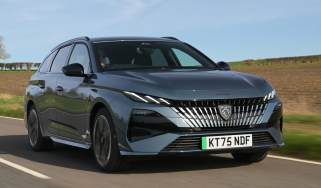
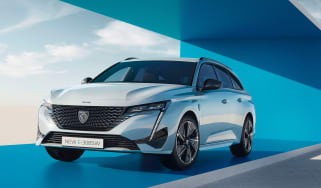
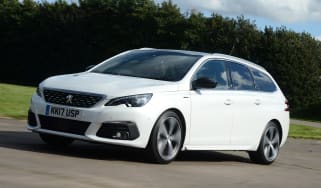
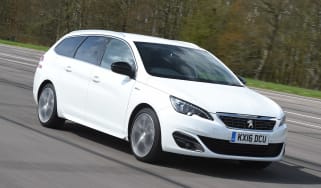
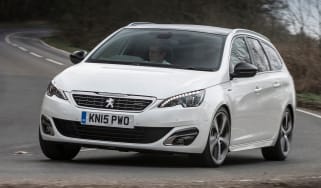
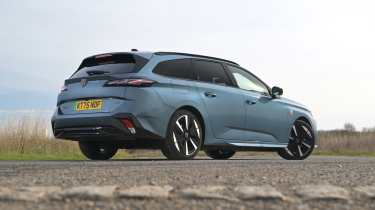
The majority of the visual changes are up front, with the new grille featuring thicker body-coloured accents and, for the first time, an illuminated Peugeot shield, which is found on all but the base-spec model. Illuminated logos seems to be the new trend for car brands at the moment, with Volkswagen, Vauxhall, Mercedes and others all blinging up their badges.
Peugeot’s old fang-like daytime running light design is gone, replaced by sleeker ‘three-claw’ DRLs that are connected by small LED strips in the nose. The main headlamps are now separate units, which are concealed by the large gloss-black air vents in the redesigned bumper that’s now more aggressive and helps make the car look wider.
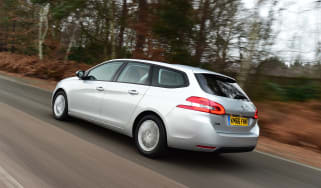
There are fresh 17 or 18-inch alloy-wheel designs, as well as a new Ingaro Blue standard paint colour. The only tweak to the rear is that every model now comes with 3D ‘three-claw’ tail-lights that used to only be fitted to range-topping examples.
Interior and dashboard design
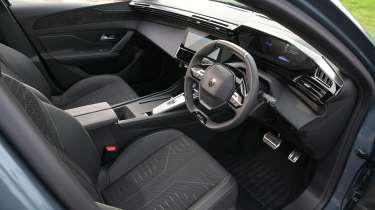
Changes to the interior for 2026 are far more subtle, extending to new seat fabrics, updated graphics for the 10-inch driver’s digital display and more luxuries for range-topping models, such as Alcantara heated, massaging seats and a 360-degree camera.
Of course, Peugeot’s unconventional i-Cockpit layout remains the proverbial elephant in the room. If you're not familiar, the set-up requires drivers to look over the top of the small, chunky, octagonal steering wheel to read the 10-inch instrument cluster. This can result in an awkward driving position for some people, as we can attest, so we recommend potential buyers try it out for themselves before they buy.
That said, we had less trouble finding a comfortable driving position in the E-308 SW than other Peugeot products we’ve tested and were still able to read the entirety of the display ahead. Although if you lower the wheel too much you can still punch yourself in the leg when cornering, so be mindful of that on a twisty road or adopt the police-approved wheel-shuffling technique.
Materials and build quality
The latest 308’s cabin has always felt well finished, and five years after the car was launched, it still looks and feels impressive. It easily outclasses the Volkswagen Golf or ID.3, which wouldn’t have been the case with the previous generation. Not only is the interior crisply designed, but it oozes premium appeal with its solid build and careful use of high-grade materials.
Infotainment, sat-nav and stereo
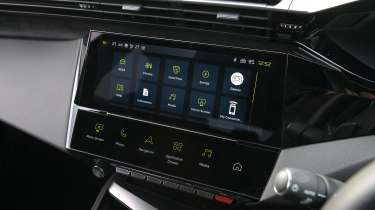
The 10-inch central touchscreen is bright and sharp, plus wireless Apple CarPlay and Android Auto are standard on every 308. However, the infotainment system is confusing to navigate and it’s not the most responsive, with Peugeot attempting to mask how slowly the menus load with Powerpoint-style transitions.
In GT or GT Premium models like the one we tested, you get another display with a row of large customisable ‘i-Toggles’ shortcut buttons that can help, and below that are physical switches, including one which can be used to deactivate some of the Advanced Driver-Assistance Systems (ADAS) features by pressing it for a second or so.
Most of the other functions on the car, such as changing the cabin temperature, have to be done via the main touchscreen, which can often be annoying and distracting due to its response times. Interestingly, in entry-level Allure trim the E-308 actually gets physical climate controls instead of the i-Toggles panel, including temperature dials and a rocker switch for the fan speed. These might not look as sleek, but we think that it might be the better set-up to use.
Boot space & practicality
Pros |
|
Cons |
|
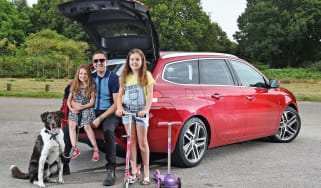
The i-Cockpit design and its smaller-than-average steering wheel might not suit everyone, but there’s plenty of adjustment available to help find a comfortable driving position where you can see all the dials, yet this takes a bit of time. The seats are supportive, too, and you’ll find plenty of handy storage dotted around the cabin, making the 308 SW a family-friendly choice.
Dimensions and size
Measuring 4,636mm from bumper-to-bumper, the 308 SW is slightly smaller than its cousin, the Vauxhall Astra Sports Tourer, and the Skoda Octavia Estate. Surprisingly, the Peugeot’s 2,735mm wheelbase is longer than the Skoda’s, however, that hasn’t translated into an extensive amount of rear legroom.
| Model | Peugeot 308 SW | Vauxhall Astra Sports Tourer | Skoda Octavia Estate |
| Length | 4,636mm | 4,642mm | 4,698mm |
| Width | 1,852mm | 1,860mm | 2,003mm |
| Height | 1,454mm | 1,443mm | 1,468mm |
| Wheelbase | 2,732mm | 2,732mm | 2,686mm |
| Boot space | 505-599 litres | 516-597 litres | 640 litres |
Seats & passenger space
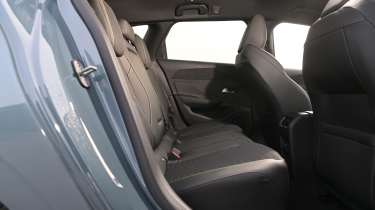
In terms of practicality, adults will find the rear cabin of the 308 rather cramped. There’s plenty of headroom, but only just enough legroom for anyone around six feet tall to squeeze in the back, and that’s only because the backs for the front seats have been sculpted in a way that makes room for passengers’ knees.
Kids and teenagers will be fine though, plus there’s a pair of USB-C charging ports and cup-holders for them. There are only two sets of Isofix mounting points for child seats, and they’re both in the back.
Boot space
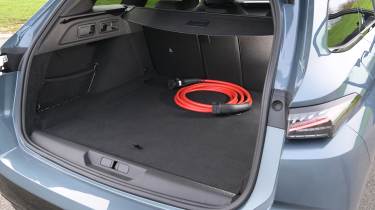
Luggage capacity in the 308 SW varies depending on which electrified powertrain you pick. The standard hybrid has a 599-litre boot, which is 187 litres more than the equivalent hatchback, however, the plug-in hybrid cuts the space on offer to only 467 litres. The E-308 SW splits the difference by offering 505 litres of boot space, which for comparison is 35 litres more than you get in a Skoda Elroq SUV.
The 308 SW’s boot is a nice square shape and there’s no load lip to contend with, so loading items should be a piece of cake. If you’ve a load of stuff to lug around, lowering the rear seats gives you up to 1,487 litres-worth of space to work with.
There are a couple of hooks dotted around if you need to stop luggage sliding around, plus a small storage net on one side and a 12V socket. There’s not much underfloor storage in the E-308 SW, but there’s just enough to cram the charging cable into the space.
Reliability & safety
Pros |
|
Cons |
|
The latest Peugeot 308 was tested by crash-safety experts Euro NCAP back in 2022 and it received a four-star rating (out of a possible five), as did its cousin the Vauxhall Astra, however, the Skoda Octavia was awarded the maximum five stars.
Arguably, the reason the 308 didn’t get a five-star rating wasn’t because of how well the Peugeot might cope in a crash, but was more to do with some of the safety technology reserved for higher-spec models or as optional extras when the car was launched.
Now though, every 308 comes with an active safety brake system that has a night function, plus cyclist and pedestrian detection, adaptive cruise control, driver-attention warning, lane-keep assist and traffic-sign recognition. However, you still have to upgrade to GT trim to get Peugeot’s SOS and assistance system, while only top-of-the-range GT Premium trim gets blind-spot detection and rear cross-traffic alert as standard.
Neither the 308 SW estate or its hatchback sibling featured on our latest list of the best cars to own, which is based on owners’ feedback from the Driver Power satisfaction survey. Two Peugeots did manage to make it onto the list though: the Mk2 3008 SUV and the Mk2 208 supermini.
Meanwhile, Peugeot as a brand finished seventh (out of 31) in the best manufacturer rankings, ahead of rivals such as Skoda (12th) and Nissan (15th), but behind fellow French firm Renault (sixth) and sister brand Vauxhall (fourth). Peugeot owners who took part in Driver Power were pleased with the handling of their cars, plus the interiors and practicality they offer. Value for money was the only area where the brand didn’t excel, finishing in 25th place in that category.
| Euro NCAP safety ratings | |
| Euro NCAP safety rating | Four stars (2022) |
| Adult occupant protection | 76% |
| Child occupant protection | 84% |
| Vulnerable road user protection | 68% |
| Safety assist | 65% |
Buying and owning
Best buy: Peugeot 308 SW Hybrid GT
We think the Peugeot 308 SW with Hybrid 145 powertrain is the pick of the bunch. It offers the most boot space in the line-up – which is the main reason most people buy an estate car – plus will be the cheapest to insure and should deliver impressive fuel efficiency. That said, if you’re a company-car driver, the electric E-308 SW is the one to go for, thanks to its rock-bottom tax bill. Plus GT trim offers extra kit such as a reversing camera, matrix LED headlights and keyless go.
Alternatives
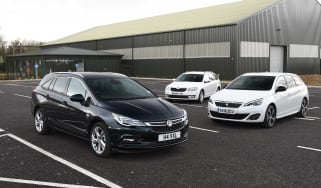
There might not be as much competition in the compact family estate car market as there once was, but the Peugeot 308 SW still has its challengers, and not just the Vauxhall Astra Sport Tourer which it's closely related to under the metal.
For instance, there’s the Toyota Corolla Touring Sports, which has a very efficient hybrid system and is surprisingly enjoyable to drive. Or there’s Skoda Octavia Estate, which is a fantastic all-round family car with masses of space and economical engines. But if room is a priority (and you’re looking for an estate, so why wouldn’t it be?), then it’s hard to look past the Skoda Superb Estate, which is more expensive but feels more upmarket and has one of the biggest boots (up to 690 litres) in the business.
Then, of course, there’s the litany of practical, family-friendly and highly regarded SUVs on the market for similar money to the 308 SW, such as the Nissan Qashqai, Kia Sportage, Renault Symbioz and Volkswagen T-Roc, to name just a few. Plus there are also all-electric ones like the Skoda Elroq and Renault Scenic E-Tech to consider.
Frequently Asked Questions
The Peugeot 308 SW is an attractive yet practical alternative to the army of ordinary family SUVs on the market these days, but there are more spacious estate cars around and the brand’s i-Cockpit isn’t for everyone.
More reviews
In-depth reviews
Long-term tests
Which Is Best
Most Economical
- Name1.6 Plug-in Hybrid 195 Allure 5dr e-DSC7
- Gearbox typeSemi-auto
- RRP£36,165