Renault Clio review
The Renault Clio is a star of the supermini class – stylish, well-built, good to drive and packed with tech

Our opinion on the Renault Clio
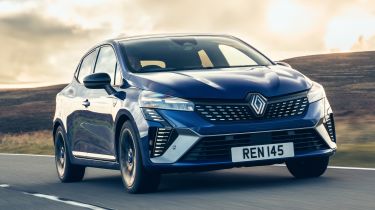
The Renault Clio refuses to relinquish its position as one of the best superminis on the market. A high-quality and well-equipped item despite its competitive pricing, the Clio feels as refined as much larger hatchbacks and handles well, too. The facelifted French supermini also has a new, much more striking look that’s transformed the already handsome Clio into a serious head-turner.
The interior admittedly lacks the wow-factor you get from Renault’s newer models and their Google tech, but the Clio’s cabin still feels polished and prioritises ergonomics over design, which is no bad thing. The full-hybrid Clio E-Tech offers impressive fuel economy and zippy EV-like performance around town, however a pure-petrol version remains available, with an attractive starting price and class-leading boot space. Either way, if you're after a capable supermini, the Renault Clio deserves your full attention.
About the Renault Clio
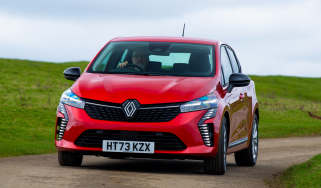
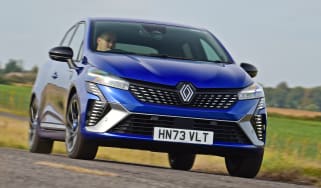
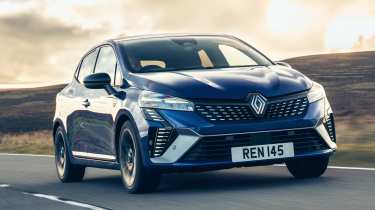
The latest Renault Clio’s striking look borrows heavily from the Renault Austral SUV, as well as the electric Renault Megane E-Tech hatchback. Design cues include an ‘F1 Blade’ in the front bumper and vertical daytime-running lights. Renault’s latest logo also sits proudly in the heart of the grille, while the rear has aerodynamic elements in the bumper to emphasise the car’s width.
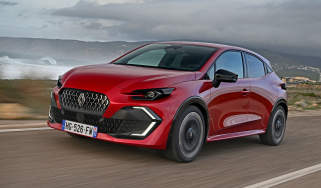
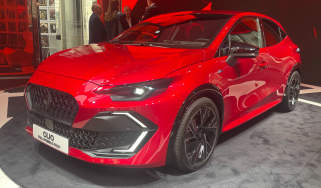
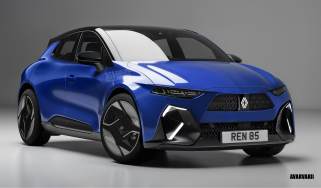
The current Clio was launched back in 2019, but its days are numbered as its replacement has already launched in Europe. This all-new model will eventually make its way to the UK in 2027. If you’re tempted by this next-generation Clio, be sure to read our road test.
Used - available now


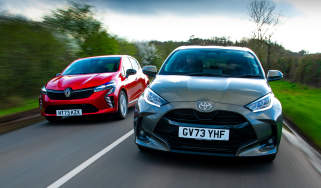
We’ve tested the current generation Clio numerous times; not only did we live with a Clio E-Tech for six months as part of our long-term test fleet, but we also evaluated one against a Toyota Yaris in a twin test. The Clio bagged the win thanks to its superior comfort, handling and value for money.
Performance & driving experience

Pros |
|
Cons |
|
Overall, the Renault Clio feels like a quality product on the road: polished, comfortable, and, at higher speeds, as refined as some hatchbacks from the class above. But the Clio has also garnered a reputation for driving thrills over the years, and it remains one of the better-handling superminis on the market.
| Model | Power | 0-62mph | Top speed |
| Clio 1.0 TCe 90 Techno+ | 89bhp | 12.2 seconds | 111mph |
| Clio 1.0 TCe 90 Techno Esprit Alpine | 89bhp | 12.2 seconds | 111mph |
| Clio 1.6 E-Tech 145 Techno+ | 141bhp | 9.3 seconds | 111mph |
Performance, 0-60mph acceleration and top speed
The regular Clio is powered by a turbocharged 1.0-litre three-cylinder petrol engine that produces 89bhp and 160Nm of torque, gets from 0-62mph in a rather lethargic 12.2 seconds, and goes on to a top speed of 112mph. Power is sent to the front wheels through a six-speed manual gearbox.
Meanwhile, the Clio E-Tech uses a 1.6-litre four-cylinder engine and two electric motors, which produce a total of 141bhp, with up to 205Nm of torque at your disposal when you’re running on the electric motor. Renault says the hybrid Clio will sprint from 0-62mph in 9.3 seconds, which sounds decent, but the gearbox can become a little flustered deciding which gear to select and when to change up or kick down. Top speed for the Clio E-Tech also stands at 112mph.
The E-Tech hybrid system is a little different to what you’ll find in a Toyota Yaris. While the Clio has two electric motors, only one helps to drive the wheels, with the second smaller motor used to fire up the engine and make gear shifts feel smoother. Power delivery is linear during hard acceleration, but once again, the transmission takes its sweet time deciding when it’s going to change gear, and there are no paddles on the steering wheel, or any other way to force it to shift up.
Town driving, visibility and parking
The Clio’s compact size means navigating urban sprawl is pretty much as stress-free as it gets. Visibility is very good all around, while the controls are light and easy to use. If there’s one area where the Clio is slightly flawed, it’s the thick C-pillars, which can be a bit obstructive when attempting to park. Fortunately, a rear-view camera is fitted as standard to help out when slotting into a space.
For the smoothest experience in town, you’ll want the Clio E-Tech. This model’s hybrid powertrain always starts off running in electric mode, so you simply zip away from a standstill. You have to be incredibly delicate with the throttle if you don’t want to wake the E-Tech’s petrol engine, otherwise it’ll wake from its slumber once you go beyond 20mph. The transition is smooth enough in the default ‘My Sense’ drive mode, but if you switch to ‘Sport’, then the step-change is more noticeable.
Country road driving and handling
The Clio’s steering is well-weighted and direct, and there’s just a hint of body roll as you chuck it into corners. This supermini also manages to remain composed even on bumpy back roads, thanks to its forgiving ride. The heavily bolstered sports seats in top-spec Esprit Alpine models also stop you from sloshing around the cabin when changing direction quickly, although wider individuals may find them a little snug.
The high-mounted six-speed manual gear lever in the pure-petrol model works well ergonomically, but doesn’t have the most engaging gear change action. Changing gear is a more pleasurable experience in a SEAT Ibiza or Volkswagen Polo, but there’s nothing especially terrible about the Clio’s manual ‘box.
Motorway driving and long-distance comfort
When it hits higher speeds, the Renault Clio does an admirable job of hiding the fact that it’s a supermini. Sure, it’s not about to threaten the likes of a fully-fledged luxury car, but the cabin remains reasonably quiet, and the ride quality copes well enough with the majority of the UK’s varying road surfaces. You’ll still feel some bumps, but the general smoothness is more than acceptable for the class.
In situations when you need to put your foot down hard, though, the TCe and E-Tech engines can become quite noisy and strained. However, they soon settle down once the Clio is cruising.
“While the Clio is larger than the Toyota Yaris, it’s no harder to manoeuvre at low speeds, plus it has a smaller turning circle that enhances its ability in town.” - Dean Gibson, senior test editor.
MPG & running costs

Pros |
|
Cons |
|
While some rival superminis like the Honda Jazz and Toyota Yaris are exclusively powered by hybrid tech, Renault told Auto Express that the pure-petrol Clio is still on sale “in order to meet the needs of some customers in a difficult economic climate."
The entry-level Clio TCe 90 uses Renault’s familiar turbocharged 1.0-litre three-cylinder petrol engine. This three-pot motor comes paired with a six-speed manual gearbox, emits between up to 119g/km of CO2 and can average up to 54.3mpg on the WLTP combined cycle.
Renault claims the Clio E-Tech hybrid will return up to 67.3mpg on the same cycle and emit up to 99g/km of CO2. We couldn’t match this level of fuel economy when we tested the hybrid supermini on UK roads, although we did manage to average 56.2mpg on a journey that included towns, motorways and a couple of spirited blasts on back roads. Following the same test, the Toyota Yaris managed 58.5mpg, which was slightly better than the Clio but still a long way off its official figure of 68.9mpg.
Due to it being a full-hybrid rather than a plug-in hybrid, the Clio E-Tech doesn’t have an official electric driving range. Its 1.2kWh battery allows for low-speed electric-only running, but Renault maintains you could spend 80 per cent of your time driving on battery power when in town.
| Model | MPG | CO2 | Insurance group |
| Clio 1.0 TCe 90 Techno+ | 53.3mpg | 119g/km | 11 |
| Clio 1.0 TCe 90 Techno Esprit Alpine | 53.3mpg | 119g/km | 11 |
| Clio 1.6 E-Tech 145 Techno+ | 65.7mpg | 98g/km | 16 |
Insurance groups
The Renault Clio sits in insurance groups 10 to 15 out of 50 so premiums will be on the lower to average by supermini standards. In its combustion form, the Vauxhall Corsa is generally pricier to cover than the Clio, in groups 19 to 27. The Peugeot 208 also finds itself way above the Renault in groups 22 and 23. However, one of the very cheapest superminis to insure is the Skoda Fabia, as this dips as low as group 4 — perfect for new drivers.
Tax
Every Renault Clio is liable for the standard rate of VED road tax, but its low pricing structure means it dodges the luxury car tax surcharge, even if you opt for the range-topping Iconic Esprit Alpine model.
Although hybrid power is on the table, company car drivers won’t see any mega tax savings with the Renault Clio. Instead, you’ll be far better off with an electric car as these incur the very lowest Benefit-in-Kind (BiK) rates. For now, the closest alternative to the Clio is arguably the Renault 5, while other electric supermini options include the Fiat Grande Panda, Peugeot E-208 and Vauxhall Corsa Electric.
Depreciation
Our market data indicates that the Renault Clio puts up a fairly strong fight against depreciation. After three years or 36,000 miles, the French supermini is set to retain 46 to 50 per cent of its original value. This is a far better outcome than the one faced by the Vauxhall Corsa, as that only scrapes 34 to 42 per cent. The Peugeot 208 is more in line with the Clio, though, at 45 to 49 per cent.
To get an accurate valuation on a specific model check out our free car valuation tool...
Interior, design & technology
Pros |
|
Cons |
|
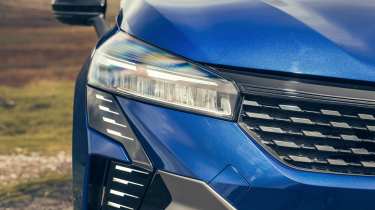
When the Clio underwent its mid-life facelift, Renault decided to ditch the smooth, subtle front end it originally had for a much sharper and certainly more distinctive look that takes its inspiration from the Renault Austral and Rafale SUVs, along with the Megane E-Tech hatchback.
The updated Clio’s LED headlights are slimmer than before and are flanked by a very dramatic lighting signature. The rear end also received a bit of a nip and tuck, with new tail-lights and aerodynamic elements in the rear bumper to emphasise the car’s width.
Interior and dashboard design
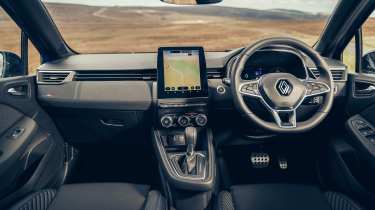
It was already one of the best interiors in the supermini class, so we’re not surprised Renault didn’t change much as part of the car’s facelift. That said, a few more tweaks wouldn’t have gone amiss, as the Clio’s cabin lacks the wow-factor you get from the Austral or Megane, and the Google tech featured in both.
On the plus side, the Clio’s dashboard continues to prioritise ergonomics over style, as it still uses physical dials and piano-style keys, plus all the major controls are raised so they’re easy to reach when you’re driving. A touchscreen infotainment display – available in two sizes – sits proudly in the centre, canted towards the driver, and is also easily reached and operated.
Materials and build quality
Compared to its predecessor, the Mk5 Clio has taken some big steps forward in terms of build quality, materials used and, perhaps most importantly in today’s market, infotainment.
There’s a lot of plastic on show, but the majority of it feels of good quality and it’s all well put-together. Plus, you won’t find any cowhide inside the Clio now, with certain models instead using either bio-sourced or partially recycled materials.
Infotainment, sat-nav and stereo
Every Renault Clio comes with wireless Android Auto and Apple CarPlay connectivity, sat-nav, a digital driver’s display and central touchscreen. But as we mentioned, lower-spec cars get two seven-inch displays, meanwhile, top-of-the-range models feature a 10-inch instrument panel and 9.3-inch touchscreen.
The Clio doesn’t benefit from Renault’s magnificent Google-powered OpenR Link infotainment software, like you’ll find in the Megane E-Tech and Austral. Instead, it sticks with Renault’s older ‘easylink’ setup that’s still easy enough to navigate, and the home page – split into three main functions – is reminiscent of the systems fitted to more premium offerings. But the Clio’s system can be quite sluggish at times, and simply isn’t as intuitive as the firm’s latest software.
The lack of a physical volume knob means that it’s not immediately obvious how to adjust audio settings on the move compared with other superminis, but the Clio does feature extra controls mounted behind the wheel on the steering column. They’re largely unchanged from Renaults built as far back as 20 years ago, and with good reason – the setup is very simple and easy-to-use.
“I was worried how the pale seats would stand up to everyday use, and although six months isn’t that long, I’ve been surprised that they still look as good as new.” - Dawn Grant, pictures editor.
Boot space & practicality

Pros |
|
Cons |
|
The Renault Clio’s revised underpinnings have allowed for some improvements in cabin space over its predecessor. All models are five-door only but retain a sporty three-door look thanks to expertly disguised rear door handles tucked into the C-pillars.
It’s easy to get comfortable up front in the Clio. There’s a wide range of adjustment, especially in the steering column, and the seats themselves are comfortable. Ergonomics are a strong point for the Clio, too, as the gear lever and other important controls are all easily reachable, plus the climate controls are just three simple, physical knobs below the touchscreen. Even the touchscreen is close enough that you don’t need to stretch to access its menus.
The Clio’s spacious doorbins and the enclosed storage between the front seats are also ideal for family use.
Dimensions and size
The Renault Clio sits within just a few millimetres of the Skoda Fabia and Vauxhall Corsa’s dimensions. Helpfully, Renault also supplies a measurement for the height of the open boot hatch – 1,979mm, in case you’re wondering.
| Dimensions comparison | |||
| Model | Renault Clio | Vauxhall Corsa | Skoda Fabia |
| Length | 4,053mm | 4,060mm | 4,137mm |
| Width | 1,798mm | 1,765mm | 1,780mm |
| Height | 1,440mm | 1,435mm | 1,482mm |
| Wheelbase | 2,583mm | 2,538mm | 2,549mm |
| Boot space |
391 litres (petrol) 301 litres (hybrid) |
309 litres (petrol) 267 litres (electric) | 380 litres |
Seats & passenger space
Improved packaging means there’s more room inside the Clio than before. Space in the back isn’t quite as good as in the Skoda Fabia, but it’s still generous. However, the back-door openings are fairly small, which could make fitting a child seat more difficult compared to rivals.
Some children might also find it tricky to open the cleverly concealed door handles, located high up in the C-pillars. Child seats can be fitted to the outer positions of the rear bench seat using a pair of standard-fit Isofix mounting points, along with another position on the front passenger seat.
Boot space
The pure-petrol Clio boasts a hugely impressive 391-litre boot. It’s one of the largest in the supermini class, surmounting rivals like the Skoda Fabia (380 litres), Volkswagen Polo (351 litres) and Toyota Yaris (286 litres). In fact, it’s even more than the 381 litres offered by the much larger Mk8 Volkswagen Golf. Folding the Clio’s rear seats down increases the luggage capacity to 1,069 litres.
However, the Clio E-Tech only has a 301-litre boot, and offers 1,006 litres of space with the rear seats folded down. That’s because the 1.2kWh battery for its hybrid powertrain is located under the boot floor, eliminating the underfloor storage you get in the regular Clio. Luggage capacity is still up on other hybrid superminis like the Toyota Yaris and Honda Jazz, though, and within spitting distance of the Peugeot 208 and Vauxhall Corsa.
Whichever version you pick, the Clio’s boot opening is still wide, and the load area itself is nice and square. However, because of how deep the Clio’s boot is, the load lip is substantial, and aside from a few bag hooks, the boot is devoid of any features. We also noticed that the button to open the boot is on the rear bumper, so it is easily covered by dirt and other road grime.
“The Renault Clio has more headroom, but the Toyota Yaris has a wider range of legroom, while deeper cutouts in the doors mean it offers more elbow room. But the Clio has better foot space under the front seats, and the soft fabric seatbacks mean there’s better space for knees, while the longer seat bases give better support.” - Dean Gibson, senior test editor.
Reliability & safety
Pros |
|
Cons |
|
The fifth-generation Renault Clio is the safest yet. It was originally crash tested by Euro NCAP in 2019 and not only was it awarded the industry body’s maximum five-star rating, but it also received 96 and 89 per cent scores in the adult and child occupant protection categories.
However, due to the car and test’s respective advancing ages, the Clio was retested in 2025 under much more stringent criteria. This time around, the little Renault only managed a four star rating, which means it now falls short of the Skoda Fabia’s five stars.
The Clio isn’t without its fair share of advanced safety and assistance tech, though. All trim levels get automatic emergency braking (AEB), lane-departure warning, lane-keeping assist, traffic sign recognition, emergency brake assist, a reversing camera and cruise control.
With a 24th-place finish out of 50 models in the 2026 Driver Power best cars to own results, Renault Clio ownership appears to be rather enjoyable for most. Owners have been particularly pleased with the amount of value on offer, as well as their cars’ safety. However, visibility and rear legroom were two areas that held the Clio back.
| Euro NCAP safety ratings | |
| Euro NCAP safety rating | 4 stars (2025) |
| Adult occupant protection | 79% |
| Child occupant protection | 82% |
| Vulnerable road user protection | 80% |
| Safety assist | 73% |
Buying, prices and deals
Best buy: Renault Clio 1.6 E-Tech 145 Techno+
The addition of a new entry-level Generation trim saw the hybrid Clio’s starting price brought down to match the petrol’s at around £21,000. However, that price will get you a higher-spec petrol model in Techno Esprit Alpine trim.
If you want the extra goodies that are included with the Techno Esprit Alpine but with the lower running costs and boosted power of the E-Tech, you’ll be looking at a price of around £23,500. We think this is worth it as it provides the best of both worlds without shelling out too much extra money.
Whichever model takes your fancy, you can save plenty on your new car when you build your new Renault Clio with the Auto Express Buy A Car service. We also have a wide selection of Clio leasing deals to choose from, as well as used Clio models in stock and ready to hit the road. We can also help you to sell your car.
Renault Clio alternatives
The Peugeot 208 is another style-conscious supermini that’s built in France, but unlike the Clio it also comes with a fully electric sibling, the Peugeot E-208. Both of these cars also have their own closely-related twins, the Vauxhall Corsa and Vauxhall Corsa Electric.
Those aforementioned rivals all come from under the Stellantis umbrella, but the VW Group also has several hats in the ring with the SEAT Ibiza, Skoda Fabia and Volkswagen Polo.
For those who are considering an electric car, the Renault 5 is similarly priced to the Clio and a firm Auto Express favourite. If you’re charmed by this car’s retro styling, the Fiat Grande Panda might also take your fancy.
Renault Clio pictures
Key updates of the Renault Clio review
3 September 2026: Latest line-up and pricing information.
Frequently Asked Questions
The Renault Clio is covered by the brand’s standard three-year/60,000-mile warranty plan.
Deals on the Clio and alternatives