Best electric SUVs to buy 2026
The electric SUV market is growing rapidly, so we’re here to help you pick the best ones to buy
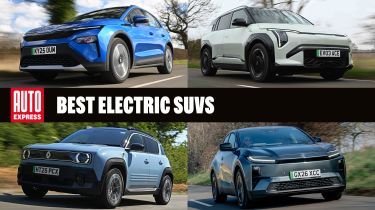
Britain is well on its way with the switch to electric power, and we are a nation in love with our SUVs. It means the best electric SUVs sit in a real sweet spot where two crucial and rapidly expanding sectors collide.
Our research shows that running costs, price and practicality are still the most crucial deciding factors for SUV buyers and the same applies to electric SUVs. Customers will be looking for a spacious family car with costs they can afford and the choices made by our team reflect that. Several of the cars included in this list qualify for the Government’s Electric Car Grant and we’ve highlighted them.
To help you decide on the best electric SUV to buy, our expert road testers have tested every electric SUV on offer in the UK and whittled this ever-growing list down to the top 10. All of these cars are kinder to the environment than combustion-powered SUVs, but they also offer far more reasonable running costs along with that surging EV performance.
Compare the top 10 best electric SUVs
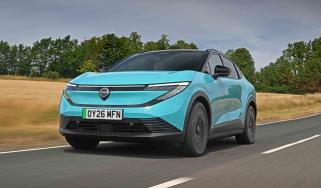
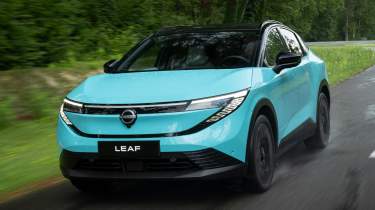
The all-new Nissan Leaf is the best electric SUV on sale - it’s a great car, and we voted it Car of the Year at the 2026 Auto Express New Car awards.
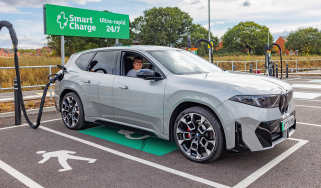
It’s moved the excellent BMW iX3 down a spot, though if you’re looking for a premium electric SUV, the iX3 is still the one to have as our 2026 Mid-size Premium SUV winner. The recently-announced iX5 might change that soon, however.
One of the iX3’s rivals, the Volvo EX60, now takes our third spot. It’s a different proposition to the iX3, less dynamic and a little more understated, but Volvo’s way of thinking is still appealing for plenty of buyers.
| Rank | Car | Prices from |
| 1 | Nissan Leaf | £32,600 |
| 2 | BMW iX3 | £53,300 |
| 3 | Volvo EX60 | £56,900 |
| 4 | Skoda Elroq | £34,000 |
| 5 | Renault 4 | £23,500 |
| 6 | Citroen e-C5 Aircross | £34,000 |
| 7 | Kia EV3 | £36,100 |
| 8 | Tesla Model Y | £42,000 |
| 9 | Renault Scenic | £33,300 |
| 10 | Toyota C-HR+ | £34,500 |
Keep reading to find out about the best electric SUVs on sale in the UK right now. You can also click the links in the table above to jump down the page to a specific model. Let’s get started..
1. Nissan Leaf
Auto Express Car of the Year for 2026, the new Leaf is the best one yet.
- Prices from £32,600
- Eligible for Band 1 of the Electric Car Grant
- Auto Express Car of the Year 2026
| Pros |
|
| Cons |
|
Fifteen years ago the Nissan Leaf didn’t have much competition in the electric car world, but also presented no real challenge for the best cars in the market overall. In 2026, things have changed somewhat: not only has the new, more crossover-styled Leaf become our favourite electric SUV against much stronger competition, but it’s also the Auto Express Car of the Year 2026.
At times Nissan has appeared to squander its early-mover advantage with EVs, but that isn’t the case with the new Leaf. Not everyone will appreciate the transition to an SUV body style but ultimately that’s what sells these days, and as a styling exercise it’s easier on the eye than the original or the somewhat dull Mk2 car. The 4.35m-long body also provides good passenger and boot space despite a rakish roofline.
Then there’s the range, 386 miles at its most generous - well over three times that of those first-generation cars that hit the UK in early 2011. From a 75kWh battery pack that signals impressive efficiency, at 4.5 miles per kWh. And while a 215bhp motor in the 75kWh car (52kWh Leafs get 174bhp) doesn’t sound much compared to some of the blisteringly fast EVs on the market, it’s hard to imagine family buyers being too put-out by a 7.6-second 0-62mph time.
The Leaf also rides and handles well and is naturally very refined. Relaxing too, in part thanks to a simple and elegant cabin design not dissimilar to that of the larger Nissan Ariya. It’s not perfect - the haptic air-con controls aren’t the most intuitive - but the Google-based infotainment system is easy to use. And of course, it’s also built right here in Britain, beneficial for both domestic industry and the Leaf’s environmental credentials.
“This is a remarkable package that’s perfectly suited to British drivers, with brilliant electric range and efficiency.” - Jordan Katsianis, news editor.
- Who will like it: Families and previous Leaf owners who’ll appreciate the extra range
- Who won’t like it: Drivers not sold on the new SUV body style.
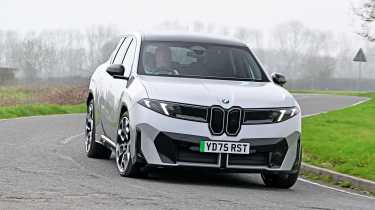
2. BMW iX3
The arrival of the latest BMW iX3 marked a true quantum leap in the electric car world.
- Prices from £53,300
- Not eligible for Electric Car Grant
| Pros |
|
| Cons |
|
The BMW iX3 is part of the Bavarian brand’s Neue Klasse generation of cars. Not only is it highly distinctive to look at, but it’s a genuine techfest, too.
With an official WLTP combined battery range of up to 500 miles, the iX3 is by far one of the longest-range electric cars on sale right now. When we tested this SUV for the first time, we saw a respectable real-world average efficiency of 3.3 miles per kWh, which equates to around 359 miles of driving. It’s worth noting that this included some spirited driving, though, and this figure quickly climbed to a truly outstanding 7.1miles per kWh when we drove in a particularly eco-conscious manner. Either way, recharging will be something of a rarity.
Being a BMW, the iX3 is genuinely enjoyable to drive, too. This mid-size SUV hides its weight surprisingly well, and you won’t be afraid to chuck it around a few B-roads when the mood takes you. The trade-off is a firmer ride quality than you’ll find in some rivals (such as those from Mercedes) but we certainly wouldn’t describe it as uncomfortable.
While the BMW iX3 is one of many new cars that has taken a step towards interior minimalism, the latest Panoramic iDrive technology is easily one of the most innovative setups that we’ve used in a long time. Five people and their luggage won’t have a problem getting comfortable, either, as the well-designed cabin layout is accompanied by a 520-litre boot.
“The key technology that stood out to us was its expanded regenerative braking system that rarely, if ever, uses the friction brakes.” - Jordan Katsianis, news editor.
- Who will like it: Spirited drivers who need to cover plenty of miles.
- Who won’t like it: Those who appreciate simplicity.
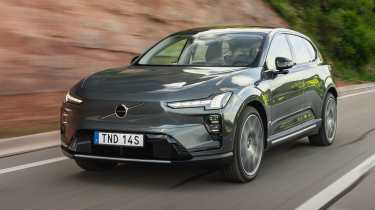
3. Volvo EX60
While expensive, the EX60 justifies itself with smart styling and a long range.
- Prices from £56,900
- Not eligible for Electric Car Grant
| Pros |
|
| Cons |
|
“Quietly impressive” is probably a good way to describe Volvo’s electric cars, and that’s not a pun on their silent powertrains. With understated styling, generous range figures and brawny performance, Volvo’s EVs, much like the decades of combustion models that came before them, just get on with the job of being solid family cars - and the EX60 is more of the same.
The EX60 is something of a no-brainer for Volvo too, given its combustion XC60 equivalent has, across only two generations, become the brand’s best-ever selling model. Given a relatively stiff starting price of nearly £57,000 (and on the cheapest lease deals it’s nearly £100 a month more than the BMW iX3 above) the EX60 might not keep that momentum going quite as quickly, but buyers will find a lot to like nevertheless.
There’s the modern, unfussy styling for one, and a similarly Scandi-cool cabin. It might be a little too stark for some, but others will appreciate its restraint. Likewise the light colour themes probably wouldn’t be the first choice of a parent with young kids, but offspring above the chocolate-smearing age shouldn’t dirty it too much. It’s very screen-heavy, but thankfully it all works well, and the cabin (and boot) is spacious too.
And with a maximum 503 miles of range in the P12 model (due in 2027), the EX60 only really lags behind a handful of BMWs as the farthest-reaching EV on the market - even the entry-level P6 can cover a claimed 380 miles. 800-volt architecture means fast charging as well, capable of 200-mile top-ups in ten minutes. Like a lot of Volvo EVs, it’s brisk too, with even the “slowest” P6 getting 369bhp, and 0-62mph in 5.9 seconds.
“For a safe, calming, no-fuss drive, the Volvo excels; it’s controlled but compliant, quick but quiet, and manoeuvrable without sacrificing the kind of versatility Volvos are famous for.” - Richard Ingram, deputy editor.
- Who will like it: Families who can get on with the light-coloured interior
- Who won’t like it: Anyone whose kids have sticky fingers.
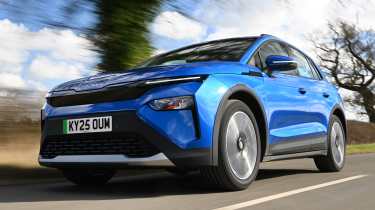
4. Skoda Elroq
The Skoda Elroq bagged the Auto Express Car of the Year award in 2025, and it’s still a top buy.
- Prices from £34,000
- Eligible for Band 2 of the Electric Car Grant
| Pros |
|
| Cons |
|
The Enyaq showed that Skoda knew how to make a good electric SUV, and the Elroq demonstrates it wasn’t a one-off. Smaller and more affordable than its bigger sibling, we think this is an even better car.
There are three batteries to choose from in the Elroq line-up, but even the smallest 63kWh (59kWh usable) pack comes with a healthy claimed range of 265 miles. It would appear that Skoda is doing a reasonable job of putting its money where its mouth is, too, as we saw 3.7 miles per kWh when we tested this model, and that results in around 218 miles.
Although this is a sensible, family-focused EV at heart, the Elroq still handles neatly when needed. However, this SUV really comes into its own in tight spaces, thanks to a small turning circle. It’s also refined and peaceful enough for the motorway commute, while even the least powerful model churns out a notable 201bhp and 310Nm of torque.
One of the very few things we’re not really keen on in the Elroq is how many controls Skoda has bundled into the infotainment touchscreen – a few more physical knobs and buttons like those in Skoda’s own Kodiaq and Superb wouldn’t hurt. This small criticism aside, though, the Elroq is an exquisite all-rounder with no shortage of interior space and ‘Simply Clever’ features. All of this value for money made the Skoda Elroq the obvious candidate for our 2025 Car of the Year award.
“The Elroq is a master of practicality, and the space inside is probably its very best feature. It offers all the room a family will ever need.” - Pete Baiden, web producer.
- Who will like it: Families who appreciate the ‘Simply Clever’ touches.
- Who won’t like it: Drivers who are seeking a thrill or two.
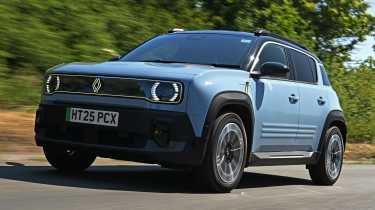
5. Renault 4
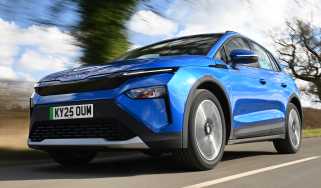
The Renault 4 has evolved into a modern electric car, but it still retains an element of old-school charm.
- Prices from £23,500
- Eligible for Band 1 of the Electric Car Grant
| Pros |
|
| Cons |
|
Renault is on a bit of a roll with its retro EVs, and the Renault 4 is another first-rate blast from the past.
Just like the Renault 5, the 4 is priced well below the £30,000 mark, yet it still offers a reasonable WLTP combined range figure of 247 miles from its sole 52kWh battery pack. We’re very pleased to report that a heat pump is included as standard across the line-up, too. We achieved a real-world average efficiency of 3.8 miles per kWh when testing the R4 on a wide variety of UK roads, and this equates to just under 200 miles of range.
The original Renault 4 was a simplistic and practical workhorse, and this modern iteration does a respectable job of following in its ancestors footsteps. It’s not quite as entertaining to drive as the R5, but the R4 is at least pretty calm and collected on the move, although there’s quite a lot of wind noise to contend with. Our road testers also couldn’t help feeling that the cabin was a bit dark inside.
As you’d expect, the modern Renault 4 is far more lavishly equipped than its predecessor from back in the day. Take one look at the dashboard and you’ll quickly see just how much it shares with the Renault 5. This isn’t a bad thing, though, as there’s a decent helping of proper switches, and the Google-based infotainment software is one of the very best systems on the current market. Despite its slightly compact size, five people can still get reasonably comfortable inside the R4, and the 420-litre boot has a very low loading lip which makes it easy to fill up.
“On the road, the R4 feels neatly tied down, despite Renault claiming it has a slightly softer set-up than the 5, with a willingness to change direction that’s missing in plenty of its rivals.” - Richard Ingram, deputy editor.
- Who will like it: Anyone who’d enjoy a zero-emission nostalgia trip.
- Who won’t like it: Families in need of a larger SUV.
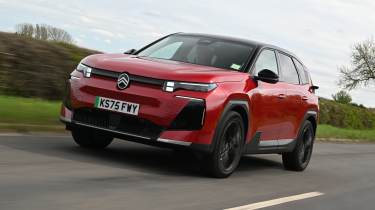
6. Citroen e-C5 Aircross
This comfort-focused EV is also good value, and impressively practical too.
- Prices from £34,000
- Eligible for Band 2 of the Electric Car Grant
| Pros |
|
| Cons |
|
The overly sporty, unsettled ride quality of some electric SUVs seems completely at odds with their mission to deliver the most stress-free, easy-going driving experience. There are no such concerns with the Citroen e-C5 Aircross, which is soft-riding almost to a fault. While we’d not call it “all at sea”, it’s clear an old-school Citroen ride was the priority here, and like those classic French family cars, handling takes a back seat.
Incidentally, the back seat’s not such a bad place to be in the e-C5 Aircross, whose fairly boxy exterior dimensions allow for greater space than many in the class, though larger adults may feel scrunched up by the high floor, given the batteries are underneath. Front space is good too and all the seats are comfortable, again with an emphasis on squashy softness rather than Germanic-style firmness. Details like the fabric-trimmed dash give it a lounge-like ambience.
Citroen’s build quality is pretty good these days too, while the 13-inch portrait touchscreen in the centre of the dash is better than its equivalent in a lot of other Stellantis products. It works well, though as it’s used for most interior functions, can divert your attention from the road a little too much. There’s a row of shortcut buttons below the screen, at least.
Citroen offers a 73.7kWh ‘Comfort Range’ and 96.9kWh ‘Long Range’ battery in the e-C5 Aircross, capable of 320 and 421 miles respectively. Both look good on paper though our experience suggests motorway cruising can chew through that quicker than in some rivals, while 160kW charging speeds are no longer much to shout about either. Still, you’re not paying a lot for the privilege: the £34k starting price is pretty competitive in this class.
“Despite its great-value pricing, it doesn’t feel like a budget product, because even the entry-level model features a large touchscreen packed with tech, and there are soft-touch materials throughout ” - Dean Gibson, senior test editor.
- Who will like it: Anyone who prioritises comfort well above handling
- Who won’t like it: Keen drivers or high-speed motorway users.
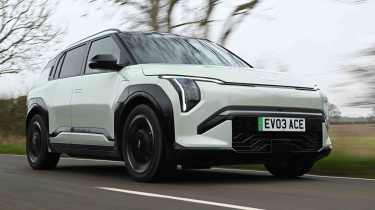
7. Kia EV3
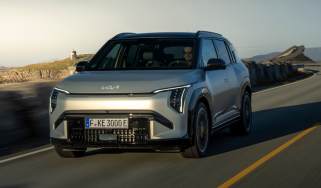
It’s rather unusual to look at, but the Kia EV3 is full of the family-friendly fundamentals.
- Prices from £31,600
- Eligible for Band 2 of the Electric Car Grant
| Pros |
|
| Cons |
|
The Kia EV3 is a bit like a scaled-down EV9, and that’s a good thing. In fact, it’s a very good thing, because the EV9 really is a bit large and bulky, whereas the EV3 feels suitably-sized for modern roads and parking spaces.
As is a common theme with Kia’s electric cars, the EV3 boasts a competitive range. The basic 58.3kWh model manages a decent 270 miles on the WLTP combined cycle, but with an 81.4kWh battery pack on board that stretches as far as 375 miles. We’ve found the actual battery range to be pretty temperature-dependent during our own testing, with the UK winter cutting around 100 miles from the latter figure, but that still leaves plenty to be getting on with. A heat pump – a £1,000 option on the top model – will help to mitigate this issue, though.
Is the EV3 fun to drive? Not really, and the drive modes are a little redundant, too, but it does ride well. The regenerative braking is also effective, which is undoubtedly a far more crucial factor in an efficient family car than the fun factor. That being said, there’s still a reasonable amount of power on offer should you need it, with 201bhp and 283Nm of torque on tap.
While some electric car manufacturers go a bit mad with their interior designs, Kia’s more simplistic approach is very easy to get on with. The EV3 is pretty spacious, too, though rear seat passengers will find some room has been sacrificed for the useful 460-litre boot.
“Even in its entry-level form the EV3 is loaded with advanced driver-assist tech, including a blind-spot detection system.” - Alex Ingram, Auto Express contributor.
- Who will like it: Families with smaller children.
- Who won’t like it: Families with taller children.
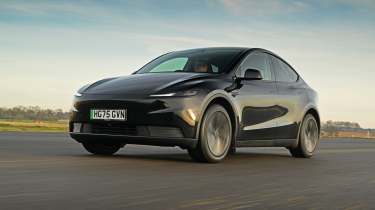
8. Tesla Model Y
The competition is ever-increasing, but the Tesla Model Y is still a compelling electric SUV.
- Prices from £42,000
- Not eligible for the Electric Car Grant
| Pros |
|
| Cons |
|
The Tesla Model Y pretty much offers the same plethora of technology, sizable batteries and eye-watering performance as the smaller Model 3, only here they’re all wrapped up in a more practical SUV body.
There’s powertrain options aplenty on the Model Y configurator, with Rear-Wheel Drive, Long Range Rear-Wheel Drive, Premium and Performance models to choose from. Regardless of your preferred variant, though, this EV offers consistently big battery ranges — varying from 314 to 391 miles — along with Tesla’s usual top-shelf tech. When we tested the Model Y against several of its closest competitors during our 2026 premium electric SUV supertest, it achieved the strongest efficiency of the bunch at 3.5 miles per kWh.
While efficiency is key, another Tesla party piece is performance. While the Model Y isn’t what we’d call outright entertaining to drive, it can be ridiculously quick with up to 453bhp on offer from the Performance model. This results in a supercar-baiting 0-62mph time of just 3.3 seconds. Mind you, even the base Rear Wheel Drive variant only takes 6.9 seconds, which is hardly slow.
Inside, Tesla’s build quality has taken a step in the right direction in more recent years, while the technology is every bit as impressive as it has ever been. Some clever engineering means a family of five won’t struggle for space, either, and the boot feels vast compared to a number of other SUVs of a similar size.
“If understatement is your thing, then the Model Y is the car for you. Aside from the huge touchscreen, the dashboard is bare, but its simple design does contain some neat details.” - Dean Gibson, senior test editor.
- Who will like it: EV fans wanting range, easy charging and technology.
- Who won’t like it: Drivers who prefer a more traditional interior.
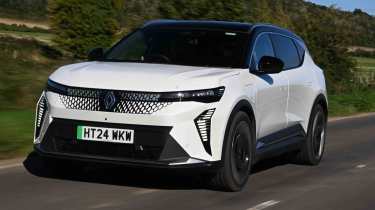
9. Renault Scenic
In keeping with its well-known moniker, the latest Scenic comes with a general sense of familiarity.
- Prices from £33,300
- Eligible for Band 2 of the Electric Car Grant
| Pros |
|
| Cons |
|
The Renault Scenic has shed its old MPV skin in favour of a more contemporary SUV shape, but its family car fundamentals have remained firmly in place.
Unlike some rivals, the Scenic only comes with a single battery, but this is a reasonably-sized 87kWh pack that gives an official range figure up to 381 miles. Our own testing returned an average efficiency of 3.8 miles/kWh after a mixture of driving, which is roughly 330 miles of real-world range. In other words, family road trips won’t require too many charging stops.
A slightly firm ride aside, the Scenic is also good to drive, and the single 215bhp electric motor moves things along nicely enough - although not as quickly as some similar EVs. Renault’s ‘My Perso’ setting for switching off the various beeps and bongs of driver assist functions remains one of the best around, too.
This Renault even manages to outshine a number of rivals, including the Volkswagen ID.4, with 545 litres of boot space. Its flat floor means that taller adults can sit comfortably in the back, too. When it comes to equipment, the Scenic’s interior is essentially a larger version of the one found in the Renault Megane E-Tech, so there’s a decent amount included as standard. Even the entry-level kit comes with posh touches such as heated front seats and a rear-view camera.
“Renault’s latest corporate look includes plenty of sharp angles and slender lights, and the Scenic mixes these with SUV proportions to cut a real dash on the road.” – Dean Gibson, senior test editor.
- Who will like it: Those in the market for a straightforward EV family car.
- Who won’t like it: Drivers who desire a bit more performance.
10. Toyota C-HR+
Toyota has long been a purveyor of excellent hybrids, but the C-HR+ has finally upped its electric car game.
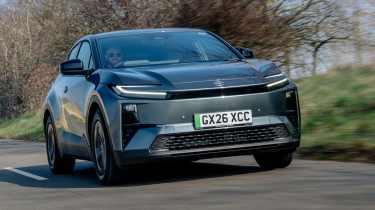
- Prices from £34,500
- Eligible for Band 2 of the Electric Car Grant
| Pros |
|
| Cons |
|
Not to be confused with the hybrid-powered Toyota C-HR, the Toyota C-HR+ is arguably the Japanese brand’s most appealing EV to date.
Although it follows a very similar design to its liquid-fuelled counterpart, the C-HR+ is powered by a 57.7kWh or 77kWh battery, with the official battery ranges standing at 284 miles and 376 miles, respectively. A standard-fit heat pump means the impact of cold weather on range is kept at bay, too, which is always a welcome touch.
We dare say there’s an undercurrent of Toyota’s sports cars in how the C-HR+ drives, too. Ok, it’s nowhere near as quick as a Tesla Model Y, but the well-weighted steering and low centre of gravity mean there’s a bit of enjoyment to be found in the corners. The aforementioned steering lightens up in town, which makes parking and manoeuvring nice and easy.
Inside, the C-HR+’s cabin isn’t worlds apart from what you’ll find in the older Toyota bZ4X, but it’s functionally laid out and well-built. There’s actually a bit more room in this car than in the regular C-HR, too, so there’s a decent amount of room on offer for its occupants, although the stylish sloping roofline does take a toll on rear passenger headroom.
“A real negative we found with the C-HR+ was its relatively slow DC charging, although at 150kW it’s still fast enough to get the battery from 10-80 per cent capacity in a little under half an hour.” - Dean Gibson, senior test editor.
- Who will like it: Buyers who are swayed by the eye-catching looks.
- Who won’t like it: Families who need more rear passenger space.
More SUV recommendations
Don’t forget, we also have a range of other pages with alternative SUV recommendations if the cars above don’t suit.
How we choose the best electric SUVs
SUVs make up a significant proportion of the UK’s best-selling cars, and as the motoring world makes the transition to electric power, electric SUVs are now a very important sector for both manufacturers and buyers.
While battery range is often the factor that receives the most scrutiny, there are also plenty of other aspects that can make or break an electric SUV.
Our expert road testers carefully evaluate every electric SUV on sale in the UK, taking a very wide range of facts, figures, measurements and characteristics into account before delivering their final verdicts.
Real-world range and efficiency
Headline battery ranges are a key draw for a huge number of electric car buyers. After all, a car with 400 miles of range will require less recharging than one with 200 miles. That much is obvious, but it’s important to remember that these numbers are only the results of official tests which have been achieved in incredibly specific laboratory conditions.
These numbers can look very different in the real-world, so our road testers carefully analyse every car’s efficiency under a series of tests on Britain’s roads. While it’s pretty rare for a car to match its claimed battery range, most of the best electric SUVs do at least come very close.
Charging speeds
No matter how many miles of range an electric SUV is capable of, it will eventually need a recharge, just like a combustion car inevitably needs refuelling. However, some electric cars can take a lot longer than others to top up their batteries.
Generally speaking, manufacturers recommend that public DC rapid chargers are only used to top up from 10 to 80 per cent in order to preserve the battery’s health. Therefore, our road testers time just how long it actually takes to perform this ‘splash and dash’, and work out whether or not it matches the manufacturer's claims.
In most cases, EV owners will regularly recharge overnight at home by using a wallbox charger. We also measure how long this charge takes from zero to 100 per cent. The less time that’s taken, the better a car’s score will be.
Practicality
Regardless of whether they opt for electric or combustion power, the vast majority of SUV buyers are attracted to this type of car by the amount of passenger and luggage space on offer.
Therefore, our road testers take note of the amount of head, leg and foot space on offer for every single occupant. They also evaluate whether or not every passenger can get genuinely comfortable, rather than feeling cramped or awkwardly positioned.
While official boot capacity figures give an indication of how much luggage you can stow away in a car, our team also takes a look at just how easy it actually is to load it in the first place. A high loading lip, awkward layouts and a lack of dedicated cable storage can all eat away at the actual usability of an SUV’s boot, so these are also taken into consideration.
Price and finance deals
Everyone loves a bargain, and cars don’t come cheap. It might seem obvious that a competitively priced car will appeal more than an expensive one, but our road testers also take any applicable finance deals into account. A car’s list price is one thing, but there are plenty of tempting PCP finance offers out there on these models, not to mention PCH leasing deals.
Frequently Asked Questions
Deciding whether it's worth buying an electric SUV will ultimately boil down to your own personal requirements. However, EVs are often much cheaper to run than their combustion-powered counterparts, and they also offer many environmental benefits. If you’re considering buying an electric SUV, you’ll need to take certain extra factors into account, such as access to charging and how much battery range you’ll realistically need.
In a hurry? These are the fastest charging electric cars on sale in the UK...