Audi Q7 (2015-2026) review
The Audi Q7 is practical and packed with hi-tech features, and it just about keeps up with its younger competitors


Our opinion on the Audi Q7
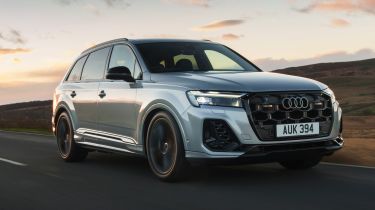
While it’s certainly not a spring chicken any more, the Audi Q7 is still accomplished enough to take on rivals like the BMW X5, Mercedes GLE, and Range Rover Sport. The Q7 is great to drive, too, expertly blending a plush ride with sure-footed grip, traction and body control. Its cavernous interior offers plenty of space for seven, and all models are well-equipped; we just wish that there were more efficient powertrains available.
About the Audi Q7
Although a latecomer to the premium SUV class, the Audi Q7 certainly made an impact when it arrived. Launched in 2007, the original stood out thanks to its imposing dimensions and spacious seven-seat layout, where most of its rivals were only five-seaters.
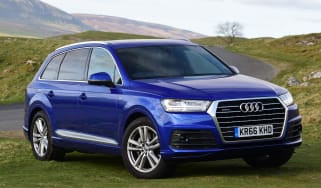
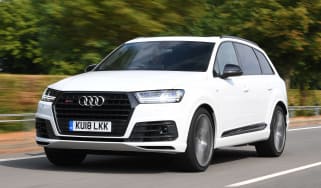
Then, in 2015, the second-generation Q7 arrived. The Q7 Mk2 offers the same level of quality as the original but in a lighter package. It was also the first model to use the VW Group's MLB platform, sharing its basic structure with the Bentley Bentayga, Porsche Cayenne, Volkswagen Touareg and even the Lamborghini Urus. However, all of these models are differentiated by their own unique DNA, and the Audi benefits from the German brand's image and its focus on technology.
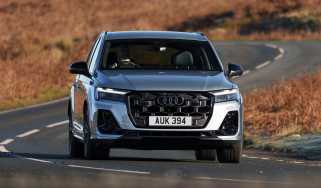
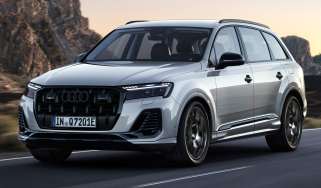
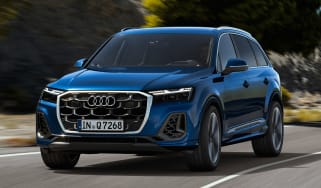
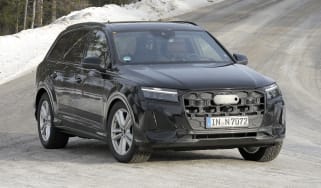
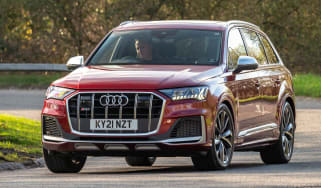
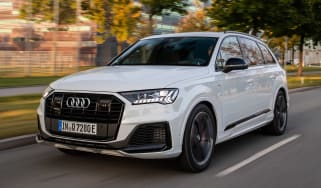
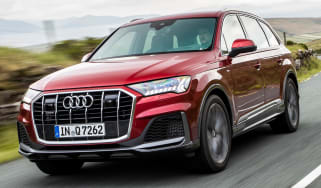
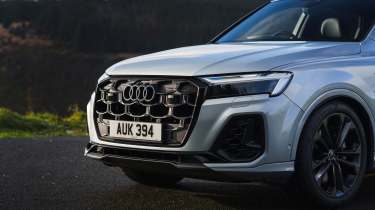
The Q7 has received a handful of updates over its rather long lifetime, and these changes have brought a sharper look, a redesigned interior with a dual-screen infotainment system, a more luxurious interior, and revised mild-hybrid petrol and diesel engines. All these revisions have been made to make sure the brand’s largest SUV keeps pace with far younger rivals.
Used - available now


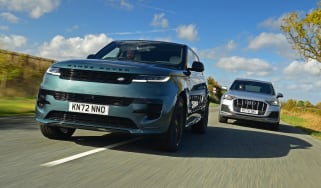
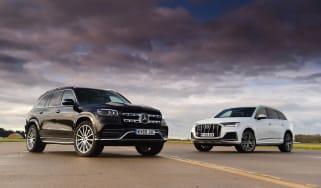
Speaking of the competition, we’ve tested the Audi Q7 against many other premium large SUVs on several occasions, including a twin test with the Range Rover Sport. While the Q7 put on a good show, it ultimately fell short of the Range Rover due to that car offering superior refinement, luxury and handling.
Audi Q7 prices and latest deals
As you’d expect from a full-size premium SUV, the Audi Q7 carries an equally bulky price tag. Powertrain and trim options affect the final figure, but the entry-level S-Line diesel will set you back at least £72,300. At the top end of the scale sits the fiery Audi SQ7, and this surpasses the £100,000 mark.
Fortunately, you can save plenty by building your ideal Audi Q7 with the Auto Express Buy a Car service. We also have a range of used Q7 models in stock, and can help you to sell your car.
Performance & driving experience
Pros |
|
Cons |
|
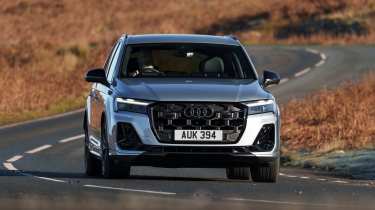
It’s clear that Audi is targeting the Range Rover Sport with its Q7 because the driving experience is all about luxury. The standard adaptive air suspension works very well, and the ride is almost as comfortable as the Rangie.
Although the Q7 isn’t designed to match a Range Rover off-road, Audi's quattro all-wheel drive system is more than capable of hauling the car through a muddy field or up a slippery track. In normal operation, it splits the torque 40:60 front to rear, but can send up to 85 per cent of the torque to the rear axle if required.
In reality, few Q7s will ever leave the road. It's agile, and adding the all-wheel steering option enhances this; while its rivals use four-wheel drive to help off-road, the Q7 feels more tuned for fun on it. Overall, the car is very pleasing and relaxing to drive either in town or on the motorway. It helps that the seats are comfortable and that very little outside noise enters the cabin.
| Model | Power | 0-62mph | Top speed |
| Q7 3.0 TDI quattro 231 S Line | 228bhp | 7.1 seconds | 140mph |
| Q7 3.0 TFSI quattro 340 S Line | 340bhp | 5.6 seconds | 155mph |
| Q7 3.0 TFSI e quattro 394 S Line | 394bhp | 5.7 seconds | 149mph |
Performance, 0-60mph acceleration and top speed
The entry-level powertrain is the 3.0-litre TDI diesel that produces 228bhp and 500Nm of torque, this is good for a top speed of 140mph and a 0-62mph time of 7.1 seconds. Opting for the more powerful 282bhp and 600Nm of torque version drops the 0-62mph time to 6.5 seconds and raises the top speed to 150mph. Both engines come with quattro four-wheel drive and a slick eight-speed tiptronic automatic gearbox.
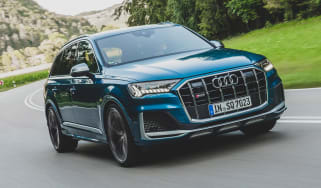
Petrol buyers are catered for by the 3.0-litre TFSI, which produces 335bhp. Acceleration is impressive in a car of this size; 0-62mph takes just 5.6 seconds and top speed is limited to 155mph. However, if it's power you're after, and your budget is able to stretch far enough, there's the barnstorming Audi SQ7. Powered by a 4.0-litre V8 petrol, this produces 500bhp and a vast 770Nm of torque, which means it completes 0-62mph in a mere 4.1 seconds.
As part of Audi’s move towards electrification, a plug-in hybrid variant of the Q7 is also up for grabs. Badged as the TFSI e, this produces a combined 388bhp and 500Nm of torque. The top speed sits at 149mph.
Town driving, visibility and parking
All versions of the Q7 are quiet and refined at lower speeds, but the PHEV is even more so given you can run around silently on electricity. However, the big Audi’s size can be its undoing when driving around town. The high driving position provides a very commanding view of the road ahead. Mind you, this is still a big car, so you still need to keep your wits about you when negotiating narrower roads, but the same is true of rivals like the Range Rover Sport.
Slotting this big SUV into a tight car parking space takes some care and attention, but Audi provides standard front and rear parking sensors to help with this, along with a reversing camera. A full 360-degree camera system is available as an option with the rather expensive Technology Pack, but it’s a shame that feature isn’t standard like it is with the Range Rover Sport.
Country road driving and handling
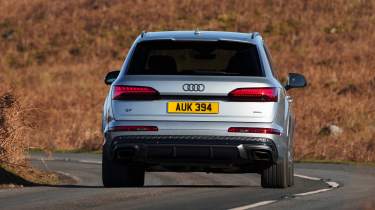
For a large off-roader, there’s lots of grip on offer, and the steering is quick and precise.
Scroll through the Audi Drive Select modes (or set your own individual parameters for the steering, throttle and suspension in ‘Individual’ mode), and the Q7 is certainly more agile than the original, and you can feel more of what is going on through the seat than before. That’s largely thanks to its MLB Evo platform – the same that underpins the Lamborghini Urus and Bentley Bentayga.
In Comfort mode, the steering is still light and short on feedback, but the car is far more willing to change direction, and stability is rock solid at high speeds. Range-topping Vorsprung models come with a four-wheel steering system that turns the rear wheels in parallel with the front wheels at high speeds, or in opposite directions at lower speeds to improve the turning circle.
This is a 4x4 you can drive incredibly quickly, too. Ramp things up to Dynamic mode and the Q7 immediately feels more alert – it’s never harsh, but the body control is tauter, which gives you more confidence to push the car harder. Permanent quattro four-wheel drive gives excellent traction, too, not to mention a feeling of stability in poorer weather.
Add all this to the sensation of flicking the smooth eight-speed auto box up and down with the steering wheel paddles, and you can have a surprising amount of fun hustling this big SUV around.
Motorway driving and long-distance comfort
As we’d expect from a premium car, very little noise makes its way into the Audi Q7’s cabin at motorway speeds. The adaptive air suspension also manages to keep the UK’s patchiest road surfaces at bay. None of the engines has to be pushed too hard to make swift progress, either, but even when you put your foot down, they sound pleasant rather than harsh.
“The eight-speed gearbox still needs a little help to overcome the car’s mass when moving off, but it’s not as lazy as the Range Rover’s transmission. Audi’s mild-hybrid tech works imperceptibly, too, with the engine cutting out and firing up again near-instantly when shuffling around town.” - Dean Gibson, senior test editor.
MPG & running costs
Pros |
|
Cons |
|
Running a large, premium, seven-seat SUV is never going to be cheap, but the Q7 shouldn’t break the bank thanks to the use of mild- and plug-in hybrid tech, along with the weight-saving regime that Audi put the car through during development.
The entry-level TDI officially manages up to 35.7mpg, depending on spec, while emitting up to 217g/km of CO2. However, the more potent 282bhp TDI is very similar at 35.6mpg and 217g/km. During our own testing of the more powerful diesel Q7, we saw an average of 33mpg across a range of driving conditions, which is respectably close to its official figure. The Range Rover Sport D300, meanwhile, only returned 27.8mpg after the same round of testing, a long way off its claimed 37.4mpg.
If you’d prefer petrol power, the 3.0-litre TFSI only achieves up to 27.6mpg on the WLTP combined cycle while emitting up to 242g/km. The performance-oriented SQ7, with its 4.0-litre V8, is as thirsty as you’d imagine, too, at up to 23.5mpg and 282g/km.
| Model | MPG | CO2 | Insurance group |
| Q7 3.0 TDI quattro 231 S Line | 35.3mpg | 208g/km | 45 |
| Q7 3.0 TFSI quattro 340 S Line | 27.4mpg | 234g/km | 47 |
| Q7 3.0 TFSI e quattro 394 S Line | 72.4mpg | 88g/km | 49 |
Electric range, battery life and charge time
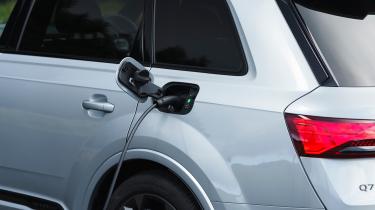
Naturally, it’s the PHEV you’ll want if you require the most efficient Audi Q7 of them all. This car can return up to 73.2mph (WLTP weighted) and emissions go as low as 88g/km. It can also cover up to 50 miles on pure electric power, courtesy of a 25.9kWh (22kWh usable) battery pack.
As with all plug-in hybrids, you’ll need to keep the battery topped up in order to see the very best economy figures. A 0-100 per cent charge should take around 4 hours with a typical 7.4kW home wallbox charger. However, this pack cannot handle DC rapid charging.
| Model | Battery size | Range | Insurance group |
| Q7 3.0 TFSI e quattro 394 S Line | 25.9kWh (22kWh usable) | 50 miles | 49 |
Insurance groups
This is a big, powerful and premium German SUV, so we doubt you’ll feel weak from shock when we tell you that insurance bills will be steep. The regular Q7 falls into groups 45 to 50 (out of 50), and the SQ7 resides in group 50.
It’s a very similar situation with the Range Rover Sport, which starts in group 44 and goes up to group 50 for the more powerful versions. There’s little difference with the BMW X5, either, with this appearing in groups 42 to 50.
Check your tax status and renewal date in seconds. Check your VED car tax now...
Tax
Every single Audi Q7 costs more than the £40,000 luxury car tax threshold for petrol, diesel, and plug-in hybrid cars, so you’re looking at a hefty annual bill regardless of your chosen spec. The PHEV does bring a little tax relief for business buyers, but for the biggest company car tax savings, you’ll be far better off looking towards electric SUVs like the Audi Q6 e-tron or BMW iX.
Depreciation
Our market data shows that the Audi Q7 should retain between 45 and 50 per cent of its initial value after 36,000 miles or three years. It falls short of the Range Rover Sport in this regard, as this competitor holds on to 53 to 60 per cent after the same period. The BMW X5’s fate is a bit of a mixed bag, though, at 42 to 52 per cent, depending on spec.
To get an accurate valuation on a specific model check out our free car valuation tool...
Interior, design & technology
Pros |
|
Cons |
|
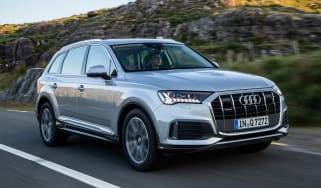
The Q7 has benefited from a number of tweaks over the years, bringing a sharper, less ungainly exterior and a cool, high-quality interior to the mix.
As is expected in this class, there’s a staggering array of technology crammed into the Q7 – either as standard or to be found on the lengthy options list. Audi’s Virtual Cockpit digital dials, sat-nav, a 36-month subscription to Audi Connect, all-round parking sensors, cruise control, a reversing camera and lane-departure warning are all fitted as standard. The options list is expansive and expensive, too, offering goodies like remote parking assist.
Interior and dashboard design
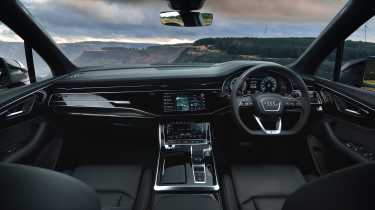
Inside, the overall feeling is akin to that found in the similar Audi Q8 SUV; an expansive, angular dashboard houses the brand’s latest dual-screen infotainment system and another screen behind the steering wheel in place of traditional dials, while swathes of leather trim and quality plastics help lend an expensive feel. Features like the optional panoramic glass roof add a further touch of luxury.
Materials and build quality
While we’ve found ourselves questioning whether the interiors of some of Audi’s latest models have taken a backwards step, the Q7 comes from an age when there was little doubt about the level of quality on display in an Audi interior. Soft materials are used everywhere you look, and everything feels solidly put together. If you’re considering the Audi Q7 as a premium family car, it should hold up rather well.
Infotainment, sat-nav and stereo
The Q7 has lots of premium kit. LED headlights, cruise control and four-zone climate control come as standard, as do heated electric seats, Bluetooth, keyless go and sat-nav. Audi’s 12.3-inch Virtual Cockpit, which adds a screen in front of the driver, is standard across the range.
Audi’s MMI Navigation Plus with MMI Touch infotainment system is standard, incorporating an upper 10.1-inch touchscreen and lower 8.6-inch touchscreen. These are used to run a responsive infotainment system that controls the majority of in-car functions. It’s among some of the more manageable systems on sale, but BMW still leads the way in terms of user friendliness. Android Auto and Apple CarPlay are both included as standard.
The Technology Pack is a roughly £3,000 option, but it does add a number of useful extras. These include a 360-degree parking camera, park assist with parking aid plus, extended ambient LED interior lighting and a 17-speaker, 16-channel, 730-watt Bang & Olufsen sound system.
“The Audi Q7’s interior follows a very clean and uncluttered design, and one which, following its facelift, doesn’t really lag behind the Range Rover Sport when it comes to tech, either.” - Dean Gibson, senior test editor.
Boot space & practicality
Pros |
|
Cons |
|
There’s a spacious, airy feel inside the Audi Q7, with more leg and headroom than before in every one of the seven seats. This premium feel is enhanced by comfortable front seats with a full range of electric movement, and luxury options like soft-close doors.
The driving position is excellent, with plenty of scope to adjust the seat and steering wheel, and visibility is great from the commanding driving position.
Dimensions and size
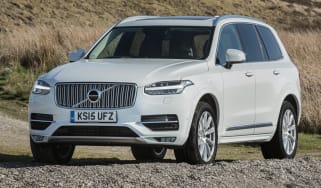
The high-riding Audi Q7 sits over five metres long and just under two metres wide. In other words, Audi’s largest SUV is on a par with rivals like the Volvo XC90 and Range Rover.
| Dimensions comparison | |||
| Model | Audi Q7 | Range Rover Sport | BMW X5 |
| Length | 5,072mm | 4,970mm | 4,935mm |
| Width | 1,970mm | 2,047mm | 2,004mm |
| Height | 1,690mm | 1,822mm | 1,765mm |
| Wheelbase | 3,000mm | 3,000mm | 2,980mm |
| Boot space | 563 to 2,050 litres | 647 to 1,491 litres | 500 to 1,870 litres |
Seats & passenger space
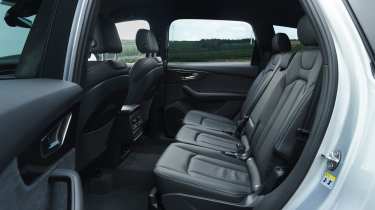
There’s loads of space on offer for passengers, although the Land Rover Discovery is still the car to beat in this respect. The Q7 feels a little cramped in the third row due to a lower roofline, while the floor is also higher, so you’re forced to sit in a less natural position. The lower roof and chunky wheel arches make it more difficult to climb into, although like the Land Rover, the Q7 gets power-folding seats.
Legroom is acceptable in the middle row, but the use of space still isn’t as clever as in the Discovery. The transmission tunnel and bluff dash mean it feels less roomy up front than the Land Rover.
The third row is designed primarily for children, but smaller adults can squeeze in there for shorter journeys, so long as the second row slides to its forwardmost position. To make access to the third row easier, the second row seats fold and tip forwards. When you don’t need the third row, simply push a button on the inside of the boot and these seats fold flush into the load floor. The plug-in hybrid is only a five-seater due to where the batteries are mounted. Every passenger seat inside the Q7 features Isofix mounting points as standard.
Boot space
With all seven seats in place, the big Audi offers 295 litres of boot space – just shy of what you’ll find in a Vauxhall Corsa – accessed via a standard powered tailgate. The Volvo XC90 just about beats this with 302 litres on offer with all seven seats in use. However, the Audi expands to a massive 2,050 litres with the seats folded. There are also useful options such as a powered luggage compartment cover, soft-close doors and a heated windscreen.
Towing
If you tow a caravan, you’re in for a treat. An electrically deployable trailer hitch is on the options list and allows you to tow up to 3,500kg. Audi’s Trailer Assist tech is also available as an option, and this allows you to use the interior touchscreen to set the desired angle of your trailer. The car will then use sensors to adjust itself accordingly.
“That the Q7 can offer this much storage space, and two seats more than the Range Rover Sport, yet still be more spacious in the middle row, is most impressive of all. If you want to use the sixth and seventh seats, those sitting ahead will need to sacrifice just a little space by sliding the seat forward.” - Dean Gibson, senior test editor.
Reliability & safety
Pros |
|
Cons |
|
The Audi Q7’s engine and gearbox are developments of pre-existing technology, so they were already proven in the real world.
The Q7 didn’t feature in the most recent Driver Power best cars to own rankings, but Audi did score a rather disappointing 19th place out of 31 brands in the best manufacturer results. Volvo (13th), BMW (8th) and Lexus (3rd) all fared much better.
In more positive news, the Audi Q7 achieved the maximum five stars when subjected to the stringent Euro NCAP crash tests, although interestingly, its performance in most areas was narrowly shaded by the Volvo XC90. The Audi achieved scores of 92 per cent for driver protection, 86 per cent for child protection and 71 per cent for pedestrian safety, as well as 72 per cent for on-board safety systems. In contrast, the Volvo was awarded ratings of 97, 87, 72 and 94 per cent, respectively.
Standard safety and assistance kit includes lane departure warning, a reversing camera, traffic sign recognition, hill-hold assist, cruise control with speed limiter and all-round parking sensors, along with automatic emergency braking. Audi offers a Tour Pack for around £1,800 that adds adaptive cruise, predictive safety assist and a range of other high-tech safety systems; higher-spec models get much of this as standard.
| Euro NCAP safety ratings | |
| Euro NCAP safety rating | Five stars (2019) |
| Adult occupant protection | 92% |
| Child occupant protection | 86% |
| Vulnerable road user protection | 71% |
| Safety assist | 72% |
Buying and owning
- Best buy: Audi Q7 3.0 TDI quattro 231 S line
While there’s certainly no such thing as a cheap Q7, we see little point in forking out even more money on anything other than the base model. This variant still comes with enough power and kit to provide an upmarket experience, while TDI diesel power means you’ll see somewhat sensible running costs (at least by large SUV standards).
Audi Q7 alternatives
The Q7’s traditional German SUV rivals take the shape of the BMW X5 and Mercedes GLE. As usual, the BMW places more emphasis on sportiness while the Merc is skewed towards comfort. Elsewhere, the Volvo XC90 is another well-proven seven-seater.
For company car buyers looking to lower their tax bill and those who want to reduce their carbon footprint, the seven-seat Kia EV9, Hyundai Ioniq 9, and Volvo EX90 are all fully electric seven-seat options.
Key updates of the Audi Q7 review
March 27 2026: Updated to include the latest model information, along with new depreciation, pricing and tax data.
Frequently Asked Questions
As with every other Audi, the Q7 comes with an unlimited mileage warranty for two years, with a 60,000-mile limit in the third year. If you're willing to pay a little extra you can arrange cover for an extra year and up to 75,000 miles, or a five-year/90,000-mile warranty
Latest deals on the Audi Q7 and rivals