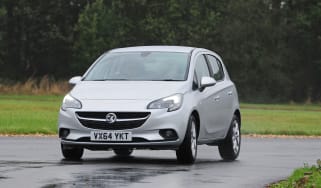
Vauxhall Corsa review
The Vauxhall Corsa is a smart-looking supermini with numerous engine options, but it isn’t particularly exciting or spacious

Our opinion on the Vauxhall Corsa
The latest Vauxhall Corsa improves on previous versions with solid levels of equipment, decent fuel economy, good comfort and – above all – attractive pricing. That does mean the Corsa feels cheap in places, though, and this isn’t the most spacious supermini, either.
The Vauxhall is also short of thrills behind the wheel - it’s competent, but if you’re looking for a dynamic supermini that plugs the gap left by the Ford Fiesta, the Corsa isn’t it. On the other hand, the Corsa has a wide appeal, thanks to its petrol, mild-hybrid and pure-electric powertrain options.
About the Vauxhall Corsa
The current Corsa arrived in 2019, and is based on the same platform as the Peugeot 208, along with plenty of other similar models from the Stellantis group like the larger Vauxhall Mokka, Citroen C4, DS3 and Jeep Avenger.
The Corsa comes in four trim levels: Yes, Design, GS and Ultimate. Rather than reserve the more potent hybrid and electric versions for the top trims, each specification is offered with petrol, hybrid, and electric power. Speaking of electric, there are two batteries available in the Corsa Electric, and we have a dedicated in-depth Vauxhall Corsa Electric review if this is the model that’s caught your eye.
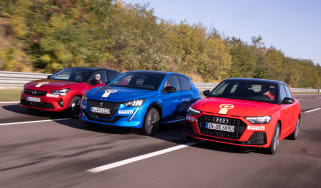
Our expert road testers have put the Vauxhall Corsa through its paces since it first hit the UK’s roads in 2019. As well as a special celebration of this supermini’s 40th birthday, where we drove and compared it alongside its predecessors, our senior news reporter, Alastair Crooks, spent six months living with a Corsa in GS trim in order to find out what life with this small car is really like.
Performance & driving experience
Pros |
|
Cons |
|
This Corsa drives well and comes with a solid range of engines that give buyers an array of choices. The comfortable low-speed ride is a highlight that we found particularly impressive on our tests. There are more thrilling superminis from a driving point of view, but the Corsa is an accomplished all-rounder offering composure as well as comfort.
Used - available now

2026 Vauxhall
Corsa
30,839 milesManualPetrol1.2L
Cash £11,999
2023 Vauxhall
Corsa
23,685 milesManualPetrol1.2L
Cash £11,611
2021 Vauxhall
Corsa
40,929 milesManualPetrol1.2L
Cash £8,852
2021 Vauxhall
Corsa
21,060 milesManualPetrol1.2L
Cash £9,226Corsa models from the top end of the range – both combustion and electric – are available with selectable driving modes. By switching to Sport mode, petrol models get an artificially enhanced engine note piped into the cabin, plus extra weight to the steering - though it's not very noticeable. Prodding the Sport button in the Corsa Electric allows the driver to access the car’s full power; otherwise, you’ll find it throttled back slightly to improve range and efficiency.
Performance, 0-60mph acceleration and top speed
The non-hybrid petrol models use a 1.2-litre three-cylinder turbo engine with 99bhp mated to either a six-speed manual or optional eight-speed auto gearbox. This engine comes with decent mid-range pulling power, meaning you don’t need to thrash it to keep up with traffic. It has a 0-62mph time of 10.8 seconds (rising to 11.2 with the automatic transmission) and a top speed of up to 121mph, which is perfectly adequate for most people in the real world. The automatic gearbox option hampers performance and feels noticeably more sluggish than the standard manual.
Those looking for a bit more punch will be well served by the 143bhp hybrid. It has an 8.6 second time for the 0-62mph sprint and a top speed of 133mph. It’s a lot swifter and more satisfying for those who regularly venture out of town for longer trips, but it is only available on pricier GS and Ultimate trims. A less powerful 109bhp hybrid is available across all trim levels, and a tiny bit swifter from 0-62mph than the petrol automatic, at 10.7 seconds.
| Model | Power | 0-62mph | Top speed |
| Corsa 1.2 Turbo Yes | 99bhp | 11.2 seconds | 121mph |
| Corsa 1.2 Turbo GS automatic | 99bhp | 10.8 seconds | 119mph |
| Corsa 1.2 Turbo Hybrid 145 Ultimate | 143bhp | 8.6 seconds | 133mph |
Town driving, visibility and parking
The ride is firmer than on the previous generation Corsa, but it’s by no means uncomfortable at low speeds over speed bumps and drain covers. Like most modern cars, the Corsa features a stop/start system, but we found it to be particularly intrusive and sluggish to respond in the 1.2-litre turbo model, which became annoying around town.
The hybrid models are good in urban driving, but the electric motor is only small and powered by a tiny 0.9kWh battery, so EV running only happens for a short time at low speeds. The petrol engine kicks in fairly seamlessly when you need to go faster. There is also a regenerative braking function that helps to recharge the battery, but as in the all-electric Corsa models, it isn’t strong enough for one-pedal driving in stop-start traffic.
Country road driving and handling
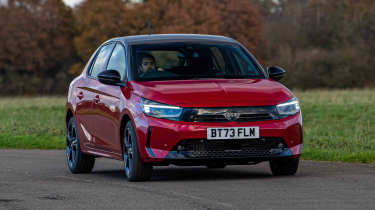
Thanks to its Stellantis platform, the latest Corsa is much better to drive than previous versions. Around corners, it feels more agile and responsive than before, and has strong grip.
Sadly, the numb steering lets it down a little, meaning the Corsa doesn’t feel as sharp as a SEAT Ibiza. At least the steering is very light, making the car easy to manoeuvre, and visibility is great - it’s no surprise the Corsa is popular with driving schools.
Motorway driving and long-distance comfort
The engines all deliver reasonable refinement, with the three-cylinder 1.2 a little vocal at higher revs and the hybrid far more hushed. The electric models are, predictably, the best.
The ride has a tendency to feel a touch bouncy at higher speeds, meaning the Corsa doesn’t feel as settled on long motorway runs as rivals such as the Hyundai i20, Renault Clio or Volkswagen Polo.
“The reasons why the current Corsa is such a hit with learner drivers are the same as was the case with older generations of the car. The steering is light and direct with enough stability to not feel too busy – perfect for when you’re trying to concentrate on what seems like a million other factors when you’re learning to drive.” - Alastair Crooks, senior news reporter.
MPG & running costs
Pros |
|
Cons |
|
The Corsa is a relatively frugal supermini. In 99bhp 1.2 Turbo guise, it’s rated at 50.4mpg on the WLTP tests with the automatic gearbox. In manual form, it officially gets up to 54.3mpg. We spent six months with one as part of our long-term test fleet, and averaged a respectable 51.3mpg in mixed driving. Officially, the petrol Corsas emit up to 128g/km of CO2.
As you’d expect, the 109bhp hybrid model is more efficient at 62.8mpg and with emissions of 103g/km. That’s on a par with the Honda Jazz, but can’t quite match the Toyota Yaris, which drops below 100g/km and gets up to 68.9mpg. The more potent 143bhp hybrid isn’t quite as efficient, at 60.1mpg and 106g/km.
The Vauxhall Corsa Electric will ultimately be the best bet for those who prioritise low running costs.
| Model | MPG | CO2 | Insurance group |
| Corsa 1.2 Turbo Yes | 53.3mpg | 119g/km | 22 |
| Corsa 1.2 Turbo GS automatic | 49.6mpg | 128g/km | 19 |
| Corsa 1.2 Turbo Hybrid 145 Ultimate | 60.1mpg | 106g/km | 27 |
Insurance groups
The Corsa should be a cheap car to insure. Entry-level Yes models with the turbocharged 1.2-litre engine start in group 22, although weirdly, the better-equipped GS model starts in group 19.
Those looking for a supermini that’s cheaper to insure might want to consider the Volkswagen Polo, which starts in insurance group three with the entry 1.0-litre petrol engine. The Skoda Fabia is also easy on the wallet, starting from group four, making these VW Group cars two of the cheapest cars to insure in the UK.
As explained in our dedicated Vauxhall Corsa Electric review, insurance for the EV is pricier than for its petrol counterparts. However, the same is true for the vast majority of its rivals.
Tax
Every Vauxhall Corsa (including the electric models) is liable for the standard rate of VED road tax, but low pricing means this supermini avoids the blight of the £40,000 luxury car tax threshold (£50,000 for EVs). Company car buyers will be best catered for by the Vauxhall Corsa Electric, because this comes with the lowest Benefit-in-Kind (BiK) rates by quite some margin. To find out more about the Vauxhall Corsa Electric, please click on the link provided to our dedicated review.
Depreciation
According to our market data, the combustion-powered Corsa line-up should retain between 39 and 48 per cent of its initial value after three years or 36,000 miles. This looks a bit disappointing compared to the Renault Clio, which retains 47 to 52 per cent of its value after the same period.
The Corsa Electric is more expensive to buy than a petrol model and depreciates much more quickly, with the majority of the range only maintaining 29 to 32 per cent of its original value over the same time period. That's quite poor considering rivals like the Renault 5 retain between 46 and 49 per cent over the same period.
Interior, design & technology
Pros |
|
Cons |
|
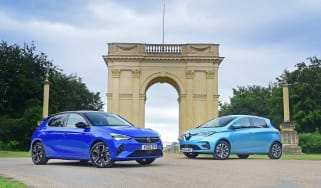
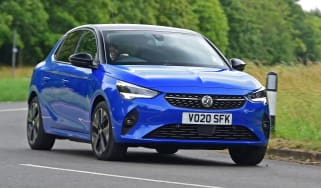
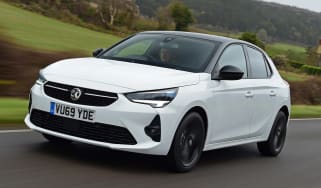
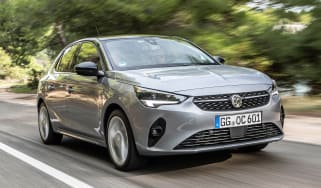
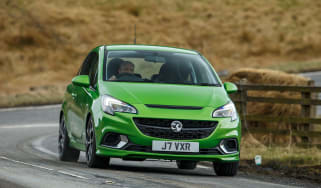
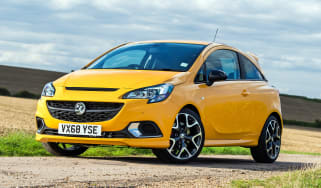
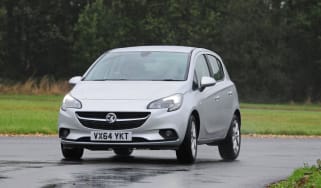
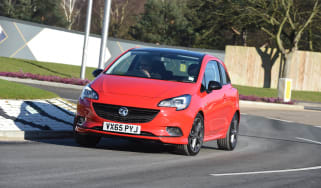
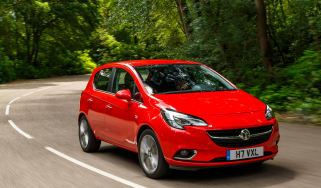
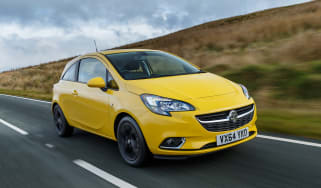
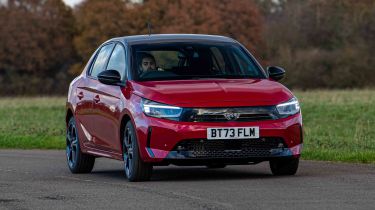
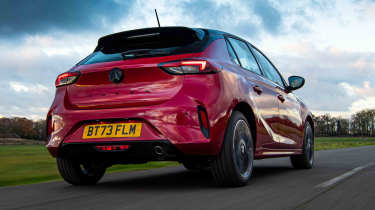
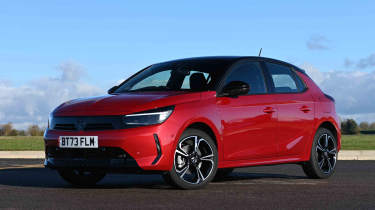
Using the Stellantis group CMP platform – which also underpins the Peugeot 208 and 2008, among others – this Corsa is wider and lower than the previous model, which makes it look more squat on the road. The design is nothing revolutionary, but we think it’s well-proportioned and looks smart.
The Corsa features Vauxhall’s ‘Vizor’ design at the front – incorporating the headlights and the grille into a horizontal strip across the nose. This update also added new trims to the range.
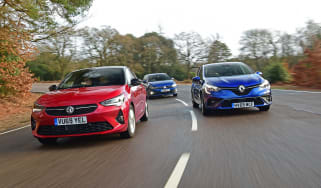
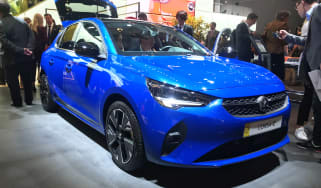
There’s a lively colour palette to choose from. Alongside the predictable greys and silvers, the far more vibrant Voltaic Blue and Power Orange offer buyers more eye-catching options. Some colours are available with a contrasting black roof and door mirrors.
The Corsa range kicks off with the Yes trim level that includes the following:
- Seven-inch driver’s display
- 10-inch touchscreen
- Apple CarPlay and Android Auto
- 16-inch alloy wheels
- Heated steering wheel
- LED headlights
- Cruise control
- Contrasting black roof
GS trim adds front parking sensors and a reversing camera, while the range-topping Ultimate adds adaptive cruise control and heated front seats. It’s also the cheapest Corsa with integrated sat-nav, so you don’t need to pair your phone.
Range-topping Ultimate trim adds climate control, lumbar support and a massage function for the driver’s seat, and unique seat trim material. It also gets blind spot monitoring across all versions (petrol, hybrid, and electric).
During our long-term test of a Corsa in GS trim, we thought the 17-inch wheels suited the car’s look, and the high beam assist came in handy on a regular basis. Our car’s rear-view camera display was pretty grainy - though strangely, if you get GS trim in a pure-electric Corsa, the camera’s quality is much better.
Interior and dashboard design
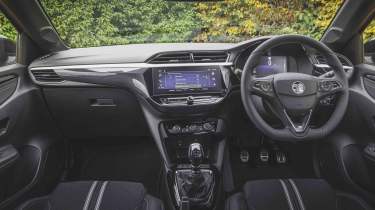
In keeping with its budget-focused origins, the Corsa’s interior is functional rather than fashionable. While it doesn’t do much to excite, the dashboard does at least provide decent ergonomics and, perhaps most importantly, proper switchgear.
Materials and build quality
The Corsa has never offered the highest quality in the supermini segment, and that continues here - though the current model is a big improvement inside over previous versions.
It’s neat, tidy, and we like the robust-feeling physical bank of switches for climate controls, but there are some areas letting the interior down. It’s quite gloomy inside the Vauxhall, and you don’t have to look hard to find cheap, scratchy plastics. However, after several months of living with a Corsa GS, we didn’t notice any trim coming loose, and the materials didn’t show signs of damage either.
Infotainment, sat-nav and stereo
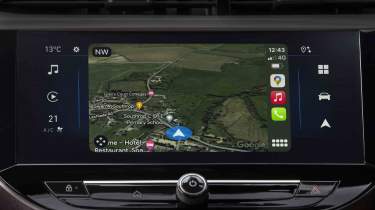
The Corsa’s 10-inch touchscreen display has clear graphics and is much slicker than what’s gone before. It comes with Apple CarPlay and Android Auto as standard, and there’s a cubbyhole at the base of the dash that allows you to connect a smartphone via a USB port – although it isn’t big enough for some of the larger smartphones.
However, it’s not the most straightforward system to use, and the menu layout isn’t as logical as the systems you’ll find from the Hyundai group. CarPlay also looks like a bit of an afterthought on the main touchscreen, with blank areas on either side.
“While the responsiveness of the central touchscreen impressed, it did receive some criticism for something that I hadn’t noticed from the wheel. It often reflects glare on the passenger side, which, when coupled with the dark background, makes it hard to see.” - Alastair Crooks, senior news reporter.
Boot space & practicality
Pros |
|
Cons |
|
This latest model comes exclusively in a single five-door bodystyle, much like the rest of its supermini rivals.
Storage is acceptable rather than spectacular for the class. The front door bins can each hold a big-ish bottle, while a pair of cup-holders is in the centre console in front of a small closed storage bin.
The smartphone tray ahead of the gear selector is a nice touch that positions your phone out of sight, and most devices will fit (except the largest ones). The glovebox is small, though, and isn’t even big enough for the slim guidebook. Rivals like the Hyundai i20, the Skoda Fabia, and the Volkswagen Polo have much larger glove boxes.
Dimensions and size
The latest Corsa measures 4,060mm long. That’s 39mm longer than its predecessor and 14mm longer than a Volkswagen Polo. At 1,765mm wide (not including mirrors) and 1,435mm tall, it’s grown 19mm wider and dropped 44mm lower than before. The wheelbase measures 2,538mm – 14mm less than the Polo.
| Dimensions comparison | |||
| Model | Vauxhall Corsa | Volkswagen Polo | Renault Clio |
| Length | 4,060mm | 4,074mm | 4,053mm |
| Width | 1,765mm | 1,751mm | 1,798mm |
| Height | 1,435mm | 1,451mm | 1,440mm |
| Wheelbase | 2,538mm | 2,552mm | 2,583mm |
| Boot space | 309 litres | 351 litres | 391 litres |
Seats & passenger space
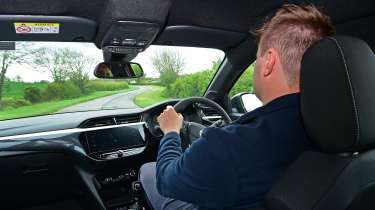
The driving position has plenty of adjustment in the front seat and steering wheel, and a decent amount of space. Ultimate trim models might be better suited for those who happen to tackle longer trips, because it comes standard with lumbar support and a massage function.
Visibility isn’t as good as it should be for a small car that’s likely to be driven around town a lot and needs to be easy to park in tight car parks. The thick roof pillars and small rear window create blind spots, so mid-range GS trim might be worthwhile going for because it has parking sensors all-around and a reversing camera.
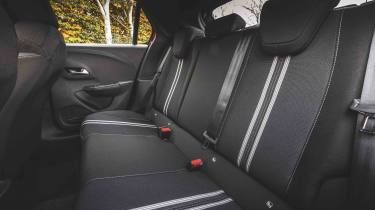
People getting in the back will need to squeeze through the small back doors. Compared with rivals such as the SEAT Ibiza and Hyundai i20, the Corsa feels cramped, and its low roof line means anyone nudging six feet tall will brush their head against the ceiling, while kneeroom isn’t great, either. The seats are comfy, though, and Isofix child seat mounting points are provided on the outer positions. They have fiddly zipped covers that are hard to remove, though.
Boot space
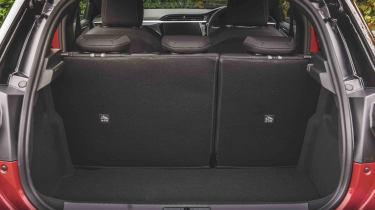
The Corsa’s boot capacity is 309 litres. That’s 24 litres more than the old car, but it comes up short against the Hyundai i20 (326 litres), SEAT Ibiza (355 litres) and particularly the Renault Clio (391 litres). Unlike the Vauxhall Corsa Electric, which has a lower boot volume of 267 litres, the Hybrid model maintains the same luggage capacity because the tiny battery pack lives under the front passenger seat, like most mild hybrids such as the Suzuki Swift.
Unlike the Vauxhall Corsa Electric, which has a lower boot volume of 267 litres, the Hybrid model maintains the same luggage capacity because the tiny battery pack lives under the front passenger seat, like most mild hybrids such as the Suzuki Swift.
The Corsa’s opening is relatively small, too, with quite a high loading lip to lift heavy items over. The rear seatbacks fold in a 60:40 split. Drop them both down and you get a maximum 1,118-litre boot space.
“My dog, who is growing fussier with her automotive transport as the years go by, seemed to be able to jump in and out of the Corsa’s boot and was pretty happy on a short journey. However, the massively thick C-pillars don’t allow for much natural light back there.” - Alastair Crooks, senior news reporter.
Reliability & safety
Pros |
|
Cons |
|
The latest Vauxhall Corsa achieved a four-star rating (out of a possible five) from Euro NCAP in its crash tests, with scores of 84 and 86 per cent for adult and child occupant protection, respectively. However, this safety test was carried out in 2019, so the rating has since expired because the testing criteria has become more stringent in the intervening years.
Every Corsa comes with a lane-departure warning and lane-keeping assist system to help keep you within your lane on a motorway and speed-sign recognition to warn you of changing speed limits. There’s also automatic emergency braking as standard to try and mitigate – or even prevent – low-speed collisions with other vehicles. Top-spec Ultimate cars add adaptive cruise control to keep you at a safe distance from the car in front.
Vauxhall as a brand did well in the Driver Power manufacturers’ survey, coming a respectable sixth out of 30. The Corsa also ranked well in the best cars to own part of the survey, coming 11th out of 50. Owners liked the driving experience, its styling, and the interior. It wasn't all positive news, because the sat-nav system and smartphone connectivity all had room for improvement.
Buying, prices and deals
Best buy: Vauxhall Corsa 1.2 Turbo Manual Yes
Prices for the Vauxhall Corsa start from a little over £19,000, with the least expensive hybrid costing around £21,500. The electric version starts at around £27,000.
The Vauxhall Corsa is best in Yes trim, given the amount of equipment you get for under £20,000. After that, it’s a juggling of priorities. There are more efficient hybrid superminis out there than the Corsa Hybrid, so we’d opt for the 1.2-litre turbocharged engine with the six-speed manual.
You can save on your new car by building your ideal Vauxhall Corsa via the Auto Express Buy a Car service. We also have a range of Corsa leasing deals, and plenty of used Vauxhall Corsa examples in stock. We can even help to sell your old car via our Sell My Car page.
Vauxhall Corsa alternatives
We’ve lost the Ford Fiesta and Mazda 2 from the supermini class, but the Corsa still has plenty of rivals. The Volkswagen Polo remains a great option for those prioritising interior quality and refinement, although the German supermini sits at the upper end of the segment on price.
The Toyota Yaris is also a great option for fuel economy, thanks to its hybrid powertrain providing almost 70mpg on the combined cycle. Then there’s the Skoda Fabia, which does a similar job to the Polo for less money, and the budget-focused MG3, which has a stonking 193bhp hybrid system.
Vauxhall Corsa owner reviews
Here’s what owners in the most recent Driver Power survey thought of the Vauxhall Corsa.
| What they like | What they don't like |
| I’m impressed by how such a small car has so much boot capacity.” | “The screen isn’t as responsive as it ought to be and the infotainment should be more intuitive. The sat-nav, for example, is more complicated than it needs to be." |
| “Much better than my last Corsa, and it does about 400 miles on a tank, which is great. Other running costs are good, too.” | “Sometimes, forward visibility is poor when pulling out at a forked junction, due to the A-pillars, but at a regular junction it’s fine. " |
| “For such a small, cheapish car, the equipment list is amazing. It includes heated seats, a heated steering wheel, and a rear camera.” | “Everything suits me fine except one thing: there is no interior light in the rear. It’s very difficult to fasten child seats in the gloom.” |
Key updates of the Vauxhall Corsa review
8 July 2026: General update with the latest Driver Power information
Frequently Asked Questions
Vauxhall’s standard warranty covers the Corsa for three years or 60,000 miles, whichever comes first. This pales in comparison to MG and Kia’s seven-year/100,000-mile plans.
Deals on the Vauxhall Corsa and alternatives