Honda Super-N review
Honda’s kei car has been given a sporty makeover for British city car buyers, with pleasing results


Our opinion on the Honda Super-N
The Super-N is much greater than the sum of its parts. On paper, a slightly enlarged Japanese market kei car doesn’t sound like a recipe for a great EV in the UK, but funky looks, keen pricing and a surprising amount of practicality make the little Honda a superb city runabout. It’s definitely more of a second car rather than one you’ll run exclusively, though.
About the Honda Super-N
Honda’s last crack at an electric city car didn’t go so well. Yes, the Honda e looked funky (if nowhere near as cool as the Urban EV concept that preceded it), but it was much too expensive considering its small size and range. Its appeal was limited, and thus, sales were slow.
Honda is doing things very differently this time around. Rather than developing something all-new, the starting point for this new car is the Japanese-market N-One kei car. It’s been given an overhaul to make it more suitable for the UK, though.
While the N-One fits strict dimension requirements, and measures 3,395mm long, 1,475mm wide and 1,545mm tall, the Super-N has been stretched by around 200mm and is also 91mm wider, courtesy of its chunky bodykit. It also has more power than is permitted by kei rules.
Used - available now

2019 Kia
Stinger GT
51,144 milesAutomaticPetrol3.3L
Cash £22,974
2023 Mercedes
EQC
53,731 milesAutomaticElectric
Cash £22,888
2024 SEAT
Arona
34,237 milesManualPetrol1.0L
Cash £10,856
2023 Volkswagen
Tiguan
22,564 milesAutomaticPetrol1.5L
Cash £22,935Our expert road testers have driven the Honda Super-N extensively in the UK, and have pitted it head-to-head with one of its key rivals, the Hyundai Inster. The Inster proved a more grown-up prospect but looked expensive next to the lovable Honda - which won overall.
Performance & driving experience
Pros |
|
Cons |
|
The Super-N might not be massively powerful, but at just over a tonne, it’s light, which means it’s quicker than you might imagine, and great fun to drive whether you’re nipping around town or on a country road. Venture much further away from urban areas and you might not be having quite such a good time, though.
Performance, 0-60mph acceleration and top speed
The standard N-One has either a 660cc engine (with or without a turbocharger) or an electric motor, with both versions limited to a kei car-friendly 63bhp. For the Super-N, the electric powertrain is retained, and most of the time, the power output remains the same.
That makes for a leisurely 14.5-second 0-62mph time, although as with a lot of EVs, the Super-N is sprightly off the line. It has a little trick up its sleeve in the form of a Boost mode, which temporarily raises the output to 94bhp and 162Nm, trimming the 0-62mph time down to a more respectable 10 seconds flat.
Along with the extra power, Boost also adds fake engine rumbles and synthesised gearshifts, although to our ears the bassy rumble gave a sensation of short shifting even when using full throttle. The virtual sounds are better executed than some rival systems.
Town driving, visibility and parking
Kei cars are designed for the tight confines of Japan’s city streets, and the Super-N is perfectly suited to urban driving in the UK. Compact dimensions mean you don’t need to hold your breath when negotiating width restrictions, although the car’s narrow track means that you can’t straddle speed bumps as you can in larger cars.
But the Super-N’s chassis does a great job of soaking up lumps, with a comfortable ride at lower speeds that belies the car’s small size and low price. Fast and direct steering builds confidence, and the small wheels and tyres deliver plenty of grip, too.
There are front and rear sensors to help with parking, although the large glass area and upright dimensions mean it’s a doddle to position the Super-N wherever you need it. A reversing camera is also fitted as standard, but the image quality isn’t the clearest.
There’s one-pedal driving on offer, although it’s quite strong and takes some getting used to. Paddles behind the steering wheel adjust the strength of energy recuperation independently of one-pedal drive, and there are six levels to choose from. Activate Boost mode, and the strongest recuperation is set, with fake throttle blips and downshifts as part of the artificial engine noises.
One niggle that we found was that the handbrake didn’t engage when putting the car into park – on the Hyundai Inster and other rivals, it operates automatically – but this isn’t a deal breaker. Auto Hold means you can take your foot off the brake in stop-start traffic.
Country road driving and handling
The Super-N is surprisingly fun on twisty roads, with the relatively wide body, sharp steering and grippy tyres delivering good roadholding and performance. There is some lean in bends, but since you’re sitting quite low, it’s nothing too dramatic, while the weight of the battery set low in the chassis helps to keep things stable in corners.
Motorway driving and long-distance comfort
High speeds aren’t the Super-N’s forte, although it’s not entirely out of its depth at the national limit. The main issue is with the 15-inch alloy wheels and 185/55-section tyres; overall the car remains stable, but the small-diameter set-up introduces a slight nervousness as you hit bumps at speed. There’s increased road roar from the tyres at 70mph, too, although wind noise isn’t particularly harsh when you consider the car’s upright proportions.
| Model | Power | 0-62mph | Top speed |
| Super-N | 94bhp (in Boost mode) | 10.0 sec (in Boost mode) | 83mph |
“A low weight figure really helps the Super-N when it comes to the way it drives - it means it’s reasonably quick despite a modest power figure, and huge fun to chuck around corners” - Richard Ingram, deputy editor.
MPG & running costs
Pros |
|
Cons |
|
We’ve found the Super-N to be very efficient in real-world driving conditions. Even on a standard electricity rate, running costs should be low, but as ever, our recommendation is to get yourself on a tariff that’s cheaper overnight and time your charging sessions accordingly.
This will be offset by above-average insurance costs, and for an EV, the servicing costs are quite chunky.
Electric range, battery life and charge time
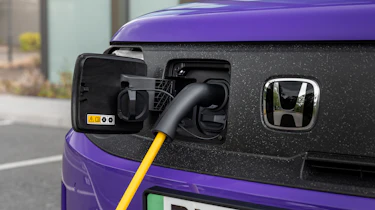
A modest 29.6kWh battery is fitted to the Super-N (that’s smaller than the 31.8kWh pack found in a Range Rover PHEV), while Honda quotes WLTP range figures of 128 miles combined, or 199 miles on the WLTP City cycle.
During our time with the Super-N, we drove on a mix of urban and motorway routes in hot weather, and yet the trip computer refused to budge from an efficiency figure of 4.7 miles per kWh. Achieve the same result, and you’re looking at a range of 139 miles, and you’re likely to get closer to the WLTP City figure if you keep your speed down.
This goes some way to overcoming the battery’s small size, and means you don’t necessarily need to charge the car every time it’s parked. From a standard home wallbox, the battery takes four hours to charge from 15 per cent to full capacity (a figure we achieved in the real world), but DC charging isn’t the fastest. There’s a maximum rate of 50kW, but because the battery is so small, it still takes the industry-standard half an hour to go from 15 to 80 per cent capacity.
| Model | Battery size | Range | Insurance group |
| Super-N | 29.6kWh | 128 miles | 27 |
Insurance groups
One of the areas where the Super-N might not be cost-effective is for insurance. Its Group 27 rating is high for a city car; a quote of £546 was more than we received for the Group 23-rated Hyundai Inster Cross (£451) for our sample driver.
Tax
The Super-N’s relatively low costs continue when it comes to state-levied charges, with Benefit-in-Kind rates among the lowest on the market. For 2026/27, standard-rate taxpayers have annual costs of £151, courtesy of a low P11D figure and the four per cent levy that applies to all EVs.
Depreciation
A 47 per cent residual rating for the Honda Super-N after three years and 36,000 miles is decent for a city car. The Hyundai Inster is in the 39-41 per cent range, while the electric Fiat 500e is closer to 30 per cent. The MINI Cooper Electric is only marginally better, ranging from 46-51 per cent.
Interior, design & technology
Pros |
|
Cons |
|
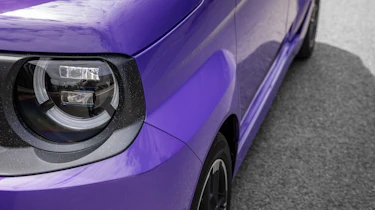
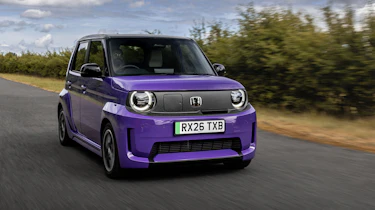
The kei-car class offers plenty of opportunity for innovation within compact dimensions, and the Super-N has lots of smart touches. On the outside, the upright shape of the N-One has been beefed up with boxed wheelarches and bigger bumpers inspired by the Honda City Turbo II to create the Super-N, but it’s still pretty small on UK roads.
Interior and dashboard design
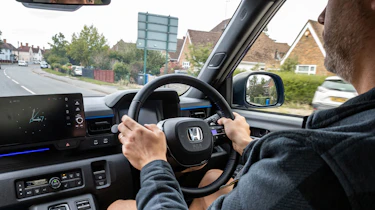
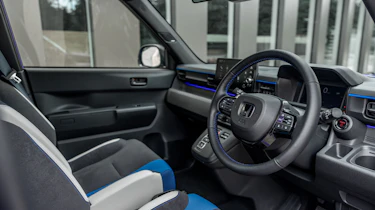
While the exterior is bound to turn heads, the cabin is more restrained, but not without neat touches. There’s lots of familiar Honda switchgear, from the drive selector to the window switches, while the black dash is lifted by blue highlights and subtle ambient lighting. The front seats have a mix of cream artificial leather, grey Alcantara and blue fabric inserts, which give the cabin a boost.
Materials and build quality
You’d expect some cost cutting due to the Super-N’s low price, but that’s far from the reality. Japanese car makers such as Honda spend as much time and money developing and refining their kei cars as they do larger models, and this shows in the overall quality of the Super-N. From the way that it drives to the feel of the steering wheel in your hands, this little Honda benefits from decades of development and refinement, and there are no really obvious signs of cheap materials.
Infotainment, sat-nav and stereo
While the Super-N is a brand-new car for the UK, the Honda N-One that it’s based on has been around in its current guise since 2020, so the tech on board is a little behind the cutting edge that you’ll find elsewhere in the class.
There’s a nine-inch touchscreen, which looks well proportioned within the confines of the cabin, but the display’s resolution isn’t the crispest we’ve seen. Ahead of the driver is a digital display that measures approximately 6.5 inches across and can be configured via steering-wheel buttons to show different information. There’s a comprehensive trip display, or you can call up three digital gauges that show real-time battery and power use.
“The Super-N’s cabin isn’t quite as funky as its boxy exterior, but we like the familiarity of all the usual Honda controls, and everything feels solid.” - Dean Gibson, senior test editor.
Boot space & practicality
Pros |
|
Cons |
|
Given just how small it is, it’s no surprise that the Super-N is limited in terms of boot space. It goes beyond expectations when it comes to passenger room, though, and not just because - like the Hyundai Inster - it’s quite tall. The clever rear seat folding arrangement could prove handy, as well.
Dimensions and size
The Super-N might be longer than permitted in Japan’s kei car rules, but it’s still dinky. When it’s dwarfed by something like a Renault Twingo, you know it’s compact.
| Dimensions comparison | |||
| Model | Honda Super-N | Hyundai Inster | Renault Twingo |
| Length | 3,599mm | 3,845mm | 3,789mm |
| Width | 1,626mm | 1,610mm | 1720mm (1953 inc mirrors) |
| Height | 1,608mm | 1,610mm | 1,491mm |
| Wheelbase | 2,516mm | 2,580mm | 2,493 |
| Boot space | 162-967 litres | 238-1,059 litres | 360-1,010 litres |
Seats & passenger space
Access to the front seats is a piece of cake, courtesy of the tall, wide-opening doors and a low sill that’s level with the cabin floor. The seats themselves are a little narrow if you have wide hips and can pinch a little, while the passenger seat has no height adjustment, although there are no issues with the amount of headroom on offer.
Practical touches include two cup-holders, one between the front seats, another to the right of the steering wheel, but there are no door pockets, just circular bottle holders. There are two USB sockets high on the dash with a tray under the central touchscreen that has very shallow sides, meaning it isn’t quite big enough for the largest smartphones.
There are just two back seats, but passenger space is excellent. The wide doors open to almost 90 degrees to boost access, while head and legroom are generous for such a small car. Storage is almost non-existent, though, with cup-holders in the doors and access to the tray between the front seats and no USB sockets or air vents.
One thing the Super-N has in common with the sporty Honda Prelude is the finish for the back seats, because they’re just trimmed in plain black fabric. The Isofix points are easily accessible via slots in the upholstery.
Boot space
You have to take a step back from the tailgate as it opens because it’s tall, like a Volkswagen Multivan’s. There’s an extremely low floor and boot lip, so loading items is easy, although the 162-litre capacity is limiting. Another issue is that there’s no load cover; the dark-tinted tailgate glass keeps things out of sight, but it also causes reflections that are visible in the rear-view mirror.
One saving grace is the Magic Seats set-up, which is the same as in the Honda Jazz supermini. The bases flip up to create a second storage area in the cabin, or the seats fold completely flat for 967 litres of space.
Reliability & safety
Pros |
|
Cons |
|
Honda’s 90,000-mile distance limit on a three-year warranty is generous, while owners can benefit from up to eight years of cover through the firm’s service-activated warranty, although maintenance costs are surprisingly expensive.
Reliability meanwhile should be very good. Electric cars are already at an advantage due to their reduction in moving parts, and Honda models have a reputation for being dependable, with the brand placing 5th out of 30 manufacturers for reliability in the most recent Driver Power survey.
There’s a decent haul of safety kit on board, with lane assist and road-sign recognition included, but no speed-limit warning beeps feature, courtesy of the older tech that the Super-N is based upon. There’s no Euro NCAP rating, and it’s unlikely to be ever assessed by the safety body.
Buying, prices and deals
Best buy: Honda Super N Advance
The Super-N is available in a single trim level called ‘Advance’. Standard equipment includes 15-inch alloy wheels, seven speakers (plus subwoofer), front/rear parking sensors, rear parking camera, Bose sound system, heated front seats, keyless entry/start, wireless Apple CarPlay/Android Auto and LED headlights.
Build your new Honda Super-N with the Auto Express Buy A Car service and you can save on the list price right now. We also have a range of tempting Super-N leasing deals to choose from.
Honda Super-N alternatives
The Hyundai Inster has similar short, narrow, yet tall proportions, and is also pretty quirky. It goes further on a charge and has a bigger boot, but it’s quite a bit more expensive. Sitting between the two in terms of cost (but closer to the Super-N) is the excellent new Renault Twingo. It’s not quite as much of a lightweight as the Honda, but it has a better range figure and more practicality for an only marginally higher price.
Honda Super-N pictures
Frequently Asked Questions
The Super-N has a few compromises owing to its small size and battery, but it’s definitely a good car, albeit one which will be better as a second vehicle for most.
Latest deals on the Super-N's rivals