Best new cars coming soon: all the big new car launches due in 2026, 2027 and beyond
Here are the most important new cars from Alfa Romeo, Audi, BMW, Dacia, Ferrari, Ford, Skoda and more

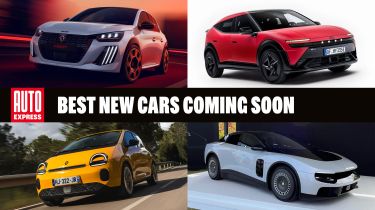
We’re only about half way through 2026 and have already seen dozens of hugely important, potentially game-changing new cars launched, from the next-generation BMW 3 Series and Nissan Juke to the pivotal Volkswagen ID. Polo and Ferrari’s first-ever EV.
Of course, not every new car showing up in showrooms is electric. Petrolheads have been treated to the jaw-dropping new Audi Nuvolari, with a 10,000rpm V8, and the promise that the Lotus Esprit will be reborn soon with a V8 hybrid drivetrain packing more than 1,000bhp. Plus the news that the Hyundai i20 N will return.

If you’re not interested in petrol-swilling speed machines, and are looking for your next family car, the new Fiat Grizzly and Dacia Striker – brilliant names, by the way – will offer head-turning looks and plenty of space for an affordable price.
Before you ask, yes the Jaguar’s long-awaited four-door GT, the Type 01, is still slated to be revealed this year. In fact, the covers are due to come off in October.
Whatever kind of new car you’re looking for, there’s going to be something for everyone. If you can’t wait to buy a new car and want one right now, check out our Buy a Car service. You can get offers from local dealers on a car of your choice, buy new from stock, check out leasing deals or choose from thousands of used cars. You can even sell your old car.
Below are all the key new model launches we know are taking place in 2026, 2027 or in the near future, listed in alphabetical order…
Alfa Romeo Giulia
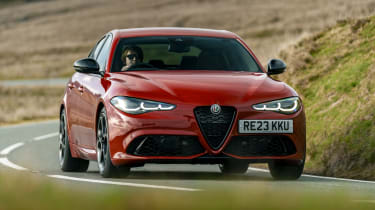
Alfa Romeo is having difficulty in realising the next-generation Giulia, and it’s still anyone’s guess when the BMW 3 Series rival might be arriving. But the Italian firm has confirmed it’s working on a “new interpretation of the Giulia” with “multi-energy solutions” while also remaining true to “performance-driven DNA”.
Despite being a decade old, the current Giulia is still one of the best-looking and best-driving executive saloons around. Alfa enthusiasts will be hoping that’s still the case for the new car, whether it has hybrid or electric power. They’ll also be delighted to hear that there will be a Quadrofoglio version with a petrol engine, most likely an evolution of the brand’s famous V6.
Alfa Romeo Guiletta
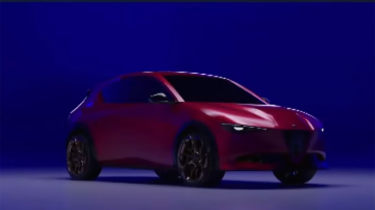
Alfa Romeo left the family hatchback market in 2020 when the Giuletta went off sale and wasn’t replaced, but finally it looks like we’ll get an Alfa rival to the Cupra Leon and BMW 1 Series. To make sure it’s up to scratch, we’re told the new car will build on “icons such as the 147 and Giulietta” and will “bring advanced technologies” thanks to using parent firm Stellantis all-new STLA One platform.
This means the new Giulietta will have the capability for pure-electric and hybrid power, a new centralised processor (like BMW’s ‘Heart of Joy’ in the new iX3), an all-new infotainment system and even steer-by-wire. However, given the expectation for how an Alfa should drive, we expect a bespoke and driver-focused set up.
Alfa Romeo Stelvio

The next-generation Alfa Romeo Stelvio wasn’t unveiled in 2025, as was originally planned, and we don’t know for sure when Italy’s answer to the BMW X3 will arrive. The brand has released images of the new SUV testing, so it’s definitely coming, but probably not until late 2027 at the earliest.
As with the current Stelvio and Giulia, the next evolutions of the pair will be developed in tandem, and use the same architecture. The new model will be offered with a choice of hybridised petrol engines and electric powertrains. Meanwhile, as with its lower-slung sibling, a Quadrofoglio version of the new Stelvio will be available, packing “something with a roar”, which should keep the Alfa purists happy.
Alpine A110
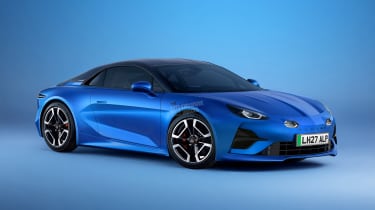
The Alpine A110 as we know it is gone, because after nearly a decade the four-pot-powered featherweight has been retired and its all-new successor due this year will be, brace yourselves, electric. However, it promises to have something that almost every electric car is lacking: soul.
We’ve also been told the new A110 is going to be lighter than a Porsche Cayman GT4 RS and use cutting-edge in-wheel motors to generate a lot of power – but not too much – plus torque vectoring to help carve its way through corners. Underneath will be a bespoke bonded-aluminium platform, which can accommodate hybrid powertrains should customers demand something other than an EV.
Aston Martin Valhalla
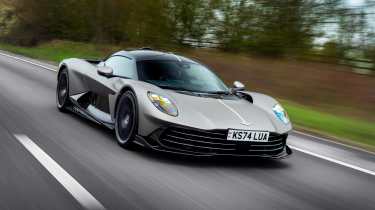
The Aston Martin Valhalla is the first series-production mid-engined road car in the British brand’s 113-year history. Just 999 examples will be made, powered by a bespoke 4.0-litre twin-turbo, flat-plane V8 engine and a pair of electric motors. Total power output is rated at 1,069bhp and 1,100Nm of torque – enough to propel the car from 0-62mph in 2.5 seconds – while the active aerodynamics are inspired by the company’s Valkyrie hypercar, and utilise F1 know-how and technology.
Bentley Continental GT Supersports
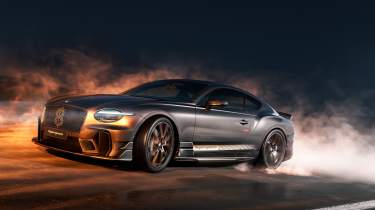
The Bentley Continental GT Supersports is basically a muscle car for the upper classes. It ditches the latest Continental GT’s hybrid tech, and uses a twin-turbo V8, with all 657bhp it produces sent exclusively to the rear wheels. This is the first Continental GT to ever do so, and by shedding nearly half a tonne of weight, it’s also the lightest version of the legendarily luxurious coupe to date.
The bellow of the V8 echoes through a bespoke titanium exhaust system designed with Akrapovic, emitting a “deep, characterful and completely authentic” soundtrack, it’s claimed. Stopping power is provided by the largest brake system on any road car, while torque vectoring and rear-wheel steering make the Supersports turn in as sharply as possible. The styling is subtly outrageous of course, for generating extra downforce and scaring Aston Martins.
BMW i3
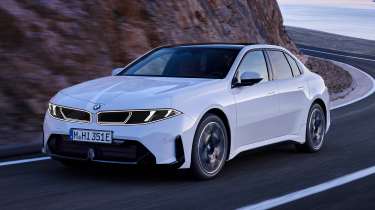
This is the new BMW i3, and plainly it’s not a futuristic city car, like the first model with this name. It’s the first all-electric 3 Series in the company’s history, and if you’re struggling to gauge the significance of that, it’s akin to Porsche electrifying the 911. The compact executive saloon is BMW’s bread-and-butter, making the new i3 the centrepoint for the brand’s fresh ‘Neue Klasse’ generation.
The ultra-futuristic saloon borrows its bold design and radical Panoramic iDrive cabin layout from the similarly game-changing BMW iX3, as well as inheriting its next-generation architecture and EV technology. The result is a range of more than 560 miles, which embarrasses the Tesla Model 3 and Mercedes C-Class Electric. The BMW i3 is on sale now from £57,905, with less pricey models to follow soon.
BMW M3
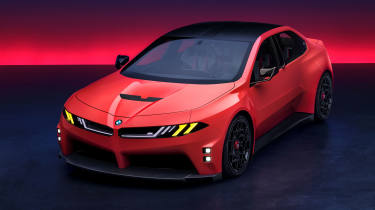
The new BMW M3 will arrive in 2027, a year after the regular 3 Series. It will be the first to feature pure-electric power, which may sound like blasphemy to some fans of the iconic sports saloon, but with a quad-motor drivetrain it’s guaranteed to be the most powerful M3 and will feature torque vectoring for remarkable agility. If you’re still not convinced, it will also be available with a twin-turbo straight-six petrol engine, just like the current model, and the M Neue Klasse concept gives us a preview of the brutal design.
Citroen 2CV
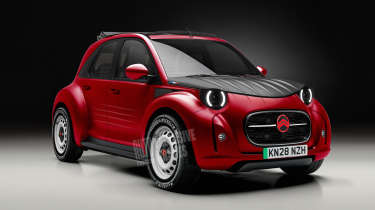
The Citroen 2CV will return in 2028 as an all-electric city car that could cost as little as £13,000. While it’ll major on eye-catching, retro-inspired design, just a single shadowy teaser has been shared so far, so our exclusive images reveal what the reborn 1940s icon could look like.
To ensure that low price tag, the 2CV will mimic the original’s budget-driven popularity by sitting on a new architecture developed for upcoming E-cars - an alternative to conventional city cars, sales of which have been dwindling away thanks to low profit margins. As a result we expect a small battery with short range to go with the big name.
Cupra Raval
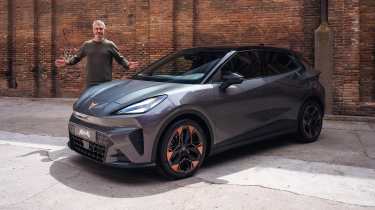
It might be small, but the arrival of the Cupra Raval is a huge moment. Not only because it has been five long years since we saw the original concept, but also because underneath the razor-sharp bodywork and copper accents is the brand-new MEB Entry+ platform that will underpin a raft of new affordable electric cars from Volkswagen Group, including the critically important VW ID. Polo.
The Raval is kicking things off, and is available from just £22,785. The Renault 5 rival may be Cupra’s baby EV, but performance is still a priority. Compared with its VW cousin, the Raval gets a ‘sport chassis’ that includes a 15mm lower ride height, tweaked suspension, a 10mm wider track and a bespoke steering tune. The extra fiery Raval VZ also gets 223bhp, a limited slip-diff and more aggressive camber at the front to provide quicker responses in the bends.
Ferrari Luce
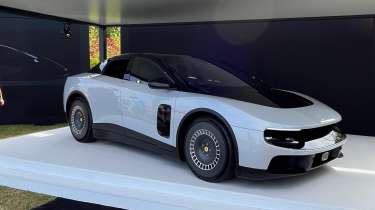
The Ferrari Luce came close to breaking the internet when it was revealed earlier this year, and the company’s first EV caused so much backlash that its marketing chief has suddenly left after 16 years. No matter what you say about the design, there’s no question former Apple design boss Sir Jony Ive managed to create something fresh and unique that challenges people's preconceptions of what a Ferrari should look like.
Beyond that, the interior Ive and his team created looks and feels like an exhibition from a design museum. It blends classically inspired elements and simplicity with modern digital interfaces that look like they’ve been pulled right out of the Apple store. Meanwhile, the Luce’s four electric motors produce 1,035bhp and a monumental 11,500Nm of torque, allowing it to do 0-62mph in just 2.5 seconds. Prices start from nearly £440,000 – before taxes.
Fiat Grizzly
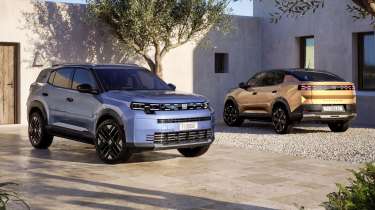
Fiat’s dream of an entire family of Panda-inspired models is starting to take shape, because the new, charmingly named Grizzly SUV and fastback will be joining the award-winning Grande Panda in the brand’s line-up soon. At four-and-a-half metres long, the pair will be looking to pick a fight with the Dacia Duster and Nissan Qashqai, so should offer plenty of space and versatility for family car buyers. Underneath will be the same Smart Car platform their adorable baby brother uses, meaning the Grizzly should be available with a similar selection of petrol, hybrid and pure-electric power.
Freelander 8
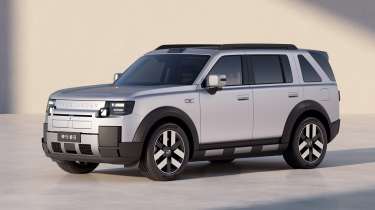
You know the old saying ‘if you can’t beat ‘em, join ’em!’? Well the Chinese goliath Chery has done just that with its new Freelander 8. You see, this isn’t another Land Rover knock-off, but the result of a joint venture between Chery and JLR. The SUV was in fact designed by the British marque, and is the first in a slew of new Freelander models.
Importantly, however, this and the other forthcoming Freelanders are not part of the Land Rover family, and are based on Chery’s platform and technology. That’s not going to stop the Freelander 8 coming to the UK though, and we’ve been told it’ll arrive here some time in the second half of 2027. But again, whatever you do, don’t call it a Land Rover.
Genesis GV60 Magma
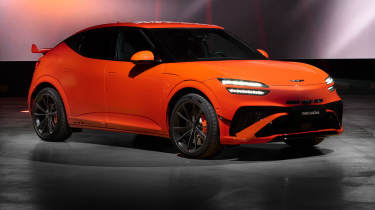
The flaming-hot Genesis GV60 Magma is the classier sister car of the exhilarating Hyundai Ioniq 5 N, and the first model from the luxury brand’s new performance and motorsport division. The Alpine A390 rival spits out 641bhp, enabling it to hit 62mph in just 3.4 seconds, and features a virtual gearshift system in a bid to provide a more engaging driving experience. However, prices start from more than £75,000, meaning it costs about £10k more than its Hyundai cousin and is more expensive than many versions of the Porsche Macan Electric.
Hyundai Ioniq 3
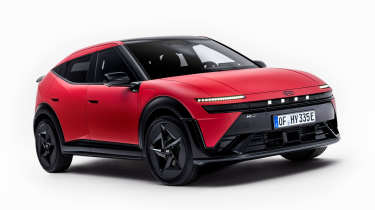
While other brands are looking to the past for inspiration, the Hyundai Ioniq 3 is so sci-fi the ‘aero hatch’ looks like it’s just escaped from the set of the next Star Trek film. The design is futuristic, bold and guaranteed to turn heads, just like the rest of Hyundai’s Ioniq-branded EVs, while the rear’s upright form and narrow light bar have a whiff of the Alfa Romeo SZ.
Thanks to its aerodynamic design, the Ioniq 3 can deliver up to 304 miles of range, which is more than you get from its cousin, the Kia EV2. Meanwhile, inside is a fresh cabin design, featuring bigger screens than any other Hyundai, but there are still physical buttons and switches, too. We’re expecting prices to start from around £25,000.
Hyundai Tucson
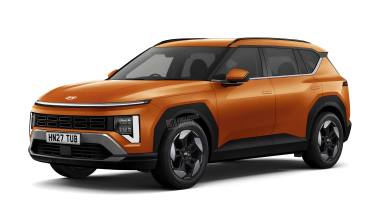
After six years, four Auto Express Mid-size SUV of the Year awards and a few million sales, it’s time for the current Hyundai Tucson to retire, with the next generation of the fantastic family hauler set to make its world debut later this year.
As you can see from our exclusive image, the new Tucson is going to be even more of a show-stopper than the last. It will be employing Hyundai's bold new ‘Art of Steel’ design language that’s meant to create sharp, precise and sculpted surfaces inspired by the way steel bends and reflects light, plus it will be powered by the brand’s next-generation hybrid technology.
Jaguar Type 01
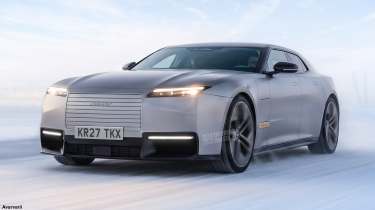
It's about time this big cat was let out of the bag and thankfully the hotly anticipated, highly controversial Jaguar Type 01 is set to be unveiled in October. Never mind that it was supposed to be revealed last year, we’re expected to finally see this new era of Jag begin, and our exclusive image shows you what the new EV could look like.
The four-door GT’s design will take its lead from the polarising Type 00 concept, while underneath the skin are a bespoke EV platform called the Jaguar Electrified Architecture and a tri-motor powertrain developing around 1,000bhp. Real-world range will apparently be around 400 miles, but lightning-fast charging abilities should mean 200 miles of range can be added in around 15 minutes. And the price for all this opulence and splendor? At least £120,000.
Kia EV1
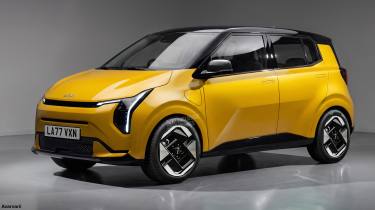
As well as being Korea’s answer to the Renault Twingo, the all-new Kia EV1 will serve as the all-electric replacement for the popular Picanto, which will be killed by emissions regulations in the next few years. Auto Express has been told Kia’s new entry-level model will start from around £17,000, is going to be based on a bespoke electric-car architecture – which won’t come cheap – and it will spawn a surprise sister car from Hyundai.
Kia EV2
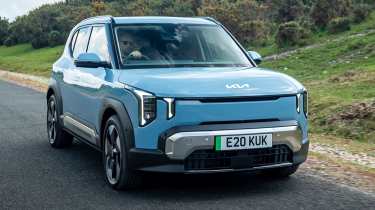
If you can’t decide whether to get a small, stylish yet spacious SUV or a more affordable and frugal supermini, worry no more, because the all-new Kia EV2 offers the best of both worlds. Right now it’s priced from just over £24,000, but cheaper models are coming.
At just over four metres from tip-to-tail, it’s the same length as a Vauxhall Corsa, allowing it to scythe through city streets. At the same time, the chunky and charming design, with its angular wheelarches and plenty of plastic cladding, makes the brand’s entry-level EV look like a pocket-sized 4x4 and provides a surprising amount of room for passengers and their belongings. Other than space and style, its other strengths are comfort and efficiency, with a class-leading range of up to 281 miles on offer.
Kia Seltos
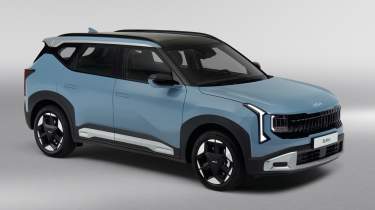
Kia already has seven SUVs of various sizes in its line-up, but somehow it’s found room for one more. The Seltos will be the Korean brand’s latest entry into the hugely important mid-size SUV segment and is almost exactly the same size as the latest Nissan Qashqai, which will be the newcomer’s arch-rival when it arrives in showrooms later this year.
The key selling points for the Seltos will be its stylish looks, a spacious interior complemented by an impressive 536-litre boot that’s bigger than any Qashqai’s, plus full-hybrid power as standard, all for around £30,000. As well as being roomy, the interior of Seltos is more about functionality than being flashy, so there are plenty of physical buttons and switches.
Land Rover Defender Sport
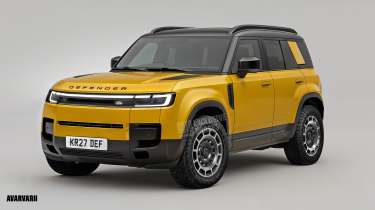
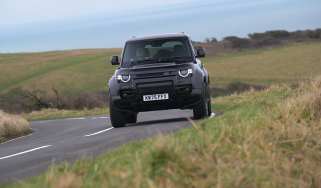
Everyone loves the Land Rover Defender, especially us Brits, so the idea of a smaller yet equally chunky and capable sibling is almost guaranteed to get people rushing to their nearest JLR dealership. The new Land Rover Defender Sport, which will be built here in the UK, should be available at a more attainable price than its beloved big brother, and we recently learned it'll be available with either full-hybrid or pure-electric power.
Lotus Esprit
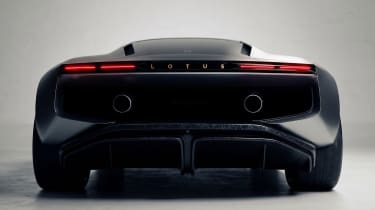
Lotus has scrapped its plans to become an electric-only car brand, and is celebrating by bringing back the Esprit as a 1,000bhp V8 supercar with all-wheel drive and cutting-edge chassis tech. There will be some level of hybrid assistance, but this being Lotus, the engineers will work to keep the new car’s weight down. The laser-sharp Lotus Theory 1 concept gives us an idea of what it will look like, but we’ll have to wait until 2028 to see the finished car.
McLaren W1
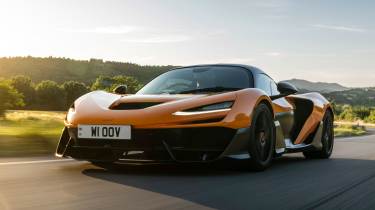
First there was the F1, then the P1, and now the McLaren W1 has arrived to show the world what Woking is capable of – on top of back-to-back Formula One constructors’ championship wins, too. A direct rival to the Ferrari F80 that arrived last year, the W1 features a twin-turbo 4.0-litre V8 hybrid powertrain that sends its full 1,258bhp to the rear wheels only.
To stop the car taking off, its “Formula One-inspired ground-effect aerodynamics” can create 1,000kg of downforce at 174mph. Put it all together and the W1 is the fastest-accelerating, fastest-lapping, road-legal machine the British outfit has ever produced.
Mercedes-AMG GT 4-Door
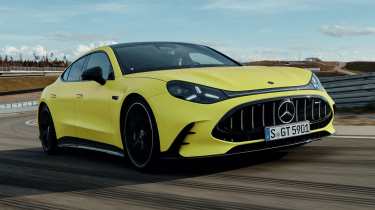
The new Mercedes-AMG GT 4-Door won’t set hearts aflutter with its looks, but should be able to get hearts racing, because this is essentially a four-door ballistic missile. The Porsche Taycan killer features three electric motors that deliver up to 1,153bhp – more than the Ferrari Luce – and it roars, tingles your spine and is designed to offer a visceral driving experience similar to the petrol-swilling V8 AMGs of days gone by. It’s available to order now, starting from over £120,000.
Nissan Juke
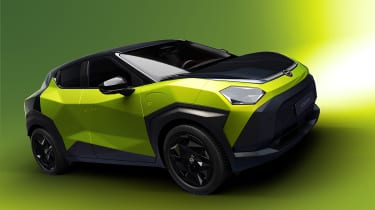
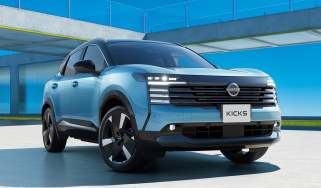
Like it or loathe it, the Nissan Juke is a very important car in the UK, which is why the arrival of the next generation is such an important event. There are plenty of wild angles and a new interpretation of the Juke’s signature, cartoonishly large headlights.
Underneath, the new Juke will be based on the same CMF-EV platform that underpins the latest Leaf. It’s going to use the same battery and motor combinations too, meaning certain versions could offer way more than 350 miles of range, which will give it a serious advantage against rivals such as the forthcoming Skoda Epiq.
Nissan Leaf
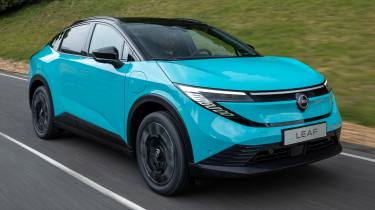
As the first mass-market EV, the Nissan Leaf was a true pioneer, but fell by the wayside in recent years due to more advanced, generally superior rivals. To increase its kerb appeal, the family hatchback has morphed into a swoopy SUV that’s powered by the same technology as the former Auto Express Car of the Year, the Nissan Ariya.
The sleek profile combined with some other trickery has made the new Leaf the most aerodynamic car the Japanese brand has produced. As a result, it boasts up to 386 miles of range from just a 75kWh battery, so running costs should stay as low as you’d expect from a car with this name. The cherry on top is that it’s currently available to order only from £32,249.
Peugeot 208
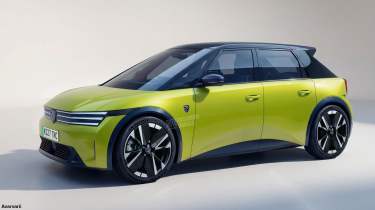
The next-generation Peugeot 208 is set to rip up the rulebook so much when it arrives next year that it’s even going to try and reinvent the wheel. Clever packaging should allow the new 208 to cram more space into a small footprint, but the big talk about the interior will be the so-called ‘Hypersquare’ steering wheel, which is part of the next evolution of Peugeot’s polarising i-Cockpit cabin design. It uses cutting-edge steer-by-wire technology, and could be a game-changer for small cars.
The show-stopping Peugeot Polygon concept we got to drive recently offered us a glimpse of what’s to come, including a bold design that goes back to the future, taking inspiration from the iconic 205 supermini of the eighties and blending it with modern details, sheer edges and clean surfacing. Underneath will be the all-new 'STLA One' vehicle architecture, which can accommodate hybrid and all-electric power.
Peugeot E-208 GTi
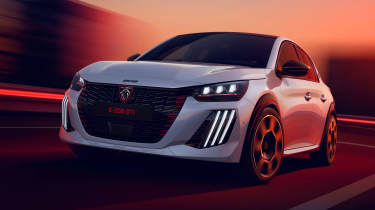
Peugeot has been out of the hot hatch fight for a few years, but it’s finally getting back in the ring with the new E-208 GTi. To have a chance of landing a knockout blow on the Alpine A290, the feisty Frenchman has 276bhp on tap from its electric motor which, as is traditional, will drive the front wheels.
Also among the performance upgrades is a limited-slip differential to boost agility, tuned suspension, larger front brakes and more responsive steering. The styling is angrier too, of course, while the 18-inch ‘Hole’ wheels are a nod to the iconic 205 GTi.
Polestar 5
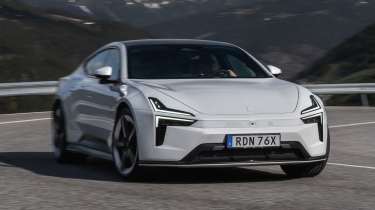
Six years after the dramatic Polestar Precept concept was revealed, at long last the brand’s new flagship GT is finally ready to take on the Porsche Taycan and Lotus Emeya. Very few design changes have been made to the showcar to create the Polestar 5, which does without a rear window to help maximise space in the rear. The cabin, meanwhile, features an extremely clean design full of clever and thoughtful material choices.
Rather than using an existing architecture, the Polestar 5 relies on a bespoke extruded and bonded-aluminium platform that was created in the UK, where the flagship EV was also developed. Every model has a dual-motor powertrain that can deliver up to 874bhp and more than 400 miles of range. Prices start from £89,500.
Polestar 7
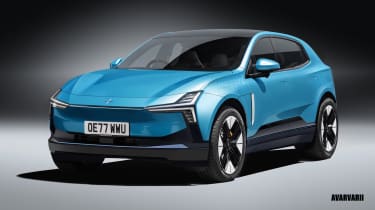
If you hadn’t already guessed, the Polestar 7 will be the seventh model launched by the Swedish brand, but more importantly, will be its answer to the Tesla Model Y. The “premium compact SUV” will be built in Europe, is due to arrive in 2028 and could be priced from around £40,000. The 7 will also be the first model based on Polestar’s next-generation architecture and technology, with the brand set to use this platform for all its models in the future to reduce complexity, costs, and investments.
Renault Twingo
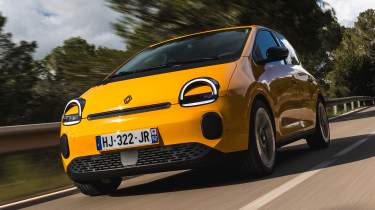
Renault’s retro reboots have been bona fide automotive gold. The Renault 5 and Renault 4 won big in the 2025 Auto Express New Car Awards and are among the best small cars to buy. So to say we have high expectations for the new Renault Twingo would be an understatement. But we doubt the French firm has anything to worry about.
The new car’s design pays homage to the original frog-eyed Renault Twingo from the nineties, but with a contemporary spin, so it doesn't look or feel like a cheesy facsimile. The same goes for the flexible and playful interior, which offers space for four people and the latest tech. Sure, it has a range of 163 miles at most, but that’s plenty for the city streets this charming EV was designed to conquer and it might cost from only around £17,000 when it goes on sale.
Rivian R2
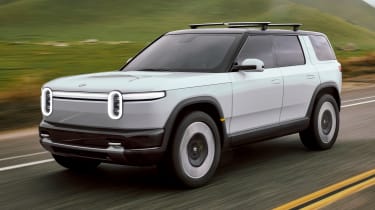
Pioneering EV start-up Rivian, maker of the world’s first all-electric pick-up truck, has taken America by storm and will soon turn its attention to Europe and the UK. The first model it’s bringing here isn’t a truck though, it’s the Rivian R2: a mid-size electric SUV that’ll rival the Tesla Model Y, among many others. While we await its arrival over here, prices in the US start from just under $45,000 (about £34,000 at the current exchange rate) and there’s a choice of three versions, including a 647bhp R2 Performance designed to be capable both on and off-road.
Toyota GR GT
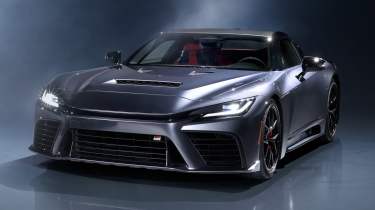
From the people who brought you the humble Corolla and frugal Yaris comes the latest challenger to the Aston Martin Vantage and Porsche 911. It’s called the Toyota GR GT, and it’s the most jaw-dropping car we’ve seen in quite some time.
Much like the Lexus LFA and Toyota 2000 GT that came before, the GR GT is a completely bespoke creation that started as a clean sheet of paper. Its twin-turbo cross-plane-crank 4.0-litre V8 works with an electric motor to reduce any lag, and delivers a combined 641bhp peak power figure and 850Nm of torque.
Toyota RAV4
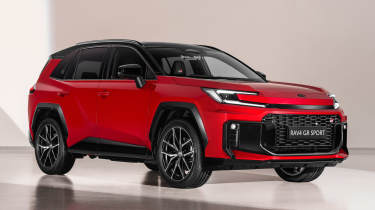
The Toyota RAV4 was the best-selling car in the world last year, and the new sixth generation will be hoping to retain that title. On sale now from under £44,000, it’s available exclusively with plug-in hybrid power in the UK and delivers up to 85 miles of zero-emissions driving (one of the longest EV ranges offered by any PHEV), plus more than 200mpg.
The designers took an evolutionary rather than revolutionary approach to the new RAV4’s design, but it’s got a bold sense of style and still offers more off-road capability than key rivals. Meanwhile, the interior has taken some inspiration from the bigger, tougher Land Cruiser, and it’s received a big tech upgrade.
Volkswagen ID. Polo
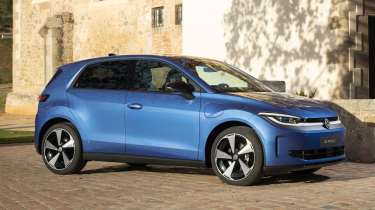
The feverishly anticipated Volkswagen ID. Polo is hoping to prove that the brand has finally got its mojo back. VW will freely admit it made a lot of mistakes with the ID.3 electric hatchback and ID.4 SUV, but it has learned from them. That’s why the new ID. Polo will be sporting a fresh, more friendly design language, a more functional and higher-quality interior, better software and a more enjoyable driving experience.
There are nods to VWs of old, including the instrument display graphics that resemble the dials on the original Golf from the seventies, although the ID. Polo hasn’t gone totally retro like the Renault 5. There’s also going to be a GTI version with a tuned chassis and 223bhp on tap to take on the Alpine A290. Prices will start from less than £25,000, with up to 283 miles of range on offer.
Volvo EX60
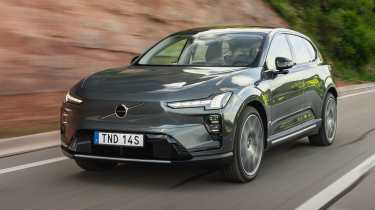
The Volvo EX60 is quite possibly the most important car the Swedish firm has launched since the original XC90 because, like the BMW iX3 it challenges, this is the foundation of a new generation of vehicles. Literally, because underneath is Volvo’s next-generation, highly scalable SPA3 electric-car architecture that will underpin all its EVs in the future.
This new platform offers big benefits in terms of range, efficiency and space, with the flagship EX60 P12 model boasting a class-leading 503 miles of range and the ability to charge from 10 to 80 per cent in less than 20 minutes. The zero-emissions XC60 alternative also features a very spacious and clever cabin that’s effortlessly classy, in a typically Scandinavian way. Prices currently start from £56,860.
Tell us which new car you’re interested in and get the very best offers from our network of over 5,500 UK dealers to compare. Let’s go…